
Mutual Funds Versus ETF Investments
AI is normally used as an abbreviation for Artificial Intelligence. In this post I suggest “AI” can also be a reminder to Avoid Investments that work against your long-term goals and future retirement income potential.
Mutual funds are easy to identify by their ticker symbol. They all are five characters long and the last two digits are usually “XX.” Therefore, even money market mutual funds like FDRXX and SPAXX end in “XX.” In general, I dislike mutual funds. Some mutual funds, by the way, are five characters long and only the last character is an “X”. An example is FZROX.
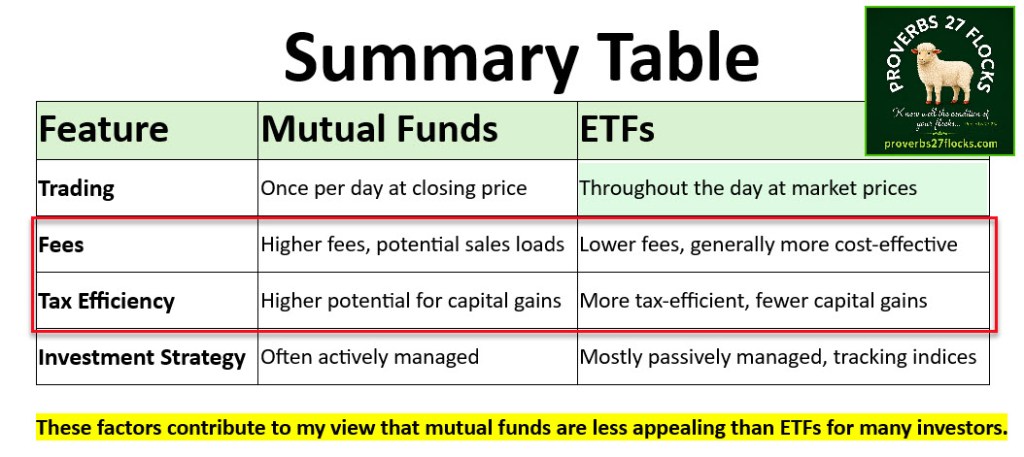
There are several reasons for this dislike. Mutual funds are generally less appealing than ETFs because they are traded only once per day at the end of the trading session, while ETFs can be bought and sold throughout the day at fluctuating market prices. Additionally, ETFs typically have lower fees and greater tax efficiency compared to mutual funds. Of course, if you hold mutual funds in a 401(k), IRA, or ROTH IRA, the tax issues are less daunting.
The Key Differences Between Mutual Funds and ETFs
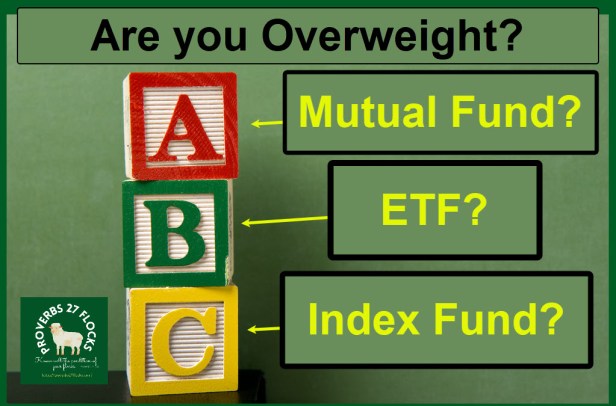
The key differences are trading flexibility, fees/costs, and tax efficiency. Furthermore, if you trade options contracts, mutual funds are not a way to make additional income. There are no options contracts on mutual funds.
Trading Flexibility
Mutual Funds: Traded only once per day after the market closes. All investors receive the same price for their transactions, regardless of when they place their orders. This may be OK for the long-term investor. However, you really don’t know what you will pay for a mutual fund share until well after the market closes for the day. In other words, you cannot set your buy or sell price.
ETFs: Can be bought and sold throughout the trading day at fluctuating market prices, similar to stocks. This allows investors to react quickly to market changes. This makes it possible to enter buy limit orders and sell limit orders. You cannot do that with mutual funds.
Fees and Costs
Mutual Funds: Often have higher fees, including potential sales loads and redemption fees. These costs can eat into overall returns. It is true that mutual fund fees have come down, and the really big ones have attractive expense ratios. However, in general the fees on comparable ETFs are lower.
ETFs: Generally have lower expense ratios and fewer associated fees. They are often more cost-effective for investors over time.
Tax Efficiency
Mutual Funds: May trigger capital gains taxes when the fund manager sells securities within the fund, affecting all shareholders, even those who haven’t sold their shares. This is a very important distinction if you hold mutual fund shares in a taxable account.
ETFs: Typically more tax-efficient due to their trading structure. They can minimize capital gains distributions, as transactions occur between investors rather than through the fund itself.
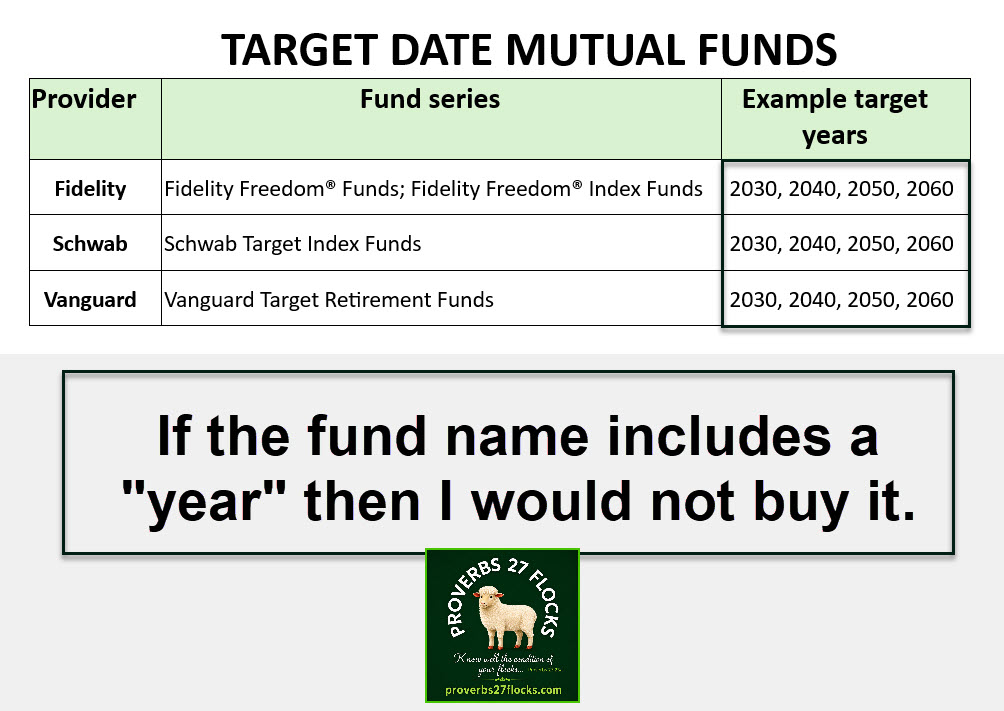
The other thing that I have noticed is the mutual funds tend to be miserly when it comes to dividend yield. There are also terrible mutual funds (and ETFs) due to their inclusion of bonds or other investments that have very poor total returns. For example, retirement date mutual funds are a less-than-ideal way to move into the retirement years.
What is the difference between an index fund, a mutual fund, and an ETF?
A mutual fund or an ETF can be and usually is an index fund. In fact, most mutual funds and ETFs are tied to an index. Some examples help (3 ETFs and three mutual funds) illustrate the wide variety of indices: VYM, SCHD, and DGRO are indexed ETFs. VHEHX, VFSTX and FBALX are indexed mutual funds.
What about a Mutual Fund with Zero Expenses?
Zero expenses may seem attractive on the surface. For example, the Fidelity ZERO Total Market Index Fund (FZROX) seems like a wonderful mutual fund. However, look at the top ten investments in the fund. They make up over a third of the total invested dollars. Furthermore, all ten are technology-related investments. That is not a good diversification strategy.
So while I like some of the investments in the top ten FZROX), having so much of the total invested in NVIDIA CORPORATION (7.19%), APPLE INC. (6.26%), MICROSOFT CORPORATION (5.07%), AMAZON.COM INC (3.42%), ALPHABET INC CLASS A (2.68%) and BROADCOM INC (2.36%) is not a prudent, balanced approach for the total investment dollars you have.
Which ETFs Should I Buy?
The answer to that question has to be in response to your strategy. If you don’t have a strategy, then I don’t know how you can pick any investment. My strategy is dividend growth, so I look for ETFs that meet that criteria. That is why I own shares of VYM, DGRO, and SCHD.
Rolling Your 401(k) to Your own IRA
It is no secret that many company retirement plans focus on mutual fund investment choices. One of the many good reasons to move to an IRA when you retire (or when you move from one company to another) is to broaden your investment choices. You can move your account, sell the mutual fund investments, and gradually replace them with good ETFs and individual stocks. You can also purchase CDs and trade options contracts.
The Big ETFs and Mutual Funds
According to AI (Artificial Intelligence), five largest U.S.-listed ETFs by assets, have expense ratios that average about 0.073% per year—roughly $7.29 annually per $10,000 invested. The largest U.S. mutual funds available to individual investors, the five funds’ simple average expense ratio is 0.053%—about $5.30 per year per $10,000 invested. That shows the mutual fund industry has at least started to come to their senses in order to compete for an investor’s dollars.
Mutual funds most likely to have high expense ratios include actively managed small-cap or emerging-market funds, sector and thematic funds, and some specialized or fund-of-funds products. Advisor or broker share classes may also cost more when they include ongoing distribution charges such as 12b-1 fees. A fee above 1% is a useful flag for a plain diversified stock or bond fund, though specialized funds can cost more. Here is a tip: compare funds within the same category. In 2025, the asset-weighted averages were 0.40% for equity mutual funds and 0.36% for bond mutual funds.
The fees are higher when a fund needs more hands-on management, research, trading, or specialized expertise. Administrative, legal, and distribution expenses can contribute too. A smaller fund may have a higher ratio because it spreads fixed costs across fewer assets; large AUM generally helps lower costs, rather than causing high fees.
Also, sales loads are separate from the expense ratio, so check the prospectus for both. This is the way your broker and financial advisor are likely to benefit. Realize that the “experts” want to be paid handsomely for their “advice.”
A mutual fund sales load primarily compensates the broker or financial professional who sells the fund. The broker-dealer firm and the fund’s distributor or underwriter may also receive part of it. FINRA says sales charges and ongoing 12b-1 fees can compensate firms and registered representatives for selling fund shares.
A “front-end load” is an awful cost. With a front-end load, the charge comes out of your investment when you buy. A deferred load is generally charged when you sell. The investor pays the cost; it is separate from the fund’s annual expense ratio, and it doesn’t guarantee better performance or advice.
Recommendations
Whenever possible, roll your employer-sponsored retirement plan accounts to your own self-directed IRA. Be careful to compare similar ETFs and mutual funds. You can often benefit from selling the mutual fund and buying the comparable ETF. Watch out for the hidden costs like sales loads on mutual fund investments. Don’t conclude that “zero expenses” means you are getting the best solution for your total investment strategy.
Seeking Alpha Subscription Information
Of all of the resources I use, the most helpful is Seeking Alpha Premium. The Seeking Alpha QUANT rating is a huge factor in my investment success. If you decide to explore a Seeking Alpha subscription, please use the following link. Seeking Alpha

SEEKING ALPHA INFORMATION AND Types of SUBSCRIPTIONS
There are several ways to subscribe to Seeking Alpha services. I use the “Seeking Alpha Premium” service. The other ones are 1) Alpha Picks, 2) Bundle Premium and Alpha Picks, and 3) Quant Growth and Income. The links for the promotions are on each of these four choices. I highly recommend “Seeking Alpha Premium” as a place to start.
You can also scan this QR Code to get the same information about Seeking Alpha Premium.

Past performance does not guarantee future results, Seeking Alpha does not provide personalized advice, and it is not a registered investment adviser.
We accept advertising compensation from companies that appear on our site. This website represents my opinions, which may not reflect those of Seeking Alpha, and does not constitute an investment recommendation or advice.
If you have any questions or problems getting connected to Seeking Alpha, reach out to them with this email address: subscriptions@seekingalpha.com

