
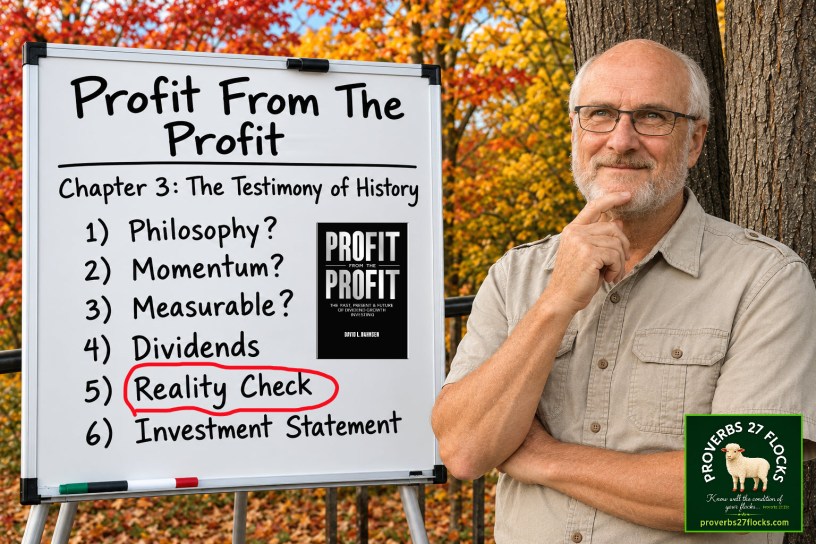
Do Your Investments Match Your Plan?
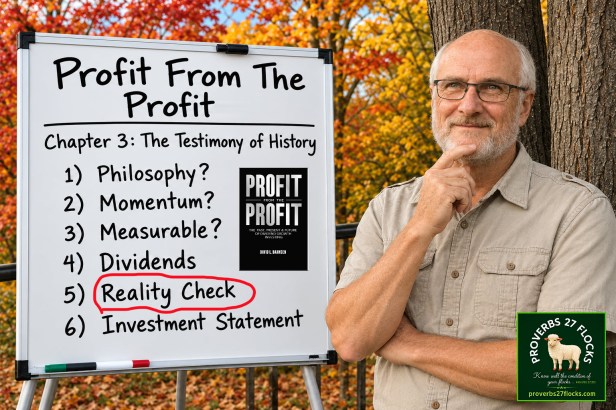
If you don’t have an investment philosophy, then I doubt that you have an investment strategy. If you don’t have a strategy, then your tactics are probably based on some sort of biases or emotional attachments. If you don’t have these pieces, it is likely you don’t have a measurable set of goals. It is something like taking a sailboat on the ocean without a compass or a rudder. The wind will blow you around, and you will get somewhere, but there is no telling where somewhere will be.
The Testimony of History in Our Accounts
Chapter 3 of Profit From the Profits is titled “The Testimony of History.” I think paying attention to your own investment history is a good way to see what is working and what doesn’t work. Of course, you need to navigate through some rough waters to get to the destination. If you have only been investing for a couple of years, or even for just a decade, you may not really understand or realize what it is like to experience the petulance of the stock market and the fickle behaviors of traders.
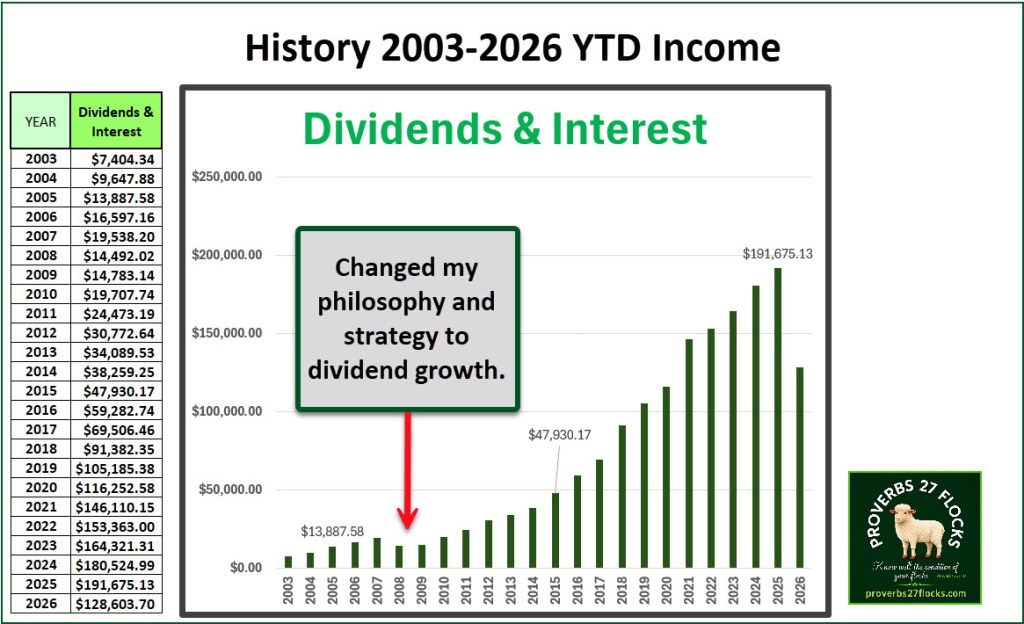
There are two things I encourage everyone to do. The first has to do with the monthly statement (or at the very least, the quarterly statements for March, June, September and December. The second has to do with understanding the importance of and reasons for dividend investing. Let me start with the second thing: the importance of and reasons for dividend investing.
Chapter Three Introduction
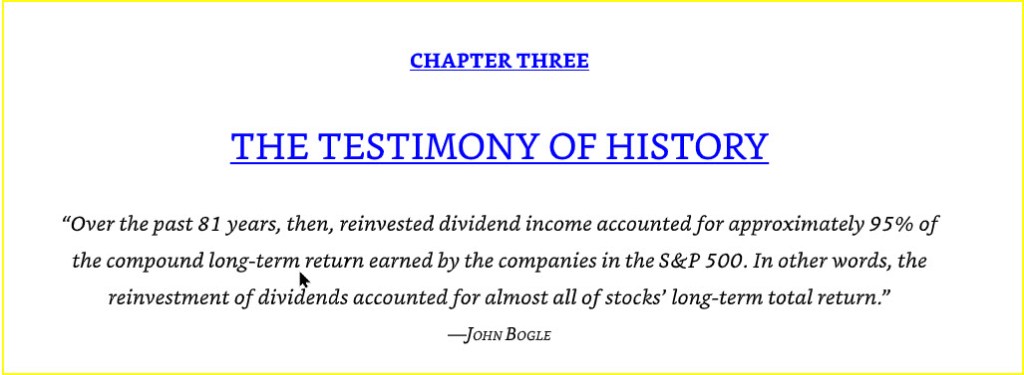
Chapter three begins with a John Bogle quote: “Over the past 81 years, then, reinvested dividend income accounted for approximately 95% of the compound long-term return earned by the companies in the S&P 500. In other words, the reinvestment of dividends accounted for almost all of stocks’ long-term total return.” That, my friend, is an amazing statement. Given who said it, I rather doubt that it is wrong.
Part of the reason that dividend investing and dividend growth investing is not mainstream is that the vast majority of traders have a long-term view. It doesn’t help that the yield of the S&P 500 is rather paltry. According to David L. Bahnsen it is only between 1.1% and 2.5% since the financial crisis of 2008. Those numbers don’t feel consequential. The thing that is overlooked is the impact of dividends during the difficult decades. Those that conclude that the future is only upward price momentum have some shocks coming for their portfolios.
There is an interesting line graph in the book that shows the S&P based on closing price from 1970 to 2025. As you might expect, the upward trajectory is good. But there are significant down years during those years. In fact, from 2000 to around 2014, the S&P’s returns were essentially the same as buying a CD or bond.
History of the S&P 500 2000-2015
From 2000 through 2014-2015 calendar years, the S&P 500’s average annual PRICE returns were approximately 4.9% per year using the arithmetic average. That is awful. The annualized price return was 2.3% per year when compounded. Total return, if you include reinvested dividends was about 5.2% annualized.
Why Such Substandard Returns?
The difference matters because the period included both the dot-com crash and the 2008 financial crisis. The annualized figure is generally more useful for describing what an investment actually earned over the entire period.
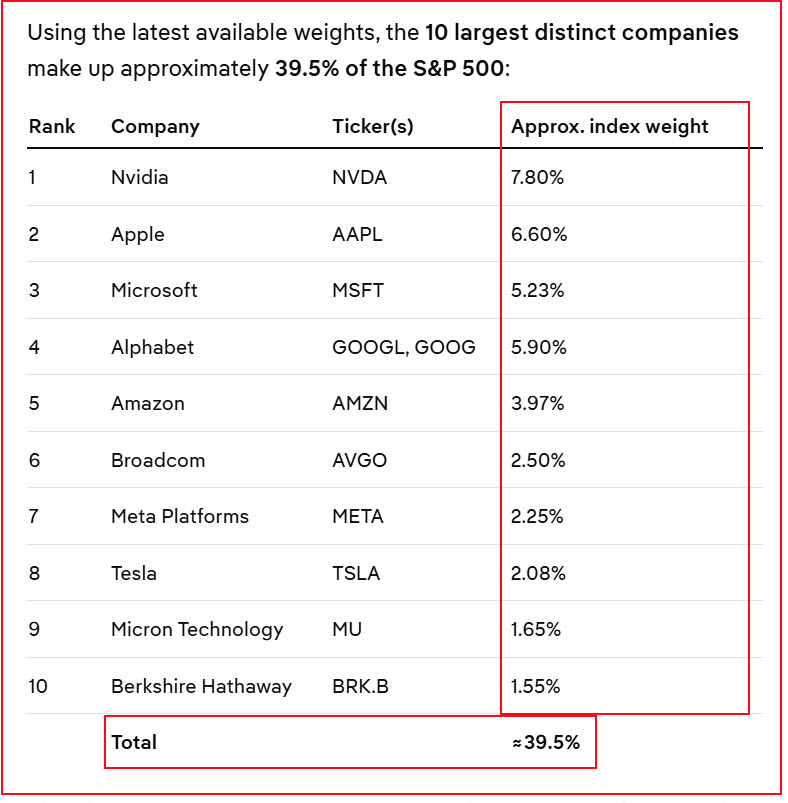
Dividends, on the other hand, represent a far more stable and also growing investment return. One of the reasons I don’t invest in any S&P 500 index mutual fund or ETF is that it is heavily skewed to the top ten companies. They make up almost 40% of the index. When these ten are showing magnificent price returns, an investor feels like a genius. I submit they have a momentum philosophy. That is a philosophy that can turn sour very quickly. Just look at history and learn.
It isn’t my goal to tell you everything the author says. One section proclaims “DIVIDEND GROWTH INVESTORS CAN DO BETTER.” He also talks about “DISTORTION OF MODERN ORTHODOXY” where he says what I said about the S&P 500 and the dangers in momentum thesis instead of the measurement thesis.
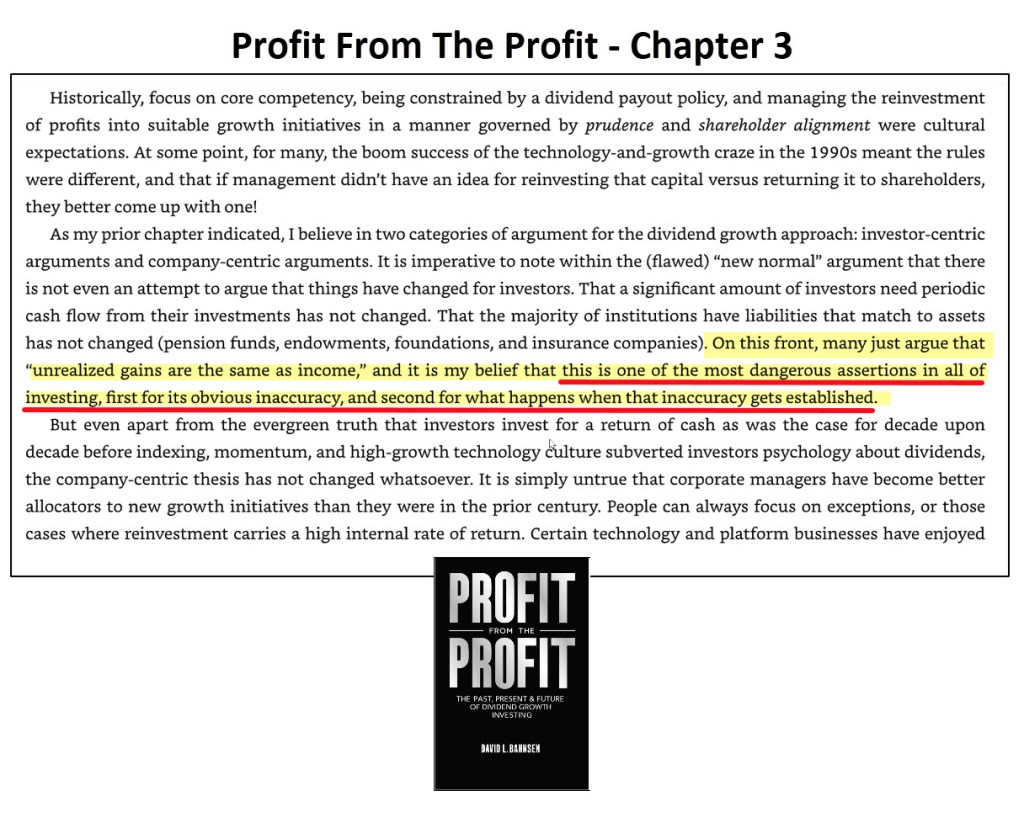
Unrealized Gains Are NOT Income
So the price of your S&P 500 index funds or ETFs are up dramatically. Congratulations. You have the potential for a lot of future gain. But you also have significant potential for significant pain. I love what the author says in the following portion of chapter 3.
Looking At The Statements
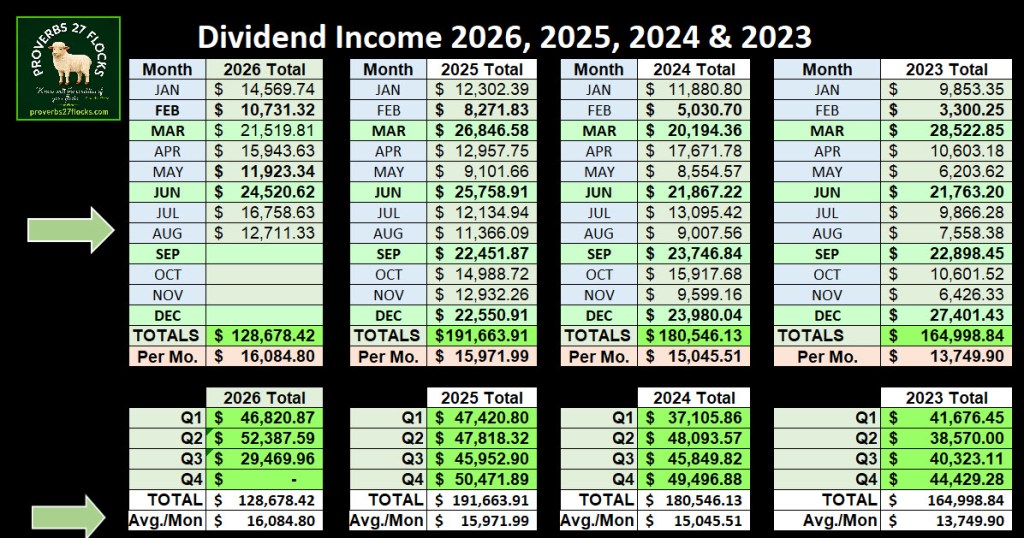
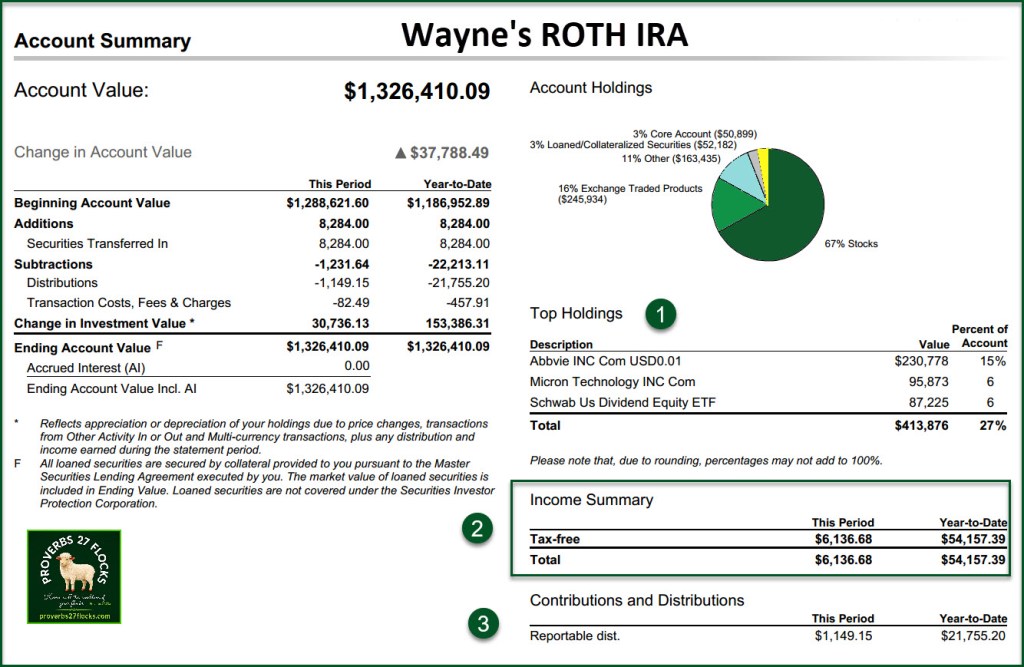
Two of our accounts at Fidelity are the big ones. My traditional IRA and my ROTH IRA. There are, therefore, two pages I look at every month. So, for example, for my ROTH IRA I want to see three important things. 1) What is the YTD change in investment value? For my ROTH it is $153K. 2) What are my top holdings? They are ABBV, Micron Technology, and Schwab’s ETF SCHD. 3) What real income flowed into my account this month and YTD? For August it was about $6K and the YTD dividend income is $54K. Remember, this is TAX FREE spendable income. I spent about $22K of that income so far this year. This does not include income from options contracts.
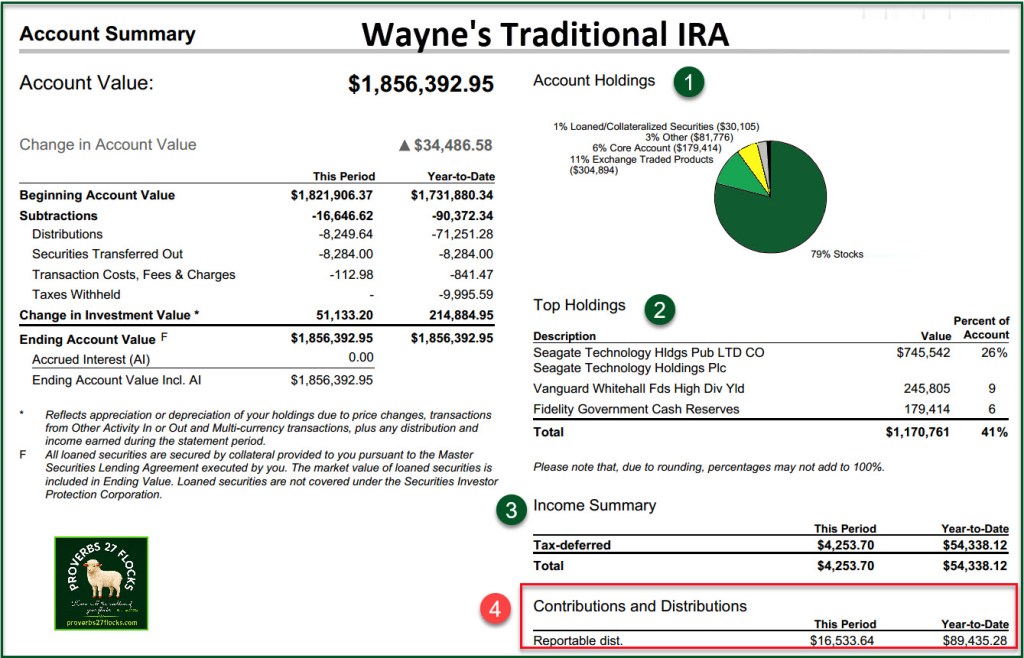
I look at the same things for the traditional IRA, which is our largest account in total dollars. Like the ROTH, the YTD dividend income is about $54K. However, withdrawals of those dollars are taxed unless I wisely do QCD charitable gifts. I’ve done more withdrawals than the dividends, and that is possible because I also trade options contracts in the IRA.
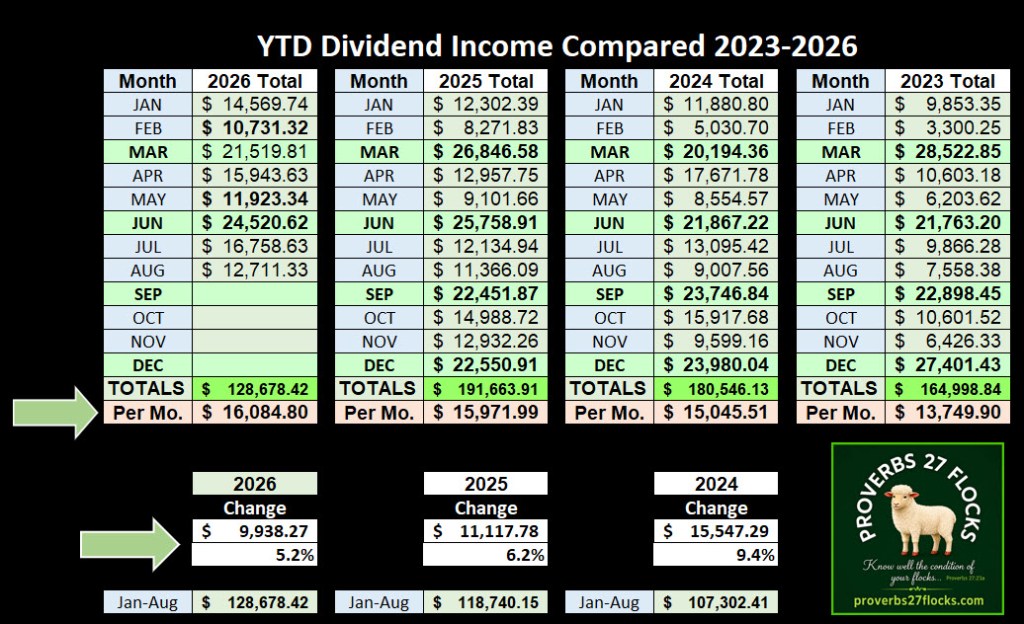
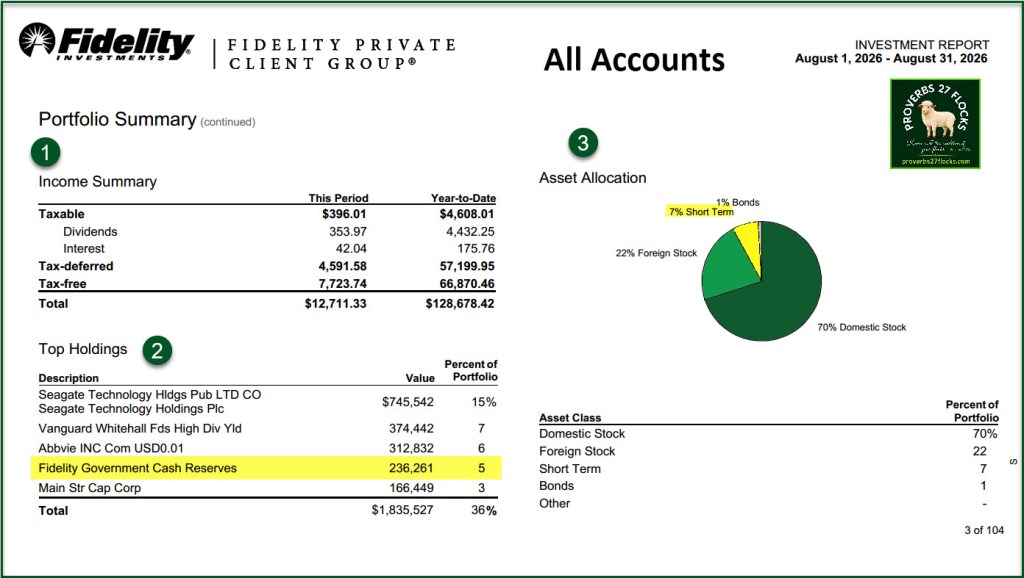
Finally, there is the all-accounts view. This view shows that total dividend income is almost $129K and almost $66K of that income is tax free. The reason for this is that Cindie’s ROTH IRA also produces tax free income from dividends.
Action Steps for Consideration
- Have you read your investment statement(s)? If not, how do you know if you are achieving your goals?
- Examine your beliefs about the S&P 500 and related mutual funds and ETFs. Are you fully aware of the risks associated with having too many dollars allocated to this strategy?
- What portion of your current investment income is tax-free? What portion is taxable? Think about what that really means for retirement.
Additional Income
As I said in the previous post in this series, there is another piece to the puzzle. There are some growth stocks that do not pay a dividend, but you can get significant “synthetic” dividends by trading options on blocks of 100 shares. I trade options all growth stocks and dividend-growth investments.
Seeking Alpha Subscription Information
Of all of the resources I use, the most helpful is Seeking Alpha Premium. The Seeking Alpha QUANT rating is a huge factor in my investment success. If you decide to explore a Seeking Alpha subscription, please use the following link. Seeking Alpha

SEEKING ALPHA INFORMATION AND Types of SUBSCRIPTIONS
There are several ways to subscribe to Seeking Alpha services. I use the “Seeking Alpha Premium” service. The other ones are 1) Alpha Picks, 2) Bundle Premium and Alpha Picks, and 3) Quant Growth and Income. The links for the promotions are on each of these four choices. I highly recommend “Seeking Alpha Premium” as a place to start.
You can also scan this QR Code to get the same information about Seeking Alpha Premium.

Past performance does not guarantee future results, Seeking Alpha does not provide personalized advice, and it is not a registered investment adviser.
We accept advertising compensation from companies that appear on our site. This website represents my opinions, which may not reflect those of Seeking Alpha, and does not constitute an investment recommendation or advice.
If you have any questions or problems getting connected to Seeking Alpha, reach out to them with this email address: subscriptions@seekingalpha.com

