The Penalty for Living Alone

In this last “Preparing for Someday” post the topic is death and taxes. Both are inevitable. The first one is certain. Rarely does a couple die at the same time. In my recollection, only one couple we know died in the same accident. Therefore, part of a good plan includes thinking about the increased taxes the widow or widower will likely pay, often with the potential for some reduction in total income. In fact, last night one widow said she was dealing with this very issue.
Simultaneous death is considered very rare among all married couples. Most cases occur because of a shared event—such as a car crash, plane crash, natural disaster, or other catastrophe. Couples may also die close together from separate illnesses, but that is different from literally dying at the same moment. You probably won’t have that situation. Therefore, some thoughtful planning is in order.
Adjusted Gross Income and Deductions
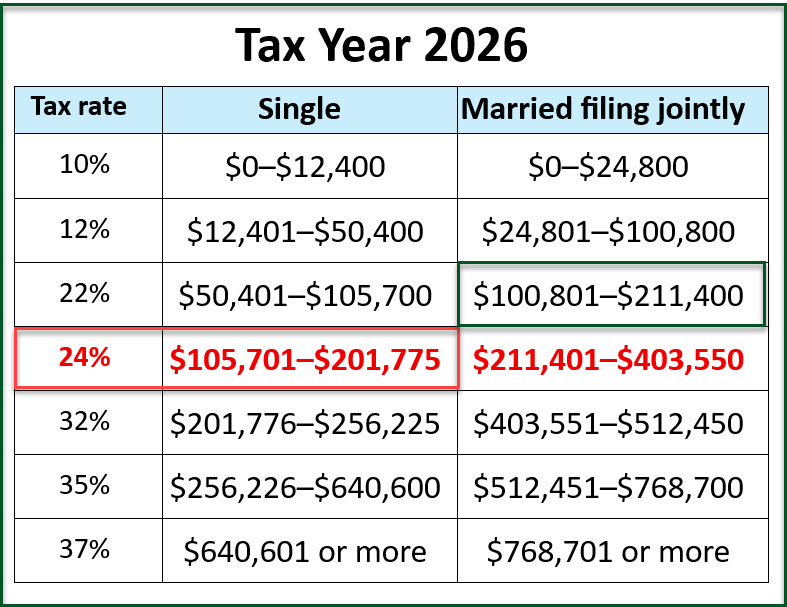
If we assume an AGI of $200,000 and you take the standard deduction (ignoring credits like child tax credit, and ignoring any itemized deductions/adjustments), the main difference between Married Filing Jointly (MFJ) and Single is the standard deduction, which changes taxable income and therefore the brackets you land in. The standard deduction amounts for tax year 2026 are: $32,200 MFJ and 16,100 single. The tax bills are significantly different due to the income tax brackets.
Single Under Age 65
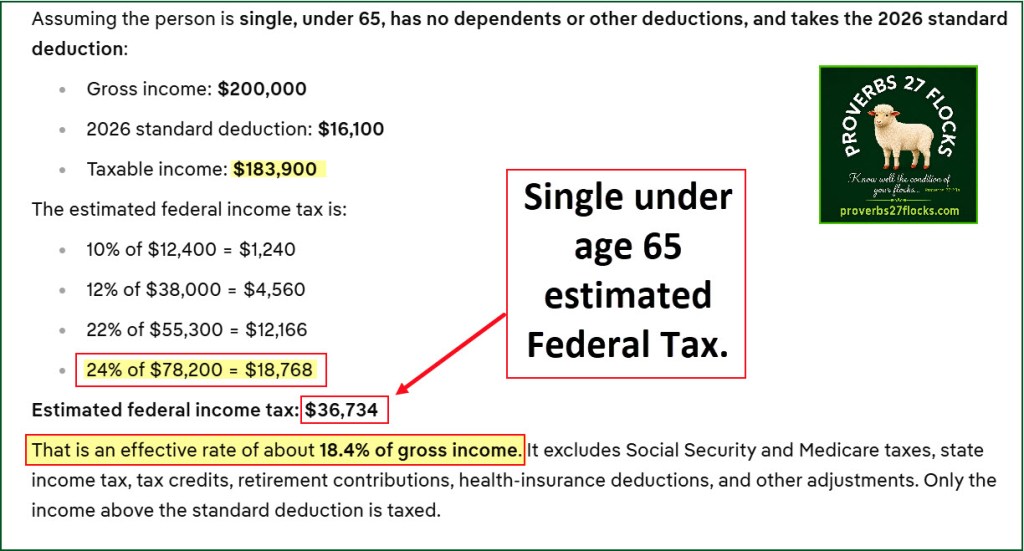
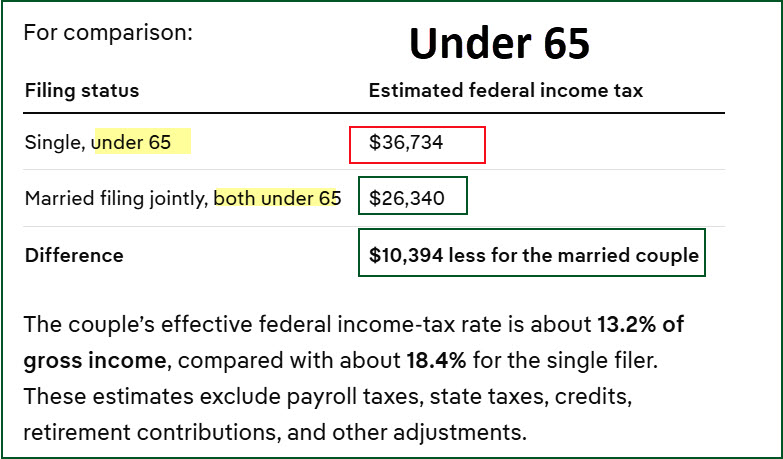
Assuming the person is single, under 65, has no dependents or other deductions, and takes the 2026 standard deduction, the total estimated Federal income tax is $36,734. That is an effective rate of about 18.4% of gross income. It excludes Social Security and Medicare taxes, state income tax, tax credits, retirement contributions, health-insurance deductions, and other adjustments. Only the income above the standard deduction is taxed.
Single Over Age 65
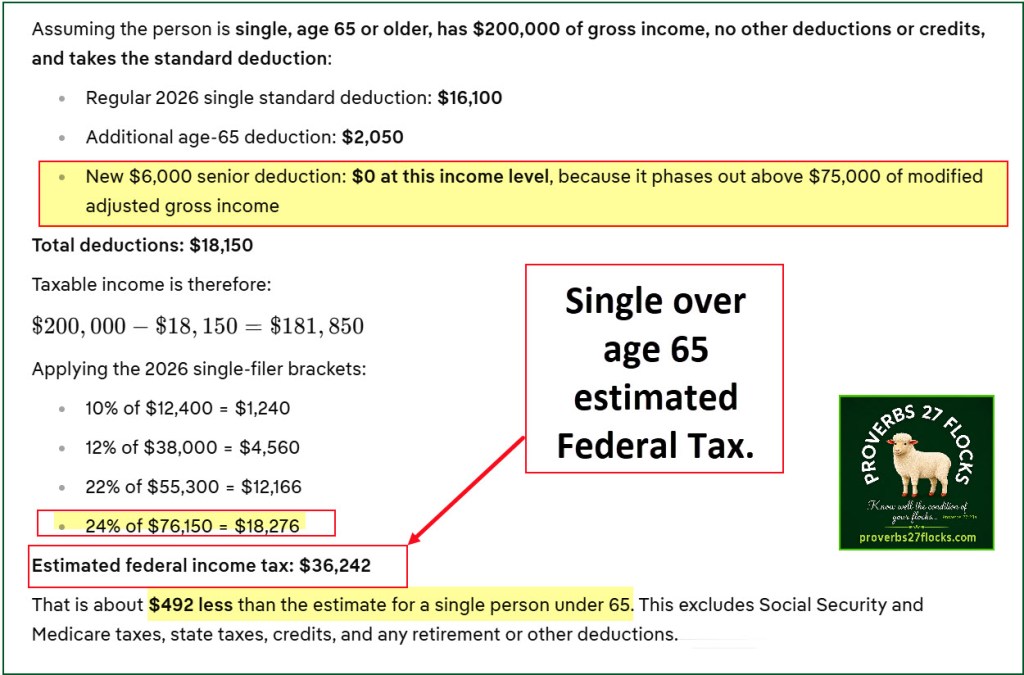
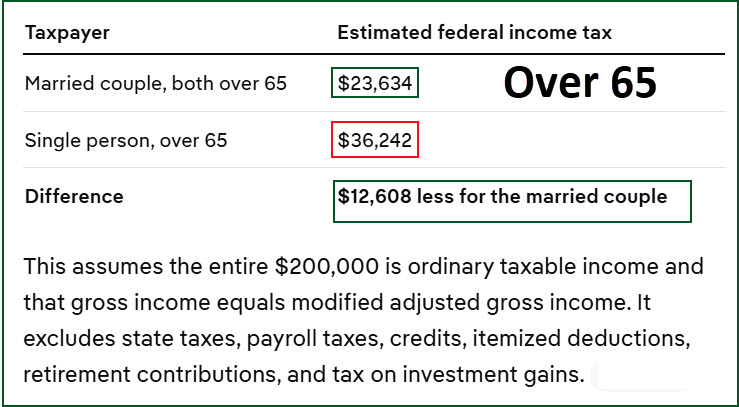
Assuming the person is single, over 65, has no dependents or other deductions, and takes the 2026 standard deduction, the total estimated Federal income tax is $36,242. That is about $492 less than the estimate for a single person under 65. This excludes Social Security and Medicare taxes, state taxes, credits, and any retirement or other deductions.
How much will a married couple under age 65 pay for Federal income taxes if their gross income is $200,000 and they file jointly? The number is significantly lower: $26,340. So the married couple pays $10,394 less than the single person with the same income.
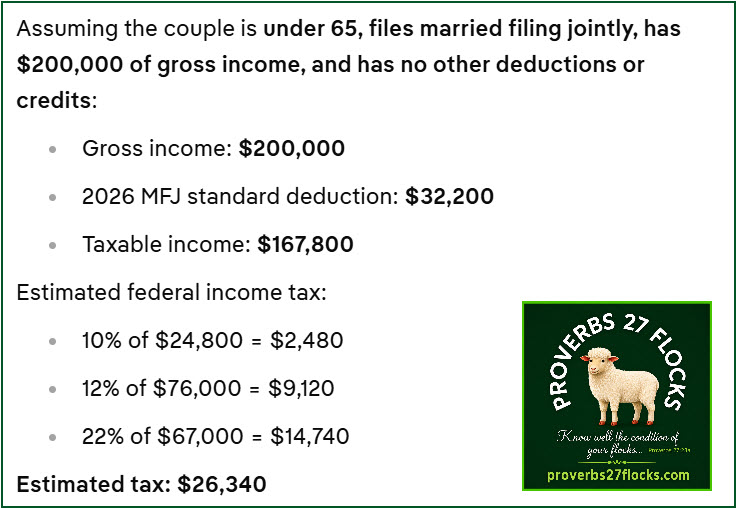
What is the difference between that tax and the single person under age 65? The couple’s effective federal income-tax rate is about 13.2% of gross income, compared with about 18.4% for the single filer. These estimates exclude payroll taxes, state taxes, credits, retirement contributions, and other adjustments.
How much will a married couple both over age 65 pay for Federal income taxes if their gross income is $200,000 and they file jointly? Assuming both spouses are 65 or older, file married filing jointly, have $200,000 of gross income, and have no other deductions or credits the regular MFJ standard deduction is $32,200. There is an additional age-65 deduction: $1,650 × 2 = $3,300. Then there is a senior deduction of $9,000 (The $12,000 senior deduction is reduced because joint modified adjusted gross income exceeds $150,000.)
What is the difference between that tax and the single person over age 65? The married couple will pay $12,608 less than the single person over age 65.
Is There Any Hope for Reducing Income Taxes?
This is where some tax planning comes into play. If all of your income is from Social Security and ROTH IRA investments, your income tax picture will be considerably less onerous. If, however, one or both spouses have traditional IRAs, the tax implications will grow increasingly worse as they age. This is due to the RMD. Of course, some of that tax burden can be reduced by doing ROTH conversions and by using QCD giving when applicable.
A traditional IRA can reduce taxes in several ways, but the best strategy depends on whether you want to lower taxes this year or reduce taxes over your lifetime. When you are working, your contributions to a traditional IRA reduce your income taxes for that year. Unfortunately, that will work against you when the RMD kicks in.
ROTH Conversions
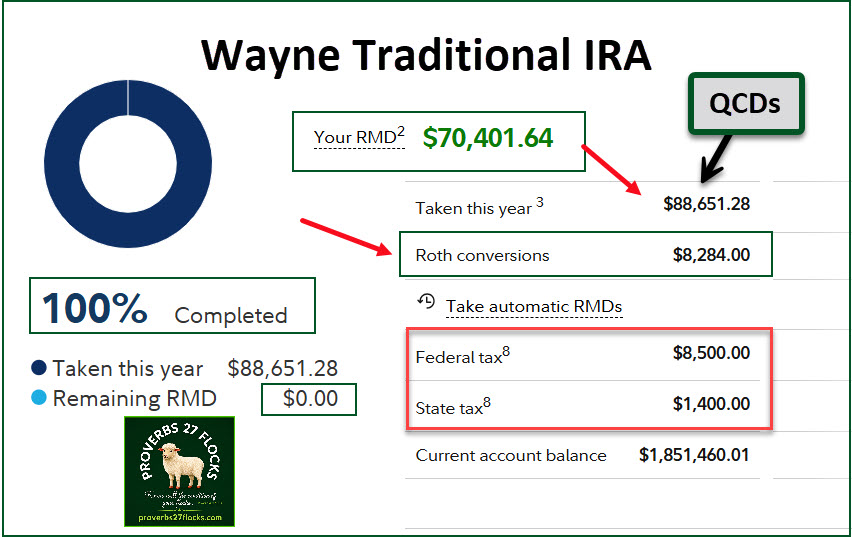
It is wise to use Roth conversions strategically. Each year I convert a part of my traditional IRA to my Roth IRA. You can do this before retirement, after retirement but before required minimum distributions begin, and after RMDs kick in. However, you must take your RMD, if required before doing conversions. I have completed my 2026 RMD and have begun converting stock (or ETF) shares from my T-IRA to my ROTH. I also convert only enough to stay within my desired tax bracket. However, I don’t let IRMAA taxes have a huge influence on my decisions. The long-term benefits outweigh the short-term pain, in my opinion.
It is best to spread conversions over several years. A large one-time conversion can push income into higher brackets and increase taxes on Social Security or Medicare Part B and prescription-drug premiums. Again, I don’t mind a slight bump in IRMAA, but I don’t want to go crazy.
QCD Instead of RMD
To complete my RMD each year, I make qualified charitable distributions. Starting at age 70½, a direct transfer from an IRA to an eligible charity can count toward required minimum distributions and generally be excluded from income, subject to annual limits. So we can give away $111,000 in 2026.
For tax year 2026, the QCD maximum is $111,000 per person. Therefore, a married couple could potentially make QCDs totaling $222,000, provided each spouse has their own eligible IRA and each makes their own qualifying distribution. Cindie doesn’t have a traditional IRA, so we cannot go above the $111,000 amount. However, because my RMD for 2026 is $70,401.64, I won’t pay taxes on the RMD amount. The goal is to give away $111,000 during the year, further reducing the total value of my T-IRA and increasing our charitable giving.
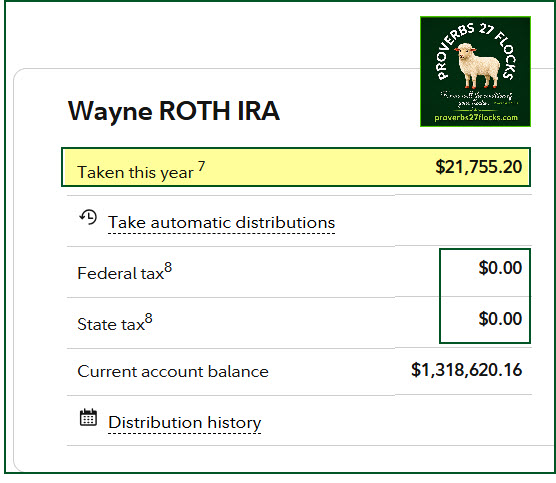
Coordinate which account you draw from. In retirement, use a mix of taxable accounts, traditional IRAs, and Roth accounts to control annual taxable income rather than withdrawing from only the traditional IRA. We also do this. There are times when I withdraw from my ROTH IRA to have tax-free income for some purchases and gifts. So, for example, YTD I have withdrawn $21,755.20 from my ROTH IRA. These dollars were used to purchase a new washer and dryer, to cover the costs of our 50th anniversary Lake Geneva getaway, to give a gift to a grandchild, and to pay for my upcoming mission trip to Guatemala.
Avoid unnecessary early withdrawals. Withdrawals before age 59½ can trigger both ordinary income tax and a 10% additional tax unless an exception applies.
For someone over 65, the most commonly useful techniques are usually partial Roth conversions before RMDs, qualified charitable distributions after age 70½, and carefully managing IRA withdrawals to avoid higher tax and Medicare-premium brackets.
Action Item
Do the math. What will your income be when you retire, based on social security, pensions, part-time income and withdrawals from your investments? Then compare the tax implications of married filing jointly with the same or similar income (likely reduced) for the surviving spouse. This makes it possible to develop a strategy that includes RMDs and possibly QCDs and ROTH conversions.