

What is DGI? It is “Autopilot is Engaged”

For an investor, DGI usually means Dividend Growth Investing. It’s a strategy focused on buying companies that pay regular dividends (usually quarterly), have a history of increasing those dividends, have sustainable earnings and cash flow to support future dividend increases, and offer long-term share-price growth. This approach lets you fly without constant changes in course and altitude.
Why Consider DGI?
The goal is typically to build a growing income stream over time, rather than simply maximize the current dividend yield. A DGI investor may prefer a company yielding 2.5% but raising its dividend 8% annually over one yielding 8% with little or no growth.
Are There Risks for DGI Investors?
Of course there are. But the risks, in my opinion, are considerably less than many of the other paths that investors choose to walk. Key risks include dividend cuts, overpaying for high-quality companies, sector concentration, and the possibility that dividend growth lags inflation. But then the same can be said for all investments, not just those in the dividend-paying category.
A Reader’s Question
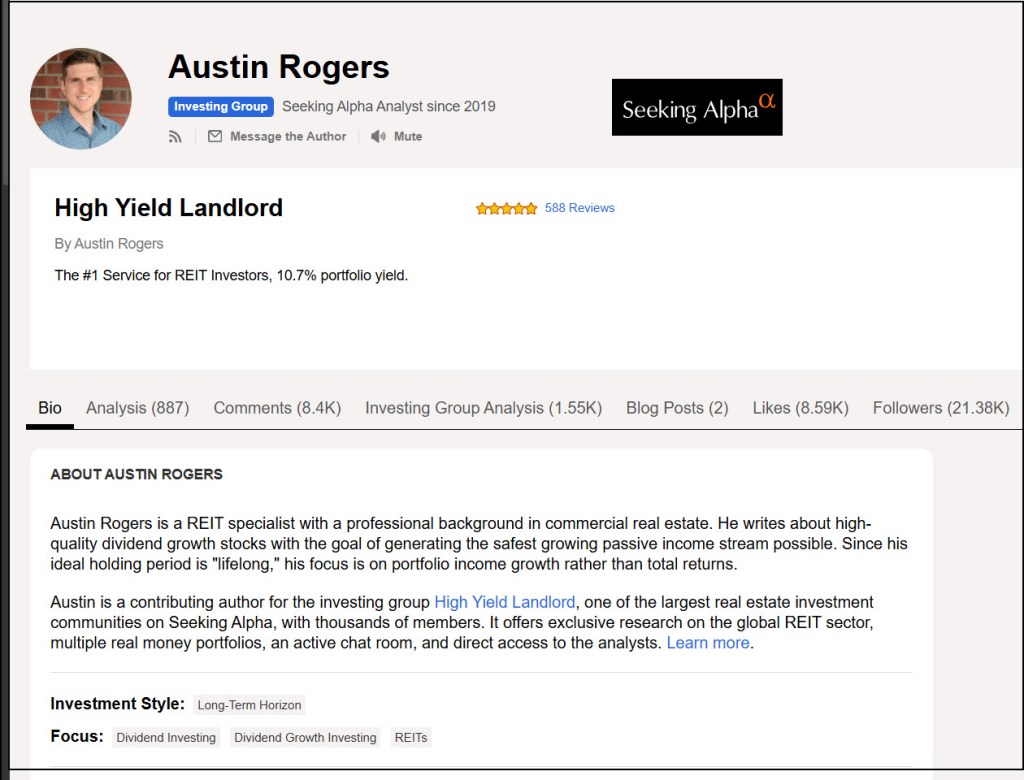
One of my readers, Mary Martha, asked me if I had seen the Seeking Alpha article “Why I Am A Dividend Growth Investor (At Age 35).” The article’s author, Austin Rogers, quotes David Bahnsen from his 2019 book, The Case For Dividend Growth (pgs. 63 and 65): “You show me an investment plan that seeks to consistently spend ‘portfolio gains’ and I will show you a vulnerable investment plan exposed to negative compounding. No discussion of this topic will ever come to a different conclusion than this: the less you withdraw from principal, the longer your money lasts.”
Far too many investors view their capital gains as spendable income. That is a train that might deliver but it might also derail at the most critical moments of an investor’s life.
Here are Mary Martha’s questions: “I was so glad to see a piece about the importance of DGI, even at a young age. And I see that the author mentioned the book that you have been working from as inspiration for your current blog posts. Do you have any thoughts about his top investments listed?”
I responded to her email and said I thought this could be a good blog discussion. She then responded with, “I thought the article was meaty as well and offered something different than a lot of the tech-focused articles. My eyebrow was raised over some of the ETFs that he suggested (with Sell/Strong Sell Quant ratings for some), but I’m very interested in WTV as a possible ETF to add to my portfolio.”
WisdomTree US Value Fund ETF – WTV
My thoughts about WTV are that this is a good ETF for a dividend growth investor. It has all of the characteristics of a fund I would buy and hold. I did not review his other recommendations, but I would certainly use Seeking Alpha if I was interested in a deeper dive.
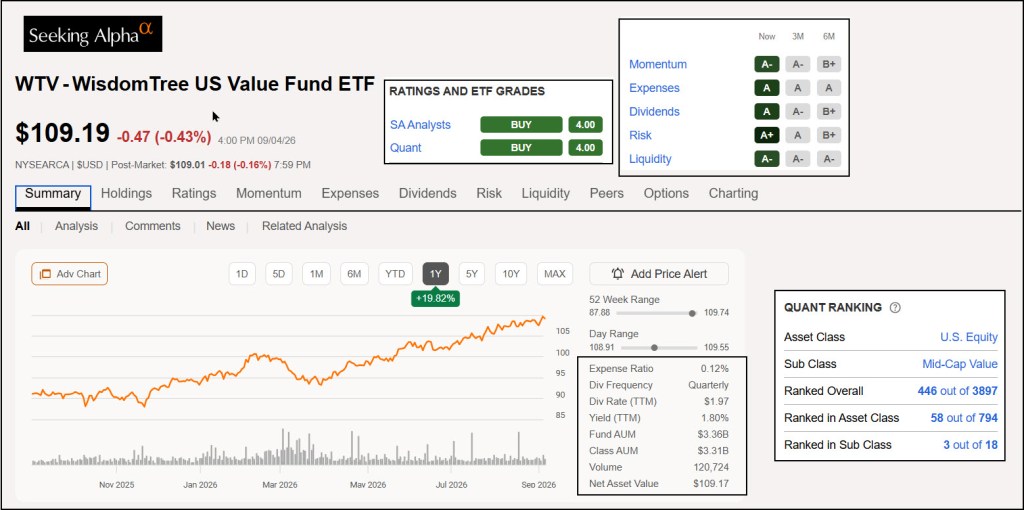
WisdomTree U.S. Value Fund is an exchange traded fund launched by WisdomTree, Inc. It is co-managed by Mellon Investments Corporation and WisdomTree Asset Management, Inc. It invests in public equity markets of the United States. The fund invests in stocks of companies operating across diversified sectors. The fund invests in growth and value stocks of companies across diversified market capitalization. It seeks to benchmark the performance of its portfolio against the S&P 500 Value Index and the MSCI USA Index. The fund employs quantitative analysis to create its portfolio.
The Fund seeks income and capital appreciation. The Fund is actively managed using model-based approach and seeks to achieve its investment objective by investing primarily in US equity securities that provide a high total shareholder yield and exhibit favorable quality characteristics aligned to company’s profitability. Benchmark: Russell 1000 Value TR
For an actively managed ETF, the expense ratio isn’t bad: 0.12%. The yield is decent at 1.80%. According to Seeking Alpha, the 5-Year Dividend Growth Rate is an impressive 16.17%.
The investments are diversified with financials and technology the most concentrated. The top ten investments in this ETF are, NVIDIA CORPORATION, BERKSHIRE HATHAWAY INC, CISCO SYSTEMS INC, ZOOM COMMUNICATIONS INC, SALESFORCE INC, TARGET CORP, DAVITA INC, CITIGROUP INC, SOUTHWEST AIRLINES CO and VIATRIS INC. The current QUANT rating is a BUY.
My Comment on the Article: Autopilot Investing
When I read an article on Seeking Alpha I will sometimes comment. Here is what I said on Austin Roger’s post: “I am also a dividend growth investor and have 95% of our assets in stocks and low-cost dividend growth ETFs. I like your take on this aspect of investing and cannot find fault with the way you explain the different investing paths. One of the things I like about dividend growth investing is the ability to leverage my portfolio to add even more income trading covered call options. Then, as the cash rolls in I can also sell cash covered put options. The combination of increasing dividends and increasing income from cash covered puts is a huge benefit. The other benefit is that I can let it run on autopilot and not have to be doing a lot of buying and selling of our core investments. At age 75 I can afford to buy and sell, but I don’t want to.”

Some Helpful Reminders
Austin Roger’s makes some compelling arguments for the DGI approach. He starts by explaining why he is taking this approach. “Multiple factors make my situation unique.”
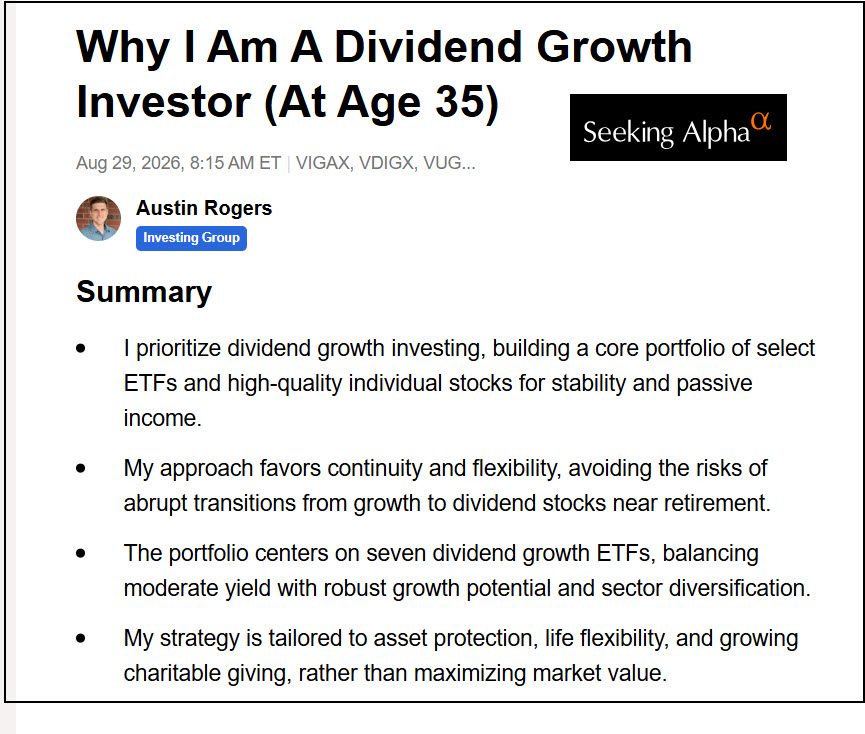
“First, I received an inheritance from my grandparents, which affords me a high level of assets relative to both my age and my income level. Whereas the typical accumulator is a “HILA” (high income, low assets) investor, I am more of a “HAMI” (high assets, moderate income) investor. That has made me psychologically more akin to a typical 60-year-old investor than a typical 35-year-old investor.”
“My priority is to protect and wisely steward my portfolio rather than to maximize its market value.”
“Second, my labor income is variable and entirely dependent on my output. I get paid per article and page view. Future income is difficult to forecast. This makes investment portfolio stability and passive income more attractive to me.”
I appreciate his third goal: “I’ve set a goal for myself to increase my charitable giving (by at least a small amount) every year. Dividend growth stocks are a convenient way to fund this goal.”
Six Reasons the DGI Strategy is Appealing
Some of his reasons had not occurred to me. One that he misses is the opportunity to use your dividend growth portfolio to add income trading covered call options contracts. His six are the sign of a mature investor: Optionality, Life Flexibility, Investment Strategy Continuity, Avoidance of Market Timing (thinking long-term), Avoiding big tax bills (I hadn’t thought of that one!) and Remembering you cannot know the future. You can read his article at this link: Austin Rogers Article
However, here is what he says about “Unknowability of the Future. “Past performance is not a guarantee of future returns. Growth stocks could suffer a “lost decade” at some point, whether due to a recession, a major war, or a tech bubble bursting. Dividend growth investing is not reliant on a continuous upward trajectory in stock prices.”
Is a growth strategy wrong? Of course not. But recognize the things the growth strategy can’t and won’t do for you. In your younger years it might be worth the risk to focus on growth. Someday, however, you might regret that decision.
Seeking Alpha Subscription Information
Of all of the resources I use, the most helpful is Seeking Alpha Premium. The Seeking Alpha QUANT rating is a huge factor in my investment success. If you decide to explore a Seeking Alpha subscription, please use the following link. Seeking Alpha

SEEKING ALPHA INFORMATION AND Types of SUBSCRIPTIONS
There are several ways to subscribe to Seeking Alpha services. I use the “Seeking Alpha Premium” service. The other ones are 1) Alpha Picks, 2) Bundle Premium and Alpha Picks, and 3) Quant Growth and Income. The links for the promotions are on each of these four choices. I highly recommend “Seeking Alpha Premium” as a place to start.
You can also scan this QR Code to get the same information about Seeking Alpha Premium.

Past performance does not guarantee future results, Seeking Alpha does not provide personalized advice, and it is not a registered investment adviser.
We accept advertising compensation from companies that appear on our site. This website represents my opinions, which may not reflect those of Seeking Alpha, and does not constitute an investment recommendation or advice.
If you have any questions or problems getting connected to Seeking Alpha, reach out to them with this email address: subscriptions@seekingalpha.com

