
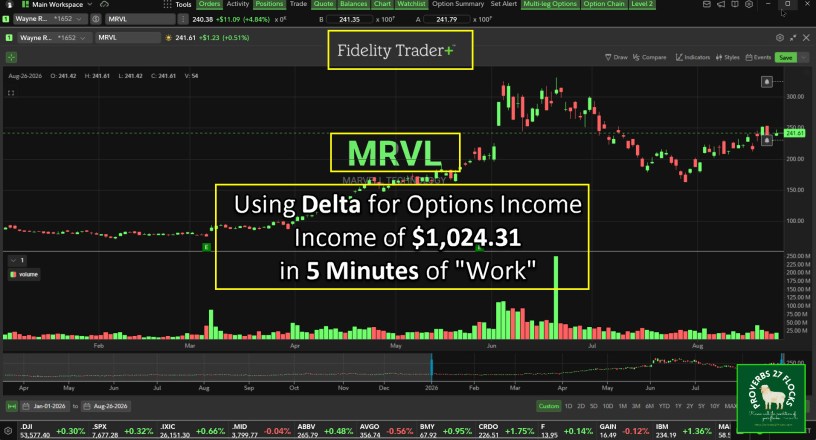
Minimizing the Risk
When you sell options contracts, whether they are covered call options on shares you own, or cash covered put options on investments you wouldn’t mind owning, the goal is to make money quickly and avoid disappointments. Before you sell any option contract it is wise to understand the significance of the Delta. What is delta? It is a probability number to help you earn income and avoid regretting your decision to enter an options contract.
What is Delta?
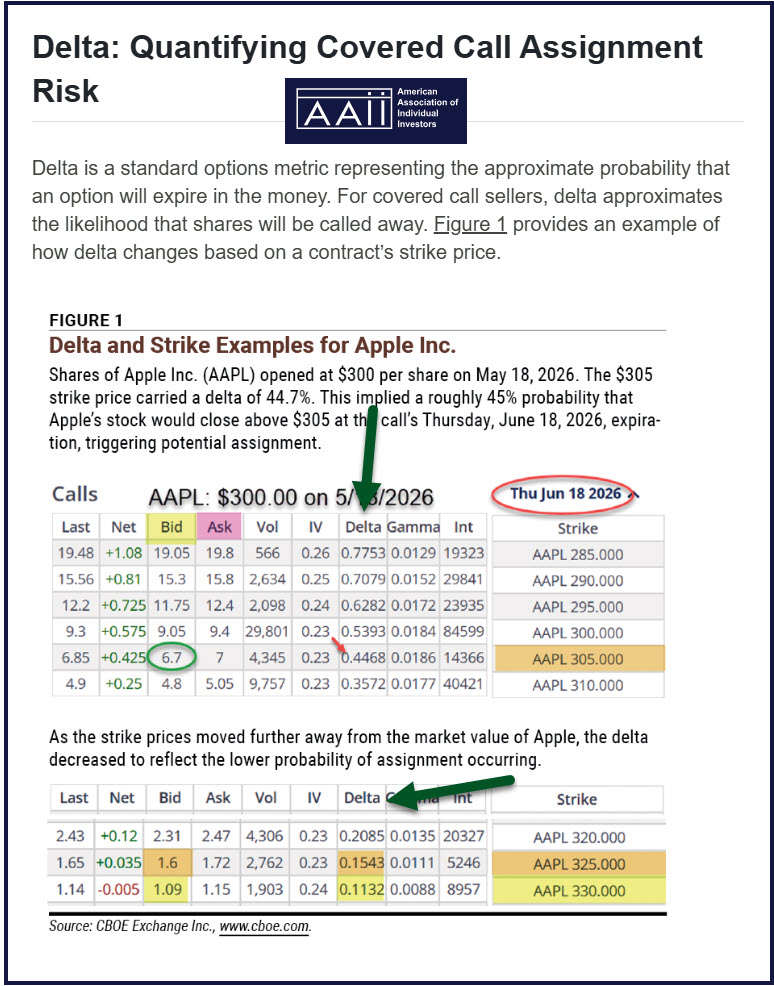
Delta measures how much an option’s price is expected to change when the underlying stock moves by $1. A call option has positive delta, from 0 to +1.00 and a put option has negative delta, from 0 to −1.00. That might seem a bit fuzzy, so let’s expand on the definition. You don’t usually want your option contract to expire in-the-money (ITM). That means you would prefer to avoid selling your shares because the stock price stays below the option contract’s price. For a put option it means you avoid buying the shares associated with the contract because the share price did not drop to or below the option contract’s price. Delta is dealing with probability.
Delta is also commonly used as a rough estimate of the probability that an option will expire in the money, though it is not an exact probability. A 0.30-delta call is often loosely interpreted as having about a 30% chance of expiring in the money, while a −0.30-delta put is interpreted similarly.
When I was using Fidelity’s Active Trader Pro, I was always looking at the probability number. That number was related to the delta. I wanted the probability that the contract would expire ITM to be less than 30%.
A “Safe” Delta Defined
What is the “safe” delta for a covered call option if you want to keep your 100 shares? What delta would be considered a higher risk?
You want to keep your shares connected to a covered call option contract so that they are not called. Being called means that your shares will be assigned to the person who bought your covered call contract. Each contract is associated with 100 shares you own.
If your main goal is to keep the 100 shares, many covered-call sellers choose a call with a delta around 0.10–0.20. That usually means selecting a strike price meaningfully above the current stock price, with a lower—but also smaller—premium.
A practical guideline for the increasing risk of the contract is as follows.
- The more conservative (lower assignment risk and lower premium is a delta of 0.10 to 0.20.
- A moderate risk is the 0.20 to 0.30 delta. You can earn a larger premium, but you also increase the risk that your 100 shares will be assigned.
- Obviously, the 0.30 to 0.40 delta has even higher risk of assignment, especially near the contract’s expiration date. However, you also earn a larger premium for taking that additional risk.
- If the delta is above 0.40 to 0.50 (40-50% risk) there is a higher risk your shares will be assigned. However, remember that you also received more money for taking on more risk.
- If the delta is above 0.50 and approaches 1.00 the likelihood of assignment is great.
That is why I usually keep my delta for options trades below 0.20 to 0.30. Said another way, the 0.30 delta estimates that I have a 70% probability of keeping my shares.
Delta is an Estimate
Delta is only an estimate—not a guarantee. A 0.20-delta call can still be assigned, particularly if the stock price makes a sharp move up. Assignment risk also increases when:
- The option is in the money near expiration
- Very little time value remains
- The stock has an upcoming ex-dividend date
- You hold the option through expiration
Delta in Trader+

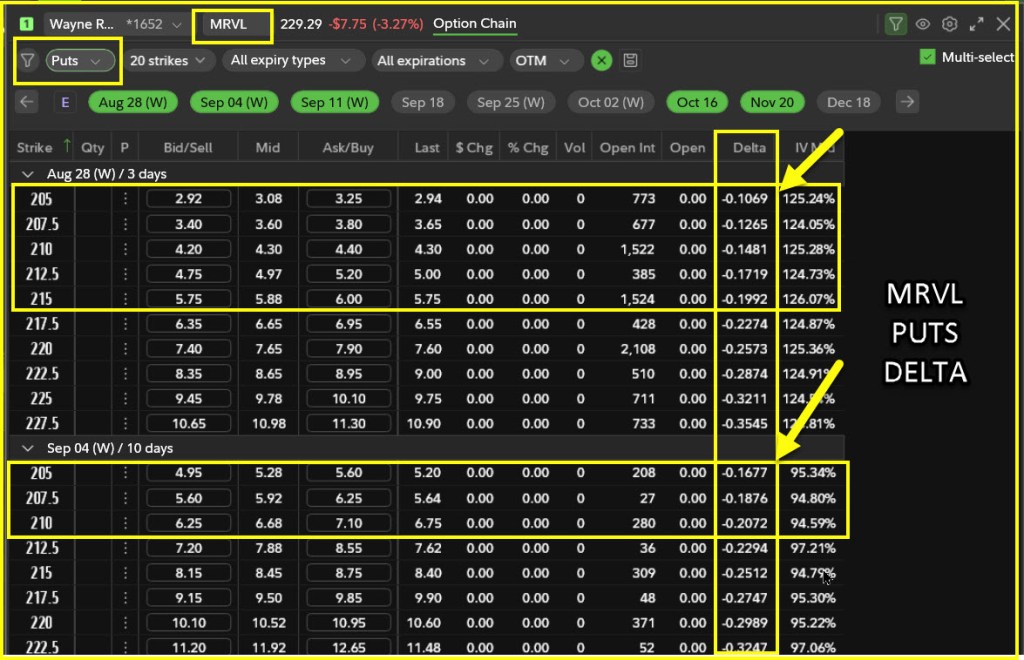
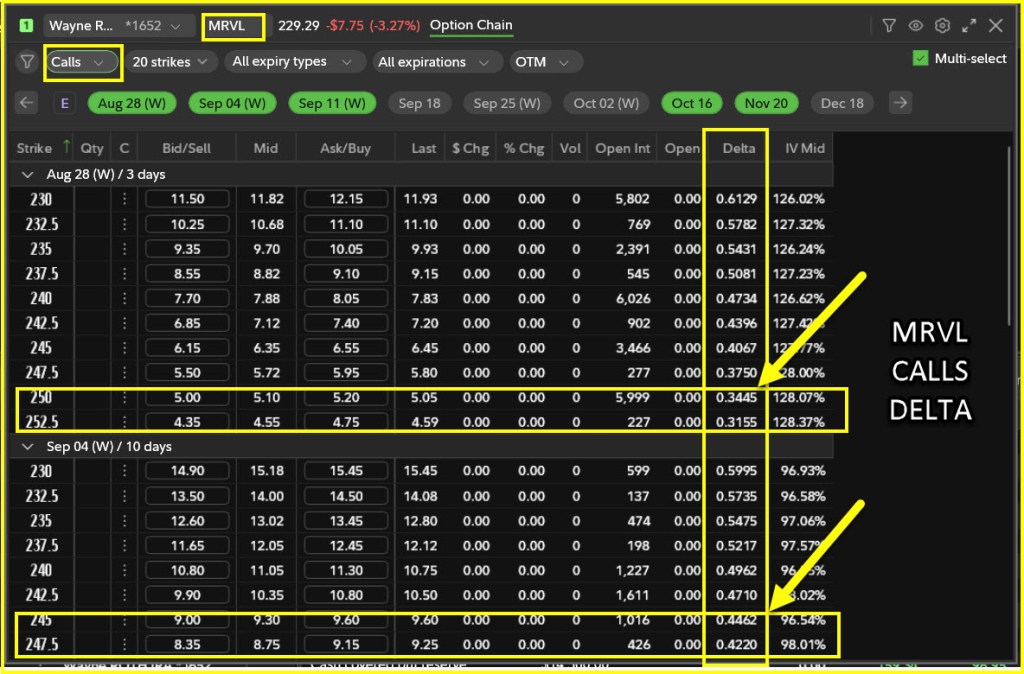
To help illustrate this concept, I used shares of MRVL (Marvell Technology, Inc) to look at the deltas for calls and puts. Rather than buy 100 shares of MRVL and sell a covered call contract on the shares, I decided to sell a cash covered put contract. The contract was “MRVL260828P240.” In other words, I am obligated to purchase 100 shares of MRVL for $240 per share if the share price is at or below $240 at the market close on Friday, August 28. Because the delta was higher than 0.30, I was able to get premium income of $1,024.31 from selling the put contract. The actual amount was $10.25 per share, but there are a small commission and fee that Fidelity takes from the sale.
Therefore, even if the share price drops to $235 on Friday, and I have to purchase the shares for $240, my true cost basis is the $240 less about $10 or $230. I can then sell covered call options on the MRVL shares.
The following two images from Trader+ show the deltas for call and put options. These images were taken earlier in the day before the stock price increased above $240 per share. The smaller the delta number the less likely your shares will be called or that you will have to purchase the shares. I’m willing to buy MRVL, so I took a higher delta value and earned a larger premium in selling the put option contract.
AAII Journal Article
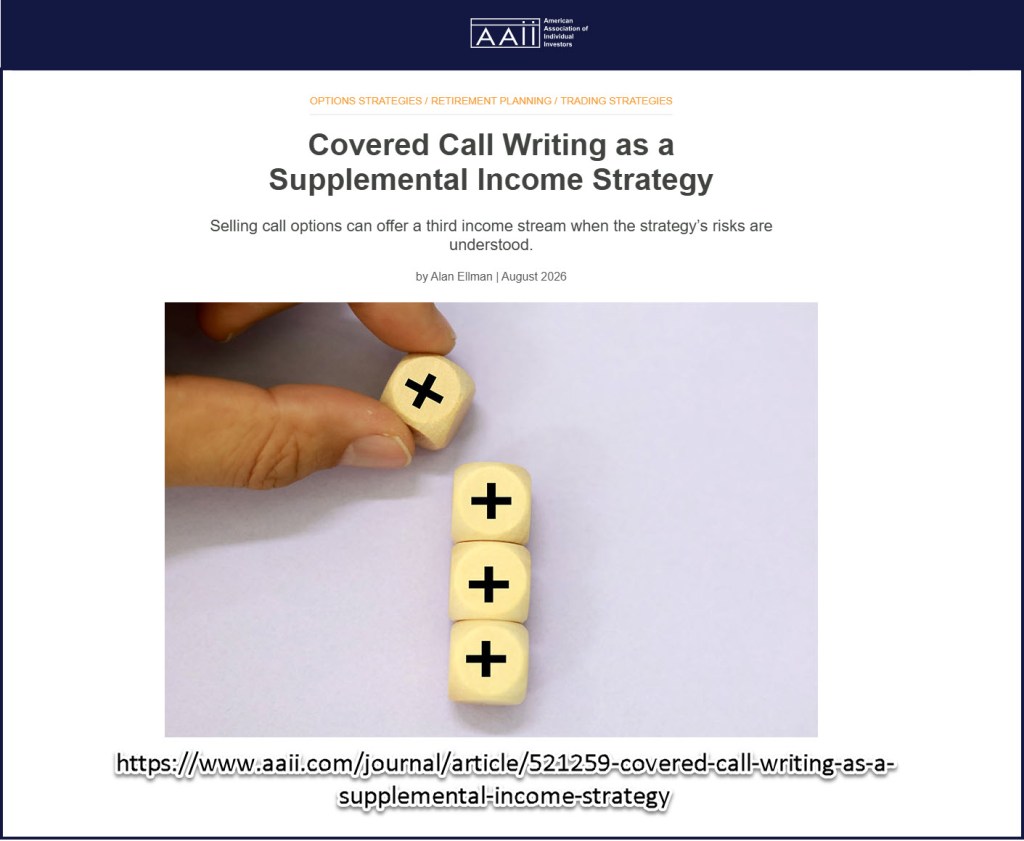
A recent AAII Journal article on options income is likely focused on using covered calls and cash-secured puts to generate portfolio income. The basic ideas in the article were:
Covered calls: Own 100 shares and sell a call option. You receive the premium, but your shares can be called away if the stock rises above the strike price.
Cash-secured puts: Set aside enough cash to buy 100 shares and sell a put. You receive the premium but may have to buy the shares at the strike price if the stock falls below it.
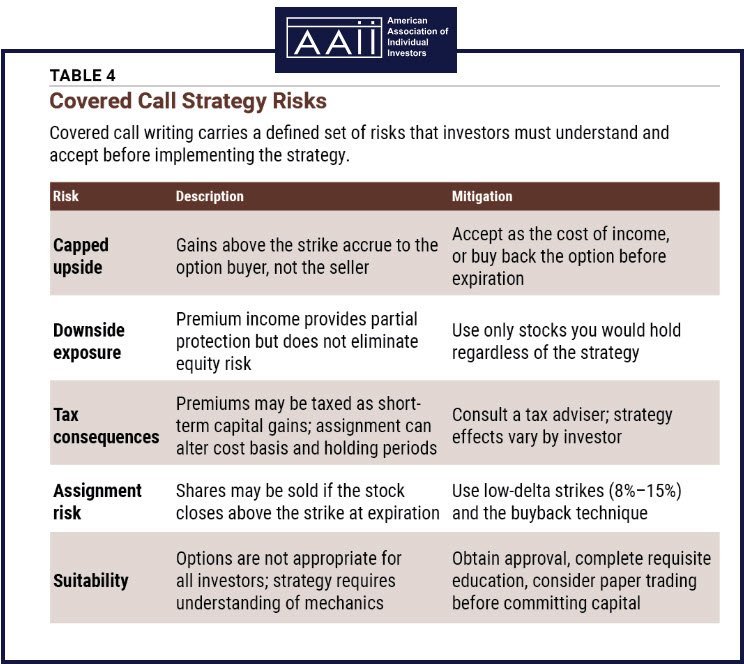
Income versus risk: The premium provides income, but it is not free yield. Covered calls cap upside, while cash-secured puts expose you to losses if the underlying stock declines.
Option selection: The article’s approach emphasizes choosing strikes and expirations based on your willingness to sell shares or buy them—not simply choosing the option with the highest premium.
Here are a couple of helpful tables from the article.
Recommendation
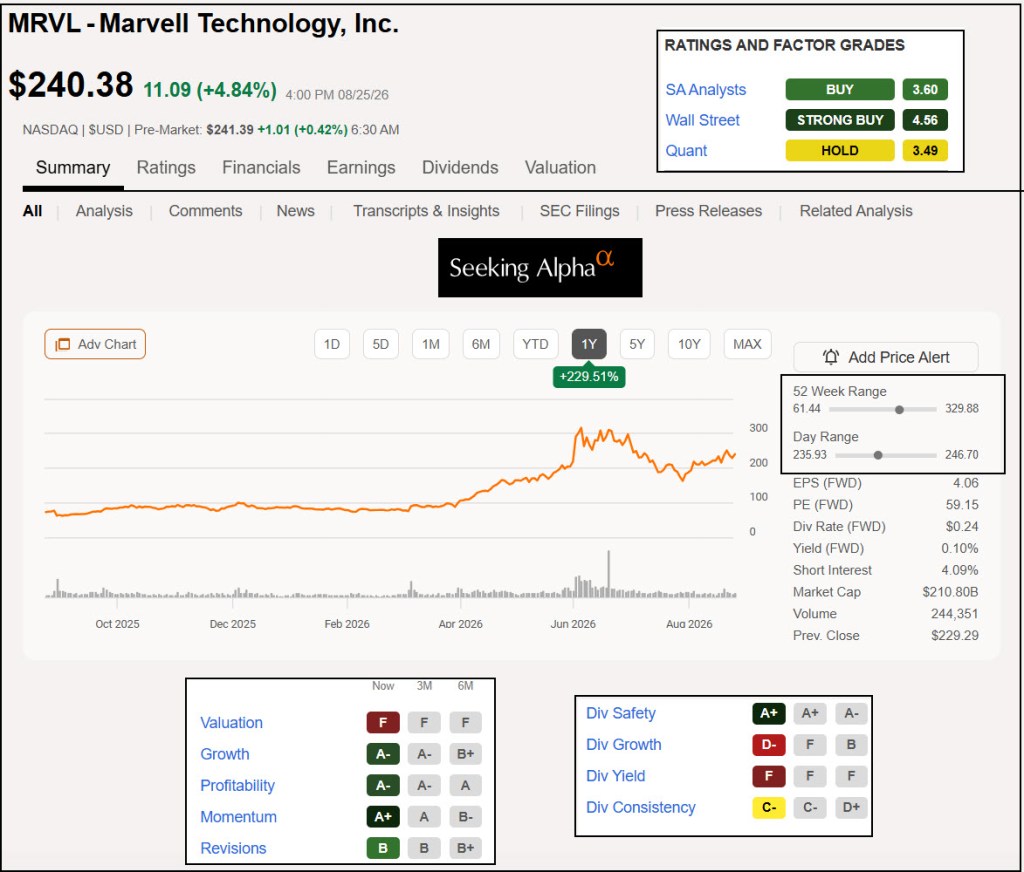
Delta is only one of the factors to consider when trading an options contract. You should consider the following dates as well: the Ex-Dividend Date and the Earnings Date. Those dates can influence the price of the shares of any stock. As always, just because I trade a specific security like MRVL doesn’t mean everyone of my readers should. Also, pay attention to the details available on Seeking Alpha.
Here is the summary page for MRVL. Notice that the Quant rating is a HOLD. That is a cautionary reminder that there is uncertainty about the current valuation of the shares. The P/E ratio could be of concern.
Seeking Alpha Subscription Information
Of all of the resources I use, the most helpful is Seeking Alpha Premium. The Seeking Alpha QUANT rating is a huge factor in my investment success. If you decide to explore a Seeking Alpha subscription, please use the following link. Seeking Alpha
SEEKING ALPHA INFORMATION AND Types of SUBSCRIPTIONS
There are several ways to subscribe to Seeking Alpha services. I use the “Seeking Alpha Premium” service. The other ones are 1) Alpha Picks, 2) Bundle Premium and Alpha Picks, and 3) Quant Growth and Income. The links for the promotions are on each of these four choices. I highly recommend “Seeking Alpha Premium” as a place to start.
You can also scan this QR Code to get the same information about Seeking Alpha Premium.

Past performance does not guarantee future results, Seeking Alpha does not provide personalized advice, and it is not a registered investment adviser.
We accept advertising compensation from companies that appear on our site. This website represents my opinions, which may not reflect those of Seeking Alpha, and does not constitute an investment recommendation or advice.
If you have any questions or problems getting connected to Seeking Alpha, reach out to them with this email address: subscriptions@seekingalpha.com

