
Questions Increase Learning
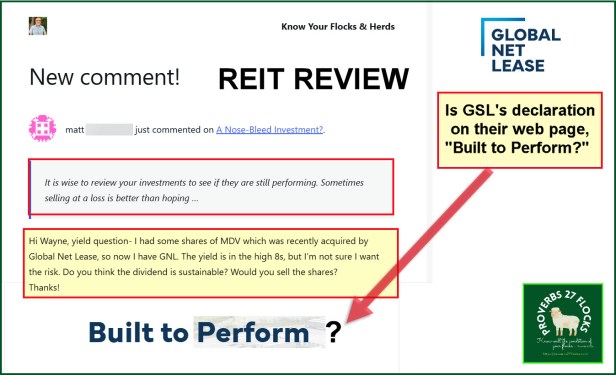
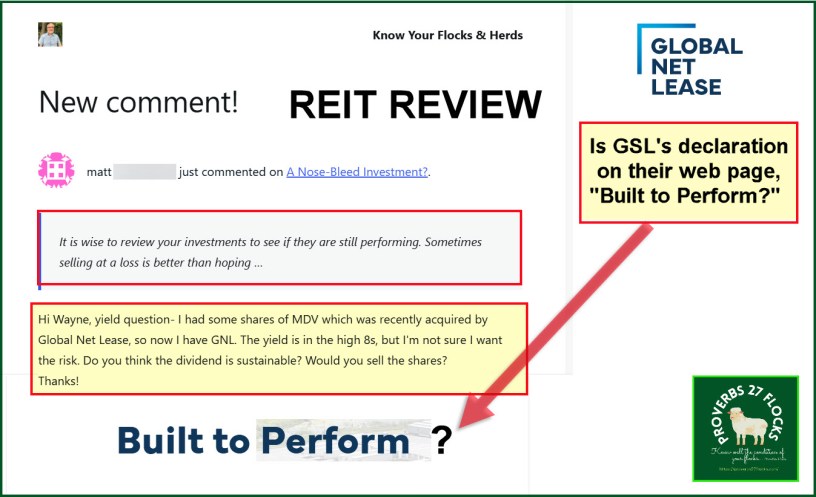
The thing I love about questions is that they provide opportunities for education. If you want to learn about investing and how to invest without paying high prices for advice, you can ask questions. This question is a good example because it is practical. The reader wrote this question on a recent blog post: “Hi Wayne, yield question- I had some shares of MDV which was recently acquired by Global Net Lease, so now I have GNL. The yield is in the high 8s, but I’m not sure I want the risk. Do you think the dividend is sustainable? Would you sell the shares?”
GNL is “Global Net Lease, Inc.” It is a REIT investment. I like REITs. But would I buy shares of GNL?
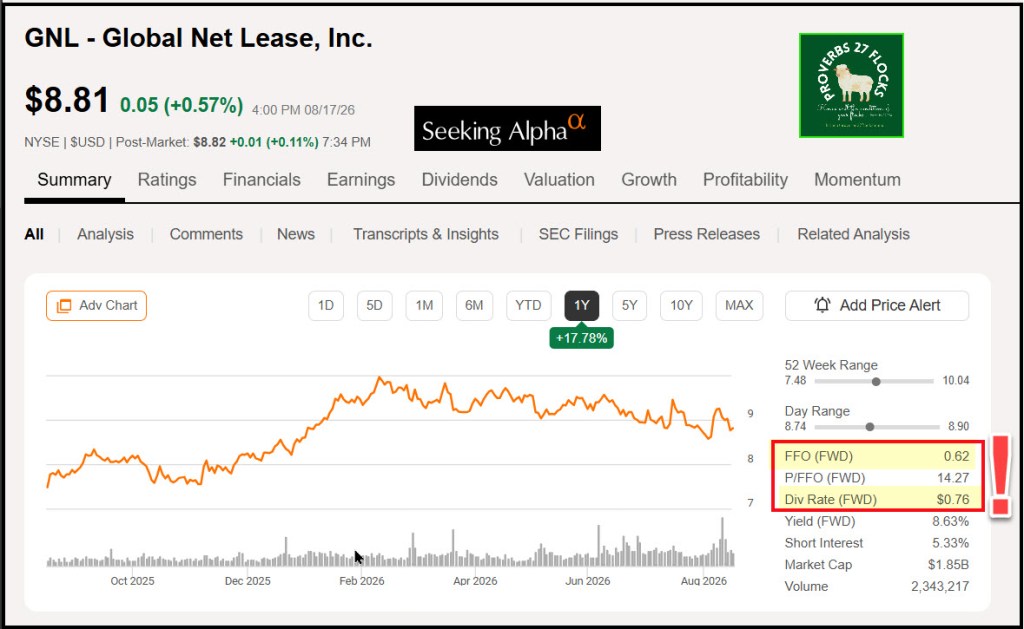
Step One: What is the FFO?
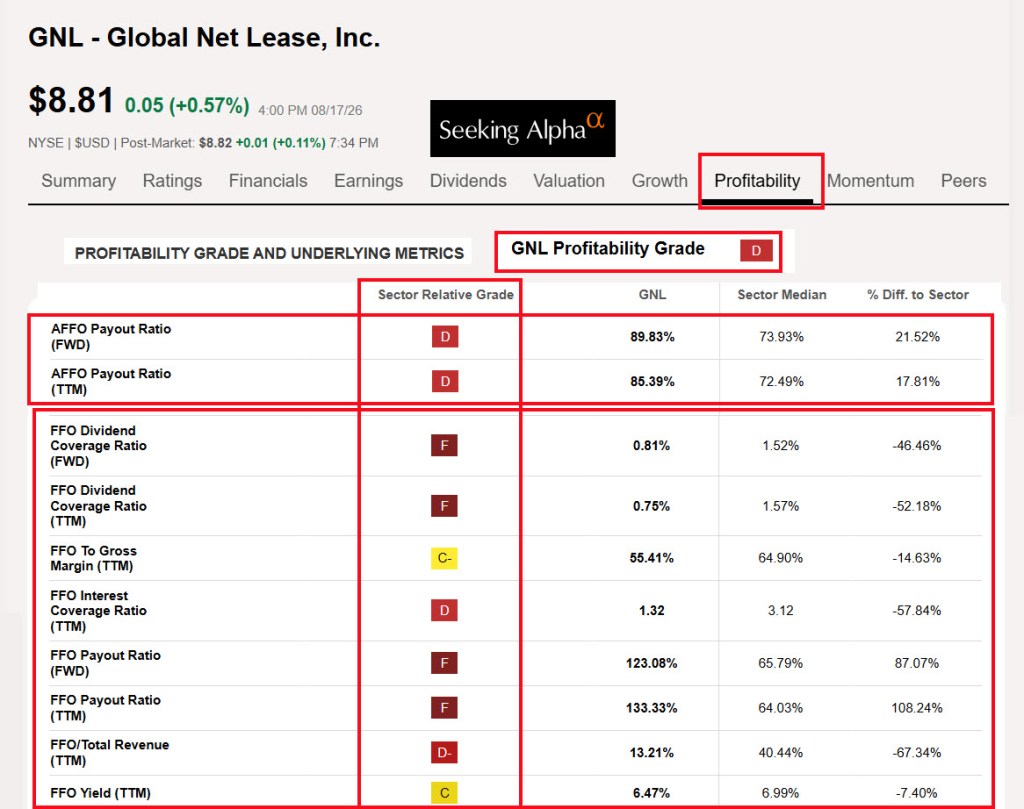
The first thing I looked at was the FFO. FFO is “Funds from Operations.” You need funds to pay a dividend, and the dollar amount should cover the dividend. For GNL the answer is not pretty. Here is an image that shows the reality from a Seeking Alpha perspective.
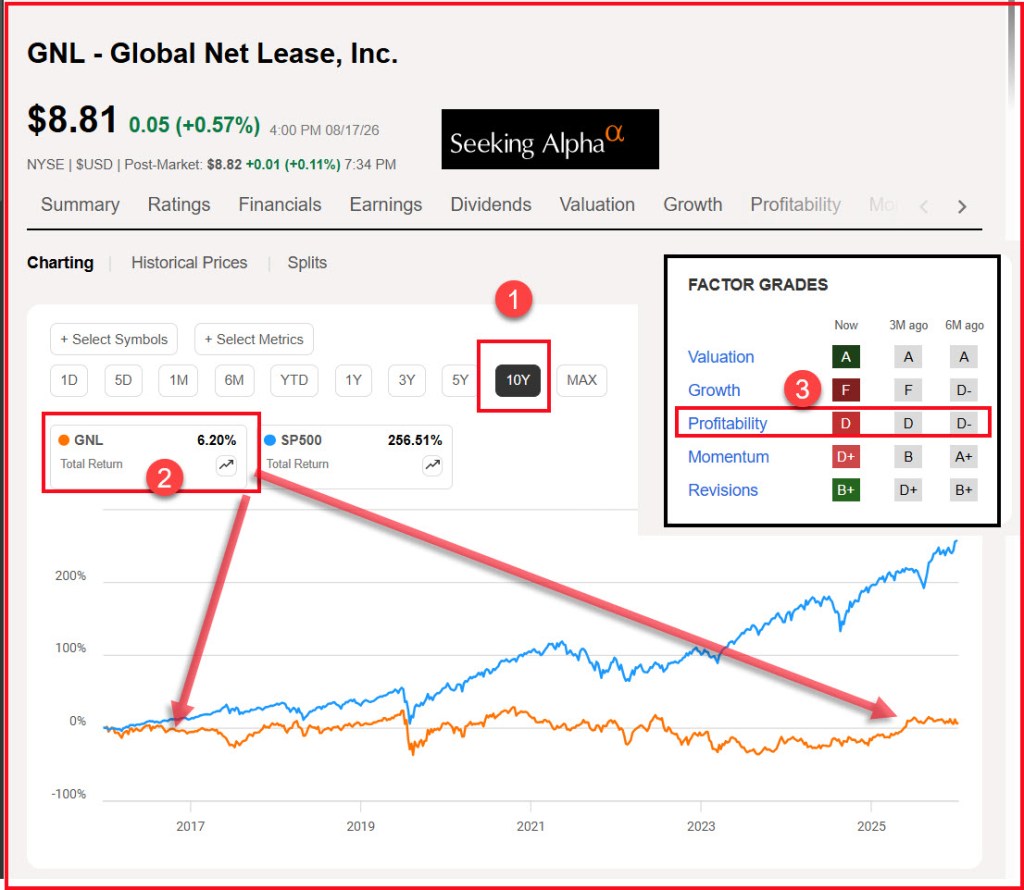
Total Ten-Year Returns Matter
Has management delivered total returns? While the future might be different, I am skeptical. The total ten-year returns (price improvement plus dividends) is nothing short of awful.
Dividend Payout Ratio Matters
While it is true that the payout ratio for a REIT should be viewed differently from other types of investments, the payout ratio matters. GNL: Payout Ratio 123.08%. Anything above 100% is crazy. To put this in perspective, there is a REIT I like: STAG. STAG’s dividend payout ratio is 58.73%. Another REIT I own is ADC: 70.51%. Yet another is GTY with a payout ratio of 76.58%. One more: FCPT: 84.37%.
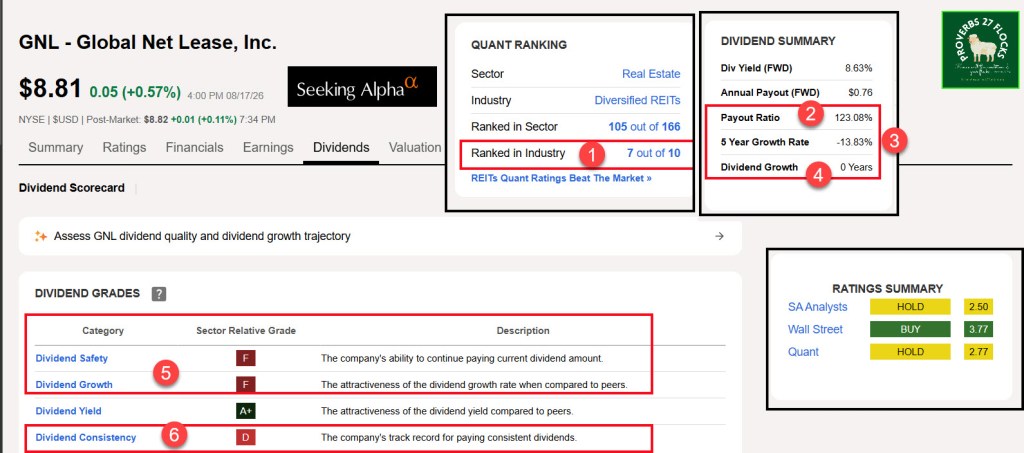
The payout ratio matters, so ignore it to your peril. Our investments in STAG, ADC, and GTY are greater than our current investment in FCPT, but that could change over time.
Dividend Growth Rate
I’m not as concerned about dividend grow rates for REITs. A steady dividend or one that is increasing slowly is just fine. Remember, we are looking at Real Estate, so it makes sense that the dividend might not grow quickly. Having said that, negative values are not good. For GNL the picture is not good: 5-Year Growth Rate -13.83%.
Seeking Alpha’s Dividend Scorecard
The easy way to judge the quality of a dividend for any company is the Seeking Alpha Dividend Scorecard. Here is a link (for subscribers) to the GNL Dividend Scorecard. However, if you don’t have a subscription: here are some of the things you would see:
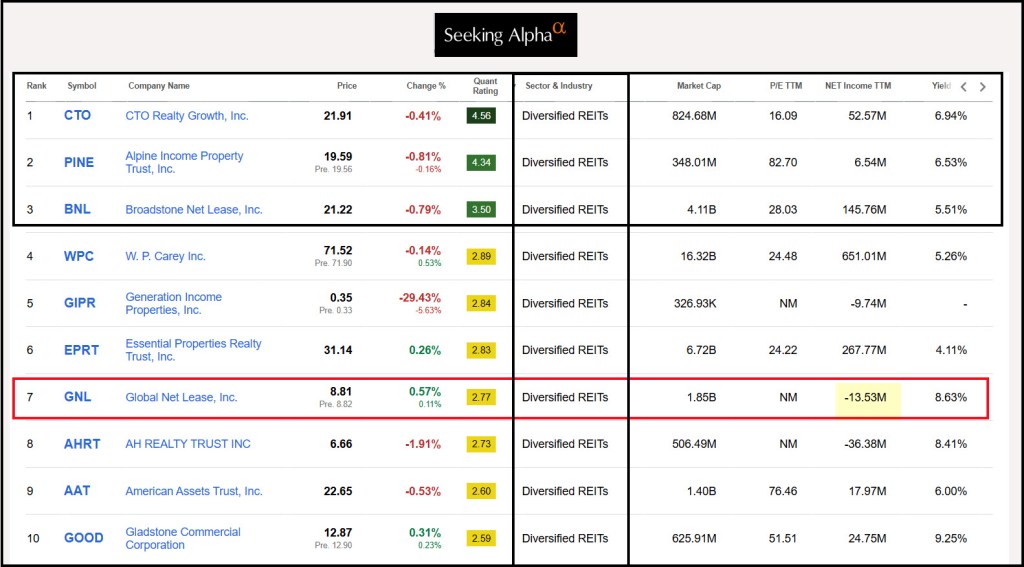
Here is another view of how GNL compares with other similar REITs:
Diving In the Deep End
If you want to dive deeper into this the following might prove helpful for the thoughtful investor who wants to better understand REIT investments.
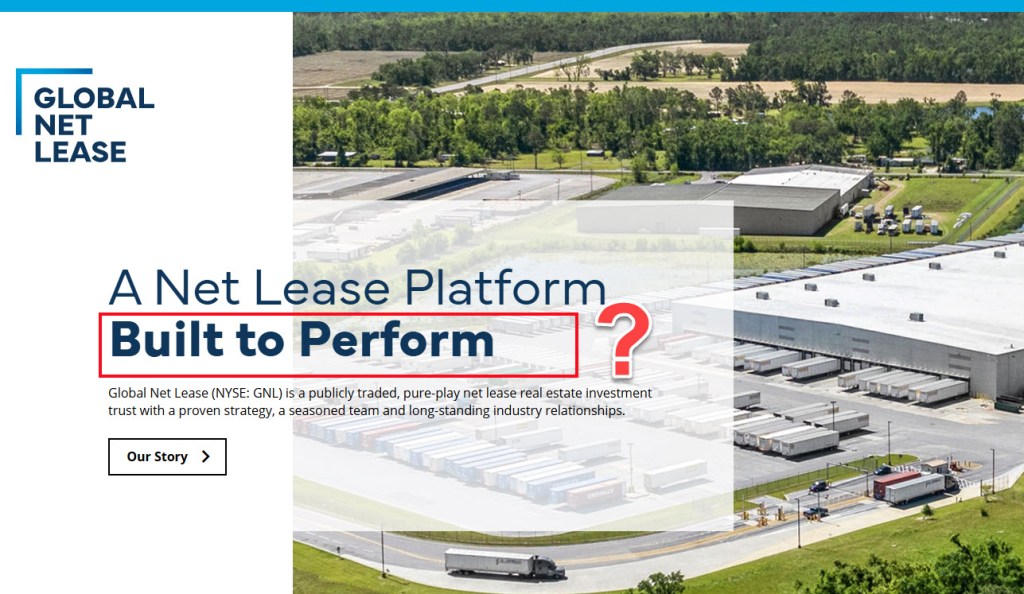
Company Profile This is an international investment. Global Net Lease, Inc. (NYSE: GNL) is a publicly traded real estate investment trust that focuses on acquiring and managing a global portfolio of income producing net lease assets across the United States, and Western and Northern Europe.
What Are the REIT Risks?
For a REIT like GNL, “FFO risk” usually isn’t just about property values—it’s about whether the things that drive Funds From Operations (net rental income and interest/financing impacts, plus stability of leases/occupancy and portfolio gains/losses) can swing against them quarter to quarter and year over year. Here are some of the risks to think about for any REIT:
Tenant credit / lease performance risk – If tenants underperform, negotiate rent reductions, become delinquent, or need concessions, GNL’s net rental income can drop—directly pressuring FFO.
Occupancy / leasing-up risk – If leases roll over into weaker demand or renewal terms are less favorable, occupancy and effective rent can decline, reducing future FFO visibility.
Rent reset (renewal) risk – Even when properties remain leased, renewals can reset to lower market rents. For net lease REITs, that’s often the key “slow bleed” risk to FFO.
Property-level expense and capital need (FFO “margin” risk) – Some costs may not be fully recoverable under leases, or capex/maintenance needs can rise (repairs, re-tenanting, leasing costs). Higher-than-expected recurring costs reduce the amount of cash/income that flows through to FFO.
Interest rate / refinancing risk – If GNL has to refinance debt at higher rates (or extend maturities on worse terms), net interest expense rises and can pressure earnings metrics that investors track alongside FFO.
Concentration and asset-type risk – GNL’s portfolio mix (e.g., office vs. industrial/retail) matters: downturns can hit some sectors harder, which affects lease demand, rent growth, and impairment likelihood. Even with “diversification,” concentration in particular markets/tenant industries can still cause FFO volatility.
Asset disposition / “capital recycling” risk – REITs often try to sell non-core assets and redeploy into better-yielding deals. If asset sales slow (or sale prices soften), FFO and growth plans can get delayed; sometimes the transaction timing affects earnings patterns.
External shocks affecting tenants and collections – Broad economic weakness, regional recessions, or disruption in retail/office demand can lead to higher vacancy, rent concessions, and/or slower collections—hurting FFO.
FFO or AFFO?
What is the difference between FFO and AFFO when it comes to dividend coverage? I usually look at FFO. For dividend coverage, the practical difference is this:
- FFO (Funds From Operations): REIT earnings metric that largely reflects the income from operations but doesn’t fully adjust for ongoing cash costs like maintenance/recurring capital expenditures.
- AFFO (Adjusted FFO): typically starts with FFO and adjusts out items that are more cash-like, especially recurring capex, straight-line rent adjustments, and other “normalizing” items—so it often tracks cash available to pay the dividend more closely.
When you do the calculations, FFO is “safer” than AFFO. AFFO is the more conservative value. Therefore, if the FFO is unacceptable, the AFFO is worse. That isn’t a good sign.
I believe GNL will continue to underperform. While the yield is attractive, it doesn’t seem to be sustainable. Because the ten-year returns are poor, one can only assume that management is not doing a very good job in providing a sustainable dividend.
Seeking Alpha Subscription Information
Of all of the resources I use, the most helpful is Seeking Alpha. The QUANT rating is very valuable. If you decide to explore a Seeking Alpha subscription, please use the following link. Seeking Alpha

SEEKING ALPHA INFORMATION AND SUBSCRIPTION
You can also scan this QR Code to get the same information.

Past performance does not guarantee future results, Seeking Alpha does not provide personalized advice, and it is not a registered investment adviser.
We accept advertising compensation from companies that appear on our site. This website represents my opinions, which may not reflect those of Seeking Alpha, and does not constitute an investment recommendation or advice.


Thanks Wayne, that was extremely helpful!
LikeLiked by 1 person
Another great article Wayne. I currently have a position in RHP.
LikeLiked by 1 person