
When Your Heart (and Brain) Stops
If your heart stopped beating tomorrow or the information stored in your brain was erased, would you leave behind confusion, mysteries, problems, and unanswered questions? There probably is no way to cover all of the bases, but you don’t have to make life harder than it has to be and will be for your loved ones.
A useful way to think about this is to prepare an “If Something Happens to Me” file. The questions you family will ask include “where” (documents, keys, accounts), “what” (assets, liabilities, online accounts, subscriptions, insurance policies), and “who” (lawyer, personal representatives, financial advisor). Your family should be able to find information quickly and understand what you own, what you owe, what you have arranged, and who needs to be contacted.
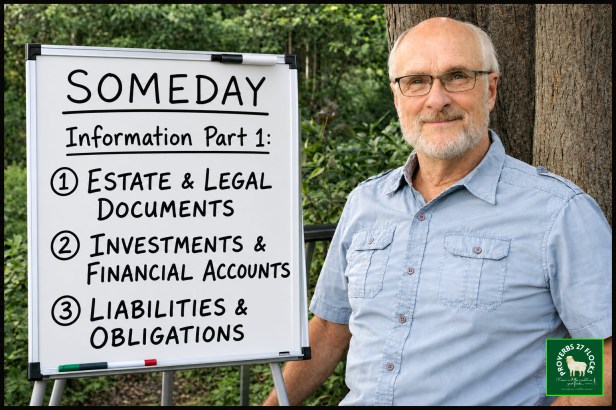
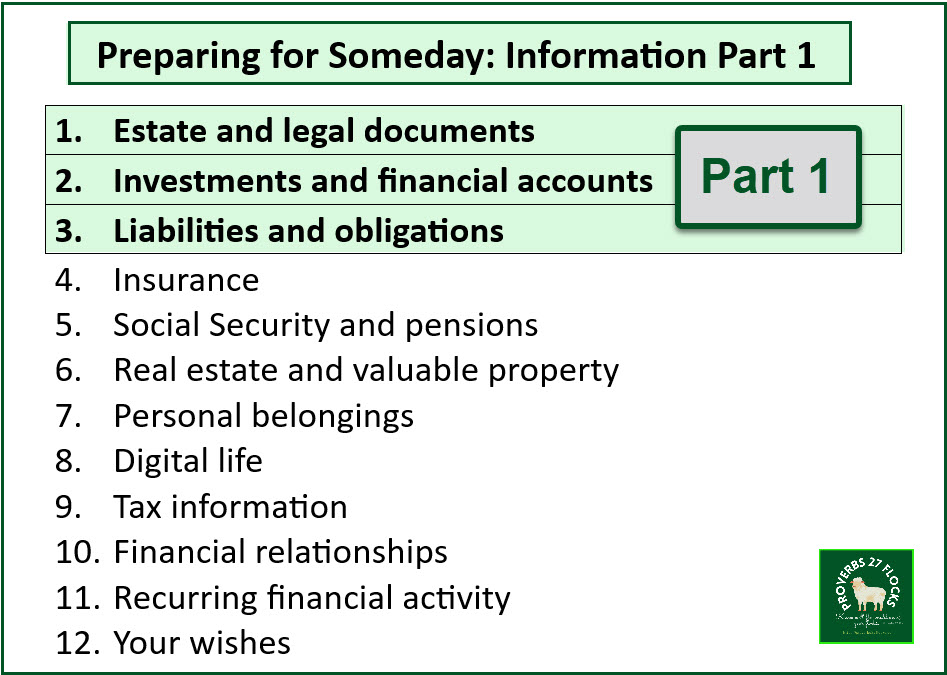
There are at least twelve things you should share. I know this will seem overwhelming. It will be an ongoing project with perhaps a monthly “to do” task. I will cover these in more than one post. The items in this post include estate and legal documents, investments and financial account information, and liabilities and obligations. In a future post I will cover insurance, Social Security and valuable property. After that we should think about personal belongings, our digital lives, tax information, financial relationships, recurring financial activity and your “wishes.”
The most important principle: Don’t make your family hunt for the information.
A good master document might be organized around these questions:
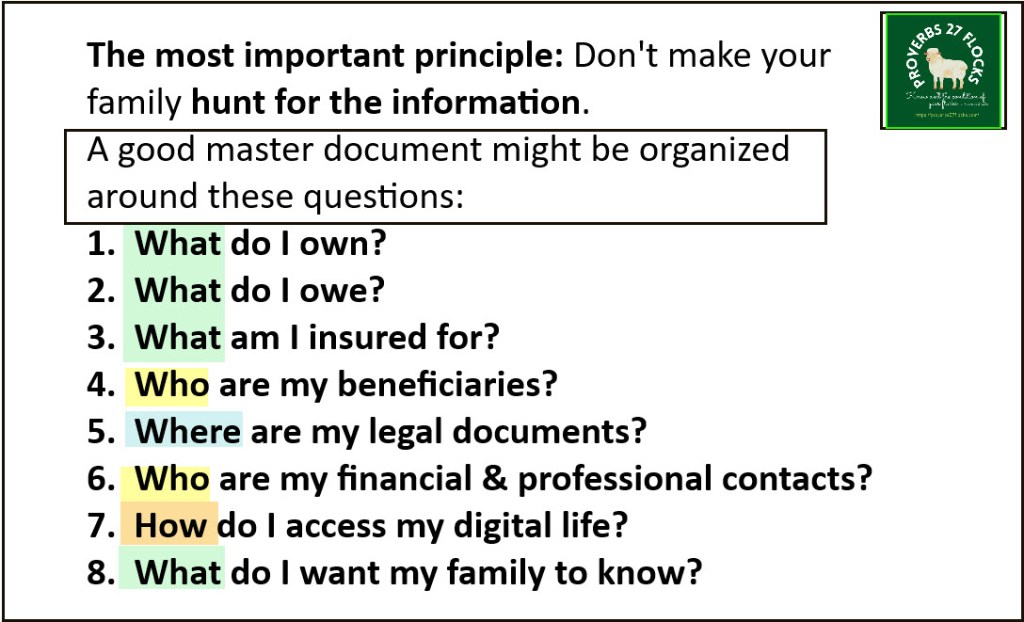
- What do I own?
- What do I owe?
- What am I insured for?
- Who are my beneficiaries?
- Where are my legal documents?
- Who are my financial & professional contacts?
- How do I access my digital life?
- What do I want my family to know?
Estate and legal documents
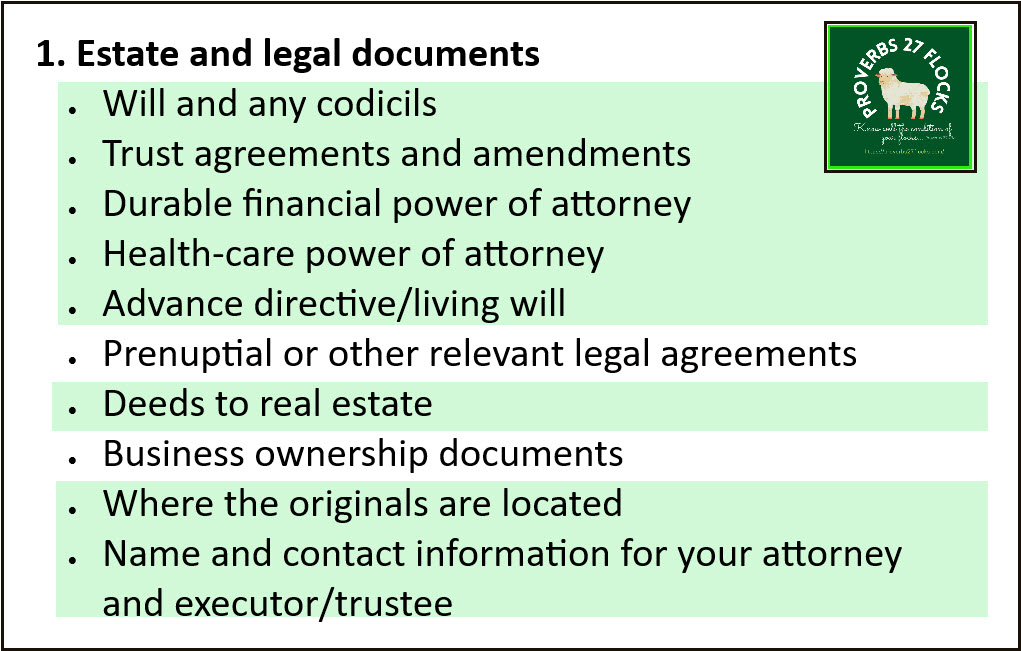
- Will and any codicils; Trust agreements and amendments
- Durable financial power of attorney; Health-care power of attorney
- Advance directive/living will
- Deeds to real estate
- Where the originals are located
- Name and contact information for your attorney and executor/trustee
- Prenuptial or other relevant legal agreements
- Business ownership documents
Investments and financial accounts
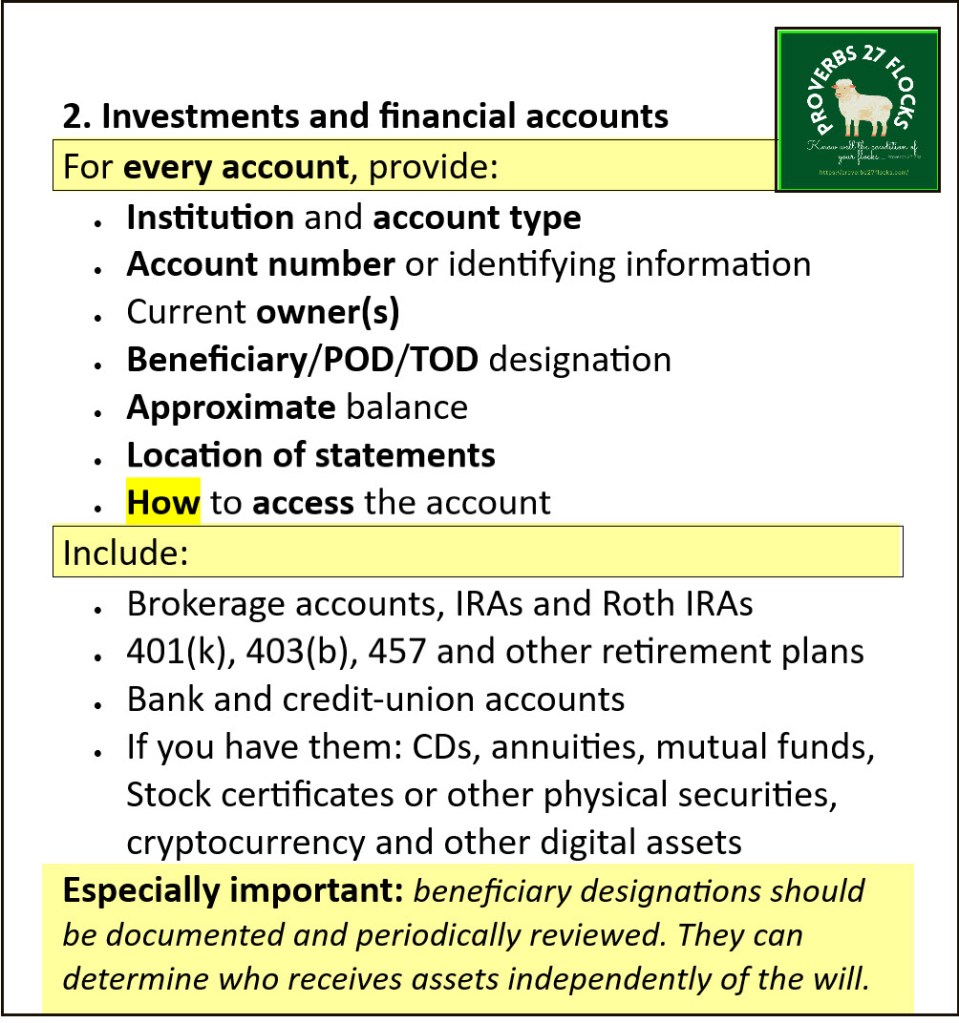
For every account, provide:
- Institution and account type
- Account number or identifying information
- Current owner(s)
- Beneficiary/POD/TOD designation
- Approximate balance
- Location of statements
- How to access the account
POD stands for “payable on death” accounts, typically used for bank accounts, while TOD stands for “transfer on death” accounts, commonly used for investment assets like stocks and bonds. Both types of accounts allow assets to pass directly to named beneficiaries without going through probate.
Especially important: beneficiary designations should be documented and periodically reviewed. They can determine who receives assets independently of the will.
Liabilities and obligations
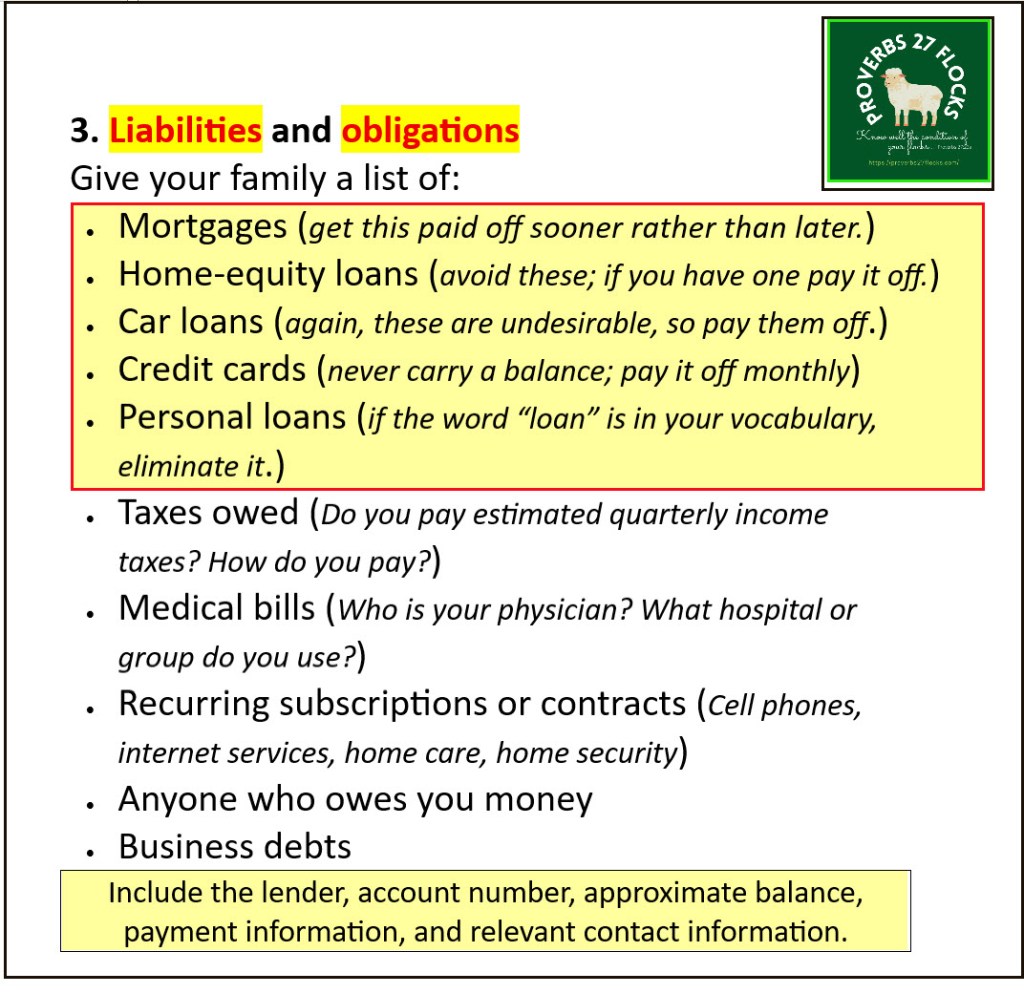
A word of advice: do as much as you can to eliminate this category from your life. If you enter retirement with debt you are creating more problems for yourself and for your family. If you do have debt, include the lender, account number, approximate balance, payment information, and relevant contact information. The only three in this list that matter to Cindie are the credit cards, taxes owed and recurring subscriptions. I keep her in the loop for all of these.
You should give your family (spouse, trusted child, personal representative) a list of:
- Mortgages (get this paid off sooner rather than later.)
- Home-equity loans (avoid these; if you have one pay it off.)
- Car loans (again, these are undesirable, so pay them off.)
- Credit cards (never carry a balance; pay it off monthly)
- Personal loans (if the word “loan” is in your vocabulary, eliminate it.)
- Taxes owed (Do you pay estimated quarterly income taxes? How do you pay?)
- Medical bills (Who is your physician? What hospital or group do you use?)
- Recurring subscriptions or contracts (Cell phones, internet services, home care, home security)
- Anyone who owes you money
- Business debts
Yes, I know this is likely to frighten you today. Imagine what your family will face if you decide to ignore this important task. You say you “love” them, so try to prepare them with information.
Action Items
- Start a file that is both electronic and paper to keep important information.
- Determine who needs to know the pieces of the puzzle.
- Start sharing information now and be open to answering questions.

