
My Role: Education and Encouragement
It is dangerous and probably ill-advised for you to assume that I am an “expert” or a registered investment advisor. I am not and I don’t want to be “registered.” I don’t want to earn income from helping others. My role is education when it comes to theology, life, and investing. Therefore, what I share when I write is designed to be educational not advisory.
One of the things I offer is transparency. I don’t know many advisors, and I have seen very few be transparent about their actual results. My goal is to talk about the successes, the failures, and the best way to generate “Easy Income” for the non-working years of a person’s life.
There are many ways to invest and to earn passive income. Passive income is a type of unearned income that is acquired with little to no labor to earn or maintain. The most passive income I receive is from dividends. Options income isn’t passive, as it requires action. However, the action can be as frequent or infrequent as I desire.
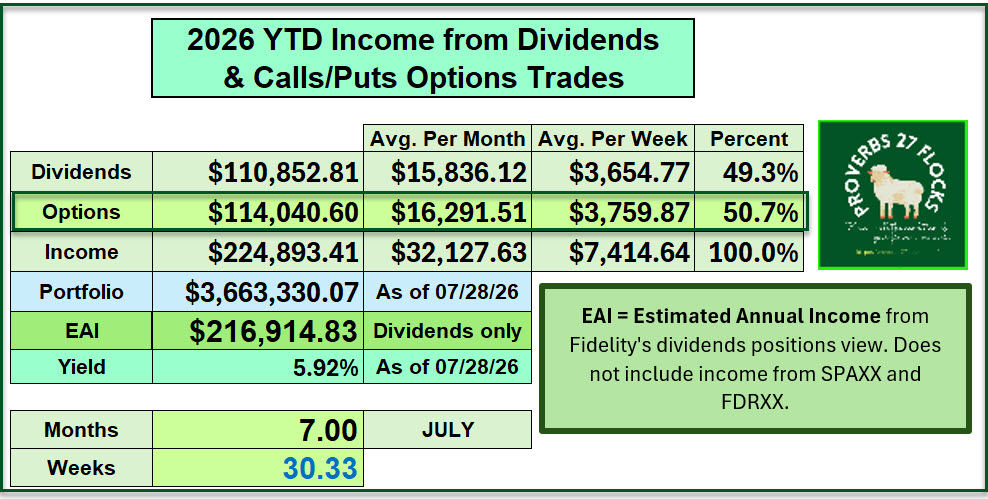
YTD Results: Passive and Active
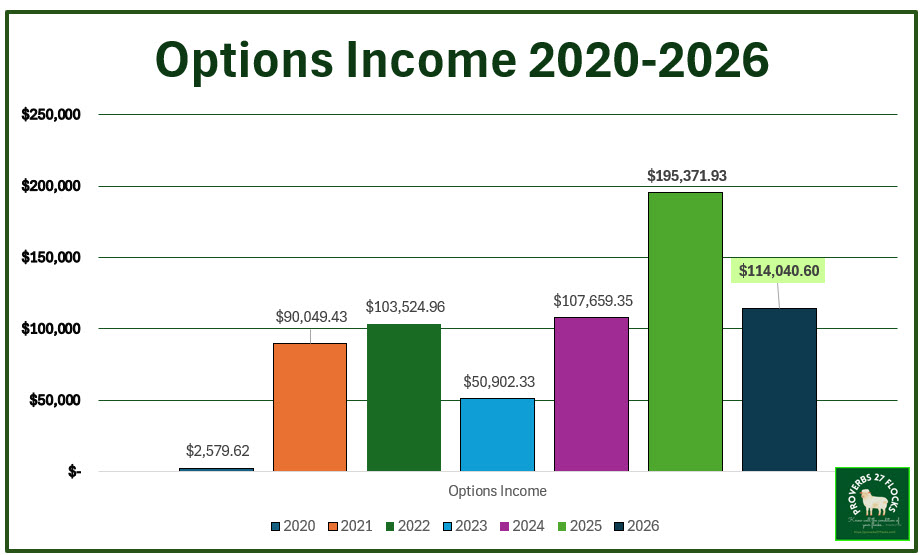
Here are the YTD results of my investment activity and inactivity. While income is good, I try not to sacrifice growth while gaining income. I don’t want to sell any of my long-term holdings unless they fall into one of my “sell” rules.
Does Everyone Need a Registered Advisor?
I don’t and I don’t believe 90% of the people I help benefit from paying an expert. I believe most of my readers don’t need to be experts in finance or in investing. Rather, they need tools, ideas, concepts and encouragement. You can certainly pay an expert to provide advice or to manage your investments if that adds to your peace of mind. The expert is expected to be registered and have completed the Series 65 exam.
If you want to pay your registered advisor, that is certainly your decision. Some probably need that kind of help. The critical factors are twofold: Are you getting what you are paying for (do you even know what that is?) and “How much are you paying and is that amount increasing as your assets increase?” If you are paying more based on assets being managed, then I question the wisdom of your choice.
Helping a Friend
One of the people I have helped since April 2025 asked for my guidance. As a result, this friend and I went to the local Fidelity Investments office where she began the process of moving her investments from her existing “full service” high-cost broker to Fidelity. She had been paying almost $4K per year for the former broker’s “help.” I wasn’t impressed with her portfolio of investments. Furthermore, she was also paying too much for her mutual funds: another $1.5K for higher cost funds. Some of them were 1.06%, 1.17%, 0.99% and 0.90%. That is totally unnecessary when similar ETF funds are far less costly.
The following images are the results of the changes I have made. Her costs have been essentially reduced to zero dollars with very low expense ratios for her ETF investments and a better array of CD’s for fixed income. This is a very conservative approach. Her one-year return is 12.33%, simply because I reduced her bond exposure while still providing income from short-term CDs. While this is less than the S&P 500 returns of 17.43% during the same time period, using the Rule of 72 her returns are such that her portfolio should continue to grow faster with Fidelity than with her former broker.
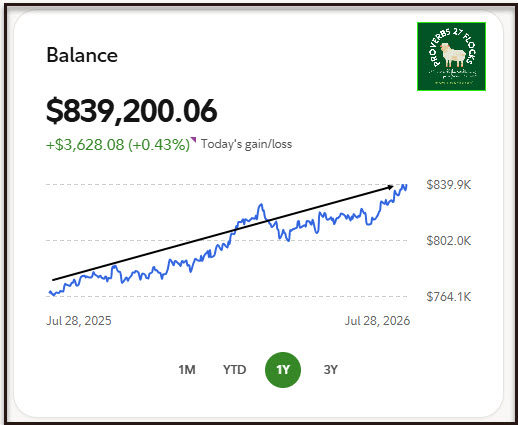
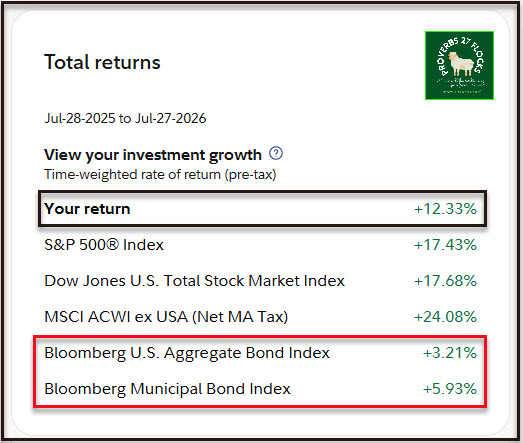
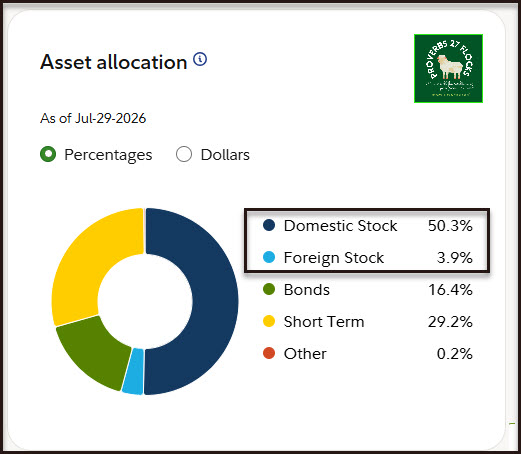
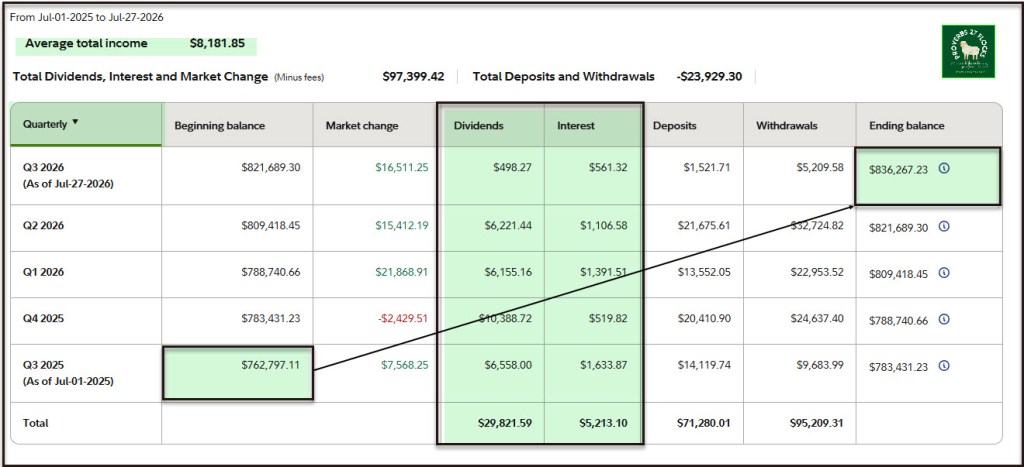
Her former broker had something I don’t have. He was registered. That means he met the legal requirements to handle her accounts. That is also Fidelity’s role. They can answer her questions and if she desired, they could also manage her accounts for her. At this point I have encouraged her to avoid paying Fidelity their fees to do what doesn’t need to be done.
I have never taken the Series 65 exam to register as an advisor. I don’t need to do this, as my function is to share ideas, concepts and provide training. Some people follow my suggestions, and some don’t. Each person must decide for themselves what help they need and how much they are willing to do on their own and how much they want to pay someone else to do the work for them.
The Series 65 Exam
The Series 65 exam (Uniform Investment Adviser Law Examination) is designed to qualify candidates as investment adviser representatives (IARs). It tests four main topic areas:
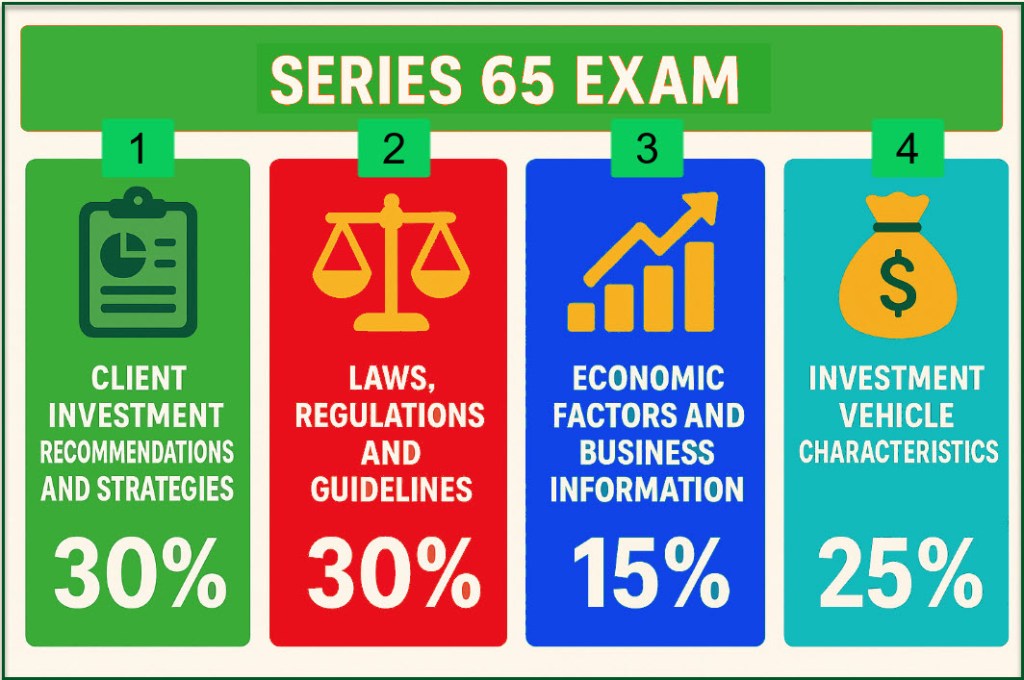
Investment vehicle characteristics (roughly 25–32%) Common investments and how they work (e.g., equities, fixed income, pooled investments, derivatives, and insurance/other products.) I have no interest in offering insurance-related advice.
Client investment recommendations & strategies (roughly 30–39%): Suitability/client objectives, portfolio strategy, client profiling, and related portfolio management concepts. I believe I can do this but I define my strategy in the things I write. So, for example, I believe the best strategy is a dividend growth strategy where dividends are invested in a focused manner.
Economic factors & business information (roughly 15–20%): Basic economic concepts, financial/analytical concepts, risk, and time value of money–type knowledge
Laws & regulations (including ethics/unethical business practices) (roughly 30–39%): State and federal investment adviser rules, IAR regulation, broker-dealer/agent-related concepts, and ethical/fiduciary obligations
The exam is 130 scored questions plus 10 unscored (pretest) questions, and the test is administered by FINRA using NASAA’s content outline.
As you read my posts, never assume that “Wayne bought this, so I should too.” Never assume that I will always have success with every investment I make.
I want to be cautious about this and careful to set expectations. My role is primarily educational. The more I personalize, recommend, or manage decisions, the more I look like an adviser and less like an educator. I don’t want to do anything that compromises my integrity or testimony for Jesus. I also don’t want to violate any US regulations. So my motives are purely educational. I am not trying to make any income from the work I might do for any of my readers. Sometimes I receive gifts for the education I provide, but that is only at the discretion of the person I teach.
Seeking Alpha Subscription Information
Of all of the resources I use, the most helpful is Seeking Alpha. The Seeking Alpha QUANT rating is a huge factor in my investment success. If you decide to explore a Seeking Alpha subscription, please use the following link. Seeking Alpha
SEEKING ALPHA INFORMATION AND SUBSCRIPTION

You can also scan this QR Code to get the same information.

Past performance does not guarantee future results, Seeking Alpha does not provide personalized advice, and it is not a registered investment adviser.
We accept advertising compensation from companies that appear on our site. This website represents my opinions, which may not reflect those of Seeking Alpha, and does not constitute an investment recommendation or advice.
If you have any questions or problems getting connected to Seeking Alpha, reach out to them with this email address: subscriptions@seekingalpha.com


Wayne, I have been reading your blog for several years now and really appreciate your honesty and transparency. You have helped me look at investing differently and motivated/educated me to develop a dividend portfolio. I look forward to each new post that comes out and I am considering learning how to do covered calls. You do a good job explaining the details with Fidelity that it makes me want to open an account with them to start with just the options. I have been with Schwab for years and have heard good things about Think or Swim and they do offer a fair amount of tutorial material on their website. Glad to hear your wife’s surgery went well. That’s the most important thing. Thank you, Scot Hansen.
LikeLiked by 1 person
Always good to hear from a reader. Thanks for the encouragement. I always tell people there are only three brokers I would use: Fidelity, Schwab or Vanguard. I prefer them in that order, but any of those three are rock solid. I’ve not used Think or Swim, but I did play with Interactive Brokers when I started experimenting with day trading. That didn’t last. It was too much effort for insignificant returns. I’d be interested to hear what you think of Think or Swim if you try that out.
LikeLike
100% concur with Scot. Your insights have been extremely helpful and I appreciate you doing this- it’s a great ministry. Ok if I ask about another stock? What do you think about Illinois Tool Works (ITW)?
Matt
LikeLiked by 1 person
I’ve owned ITW in the past but I think I would wait for the next dip.
Sector Metrics Comparative Analysis:
Valuation: ITW’s valuation appears stretched compared to its peers. The Price to Sales ratio of 5.06 is notably higher than the sector median of 1.97, indicating a premium pricing. However, the Dividend Yield is 2.28%, which is favorable compared to the sector’s 1.37%, suggesting potential income generation.
Growth: ITW’s growth metrics are underwhelming, with a forward Revenue Growth of 3%, significantly below the sector’s 7%. This indicates a slowdown in expansion compared to peers.
Profitability: ITW excels in profitability, boasting a Net Income Margin of 19% compared to the sector median of 7%. This strong profitability underscores efficient operations and robust financial health.
Momentum: ITW’s stock momentum is mixed, with a notable 6-month price performance of 10%, significantly surpassing the sector’s 2%, showcasing investor confidence in the short term.
Revisions: Earnings revisions are positive, with 11 upward EPS revisions and only 1 downward in the last three months, indicating analyst optimism about ITW’s future earnings potential.
Overall, ITW’s strong profitability and positive earnings revisions are counterbalanced by its stretched valuation and sluggish growth metrics, leading to a Hold rating.
LikeLike