
Do You Have an Investment Philosophy?
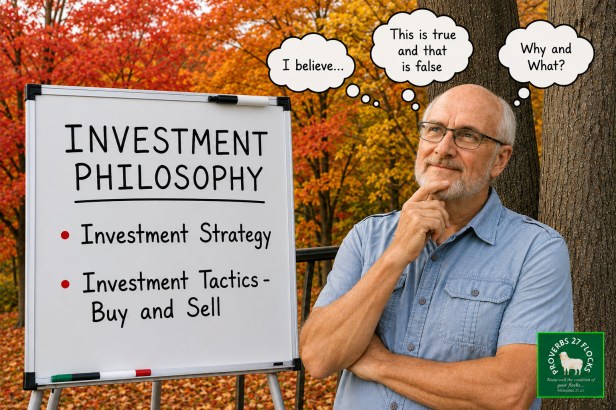
Many don’t have an investment strategy other than some simplistic statement like “I don’t want to lose money” or “I want to avoid risk.” Even more don’t have an investment philosophy. They don’t check to see if their beliefs are true or reliable. The end of that path is often disappointing.
What is a philosophy? A philosophy is a set of ideas and principles about fundamental questions. These questions include what is real, what we can know, what is right or wrong, and how life should be lived. This can be applicable to a field of study, a personal outlook, or a school of thought.
What is an investment philosophy and how does that differ from an investment strategy? An investment philosophy is the set of beliefs and principles that guide how you think investing works and what matters most. An investment philosophy asks the questions about what you believe: “Should I prioritize long-term growth, income, or capital preservation?” “Do I favor diversification, low costs, value investing or some other view of the overall market and market forces?”
An investment strategy is the specific plan you use to put that philosophy into practice. It answers questions like: “What assets will I buy?” “How will I choose individual investments?” “When and why will I buy or sell?” “How and when will I allocate and rebalance your portfolio?
Here is an example: The philosophy (belief) could be that “over long periods, diversified low-cost investments are the most reliable way to build wealth.” Therefore, the strategy would be something like: “Invest 70% in a broad stock-market index fund and 30% in a bond fund, then rebalance annually.”
In short, philosophy is the “why” and “what you believe”; strategy is the “how” you act on your beliefs. A philosophy tends to remain relatively stable, while a strategy may change as your goals, circumstances, or market conditions change. If your philosophy changes it is certain you will want to adjust your strategy.
Where Does Strategy Originate?
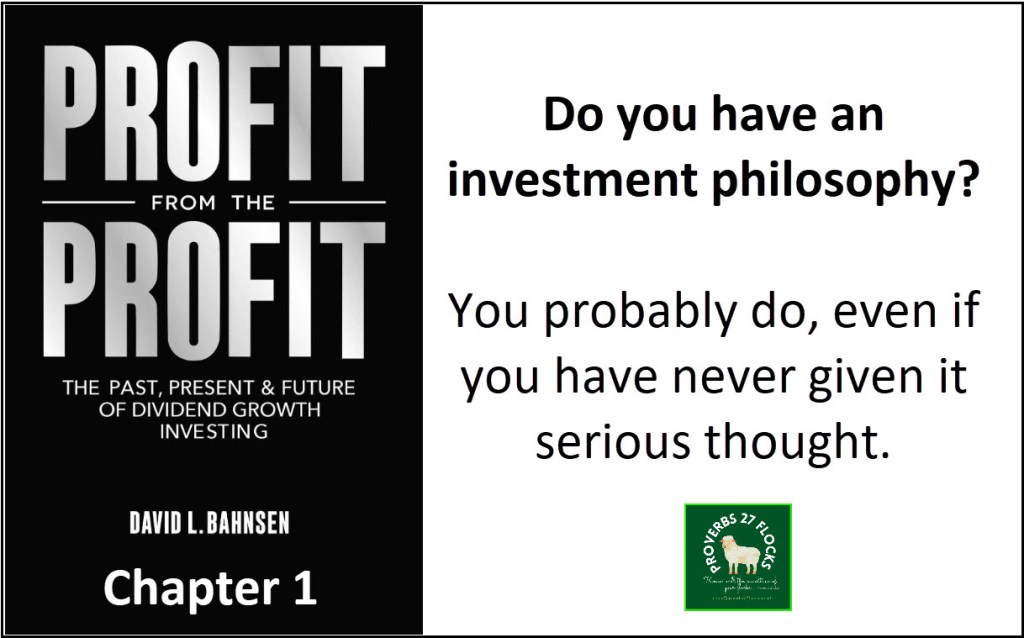
David L. Bahnsen suggests the following in the first chapter of his book, “Profit From The Profit.” “I would imagine that most people’s investment strategies have been formed either by the negative of something going very wrong, or the positive experience of something going very right.” He rightly observes, I think that “strategy is far too often based on experience rather than something more intellectually defensible.”
Before we move into the balance of the chapter, I think a section in the Introduction of the book is worth mentioning. I am a dividend growth investor, and I have said that many times in many posts. Most don’t know what that is nor do they know why it works. Growth is only useful when you sell the investment. By itself, a growth stock (without any dividends) is just an asset. It doesn’t let you buy something until you sell it. Your stock could shoot to the moon, and you would call it a success. However, if it drops as quickly, your supposed profits are gone. Bahnsen says he remains committed to the belief that dividend growth is a superior strategy. Notice the word strategy. It is not a philosophy.
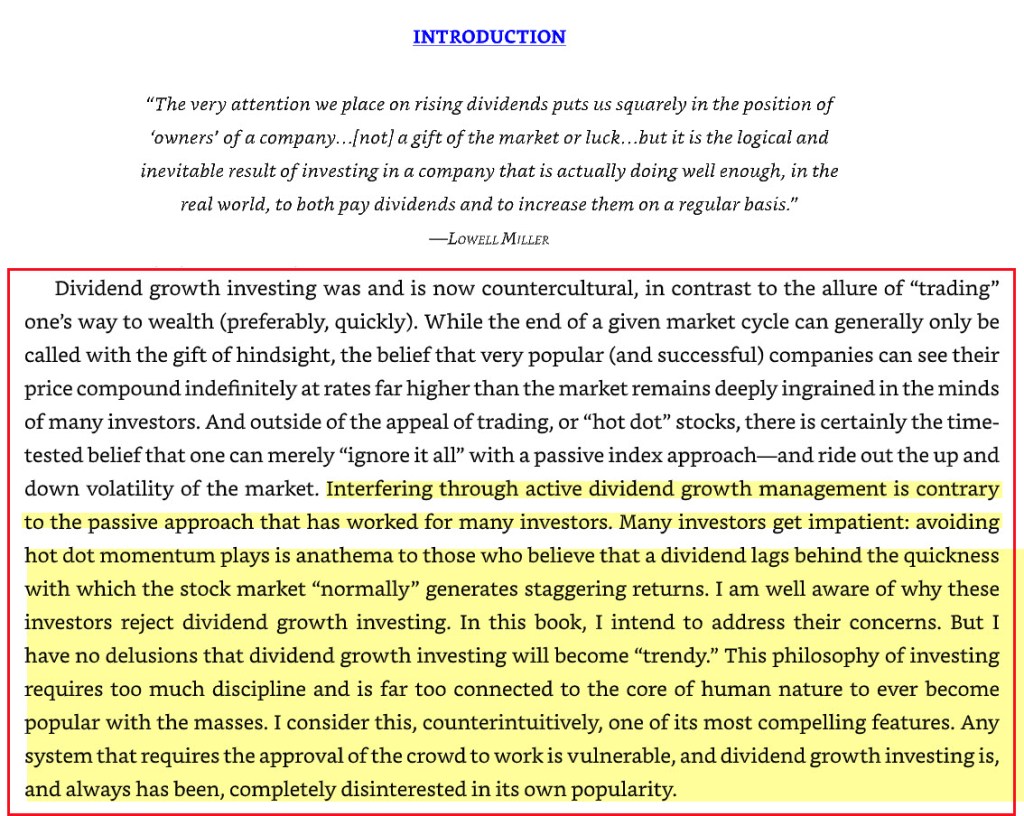
CHAPTER ONE: An Investment Philosophy
I believe there are some nuggets in the first chapter worthy of consideration. Bahnsen says everyone has an investment philosophy. They may lack awareness of their philosophy but they have beliefs that form the basis for their investment decisions.
He then says something worthy of a slow read: “The question is not whether there is a philosophy at play; rather, the question is how thoughtful, coherent, and defensible that philosophy my be.” Having a good philosophy doesn’t negate the need to execute wisely and make decisions based on the beliefs we hold. The “bottom line” he says, is “if someone invests capital without knowing what he believes, he is unlikely to be good at investing capital.”
Perhaps the best way to understand “strategy” and “philosophy” is the illustration Bahnsen gives. “Buy and Hold” is a strategy. The philosophy is the belief structure that informs that strategy. The beliefs would include things like 1) Companies can and do have earnings growth. What has happened in the past is likely to continue for many companies. 2) The goal is compounding (remember the Rule of 72) so you don’t have to guess today’s winners and losers. 3) Humans are bad at guessing the future and market timing has proven to be the undoing of many “investors.” 4) If you have a diversified portfolio, you don’t have to be concerned about every company. One companies results don’t determine the result of the overall market.
A Philosophy of Economics
Bahnsen then wisely, in my view, shows where he has a foundation for his philosophy. It is biblical in nature. It has to do with God and images of God. The Bible clearly states in the very first book of the Old Testament that we are made in the image of God. He then rightly believes that “humans act out of their own God-given instincts, reason, and rational facilities,…and markets emerge from these traits.” That is a huge factor.
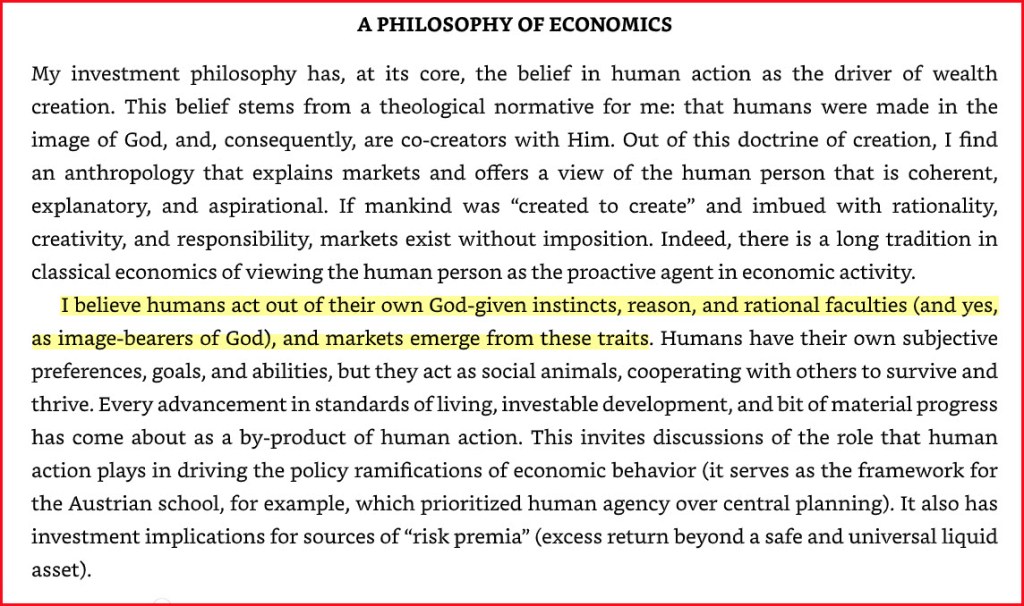
The questions we must ask are both “why” and “what” questions. His questions, therefore include the following (quoted from the book):
- Why do you own what you own?
- Why do you believe what you own makes up a cohesive investment strategy?
- What do you know of human experience and knowledge that validates this strategy?
- What do you know of human experience and knowledge that might contradict it?
Beliefs Drive Behaviors
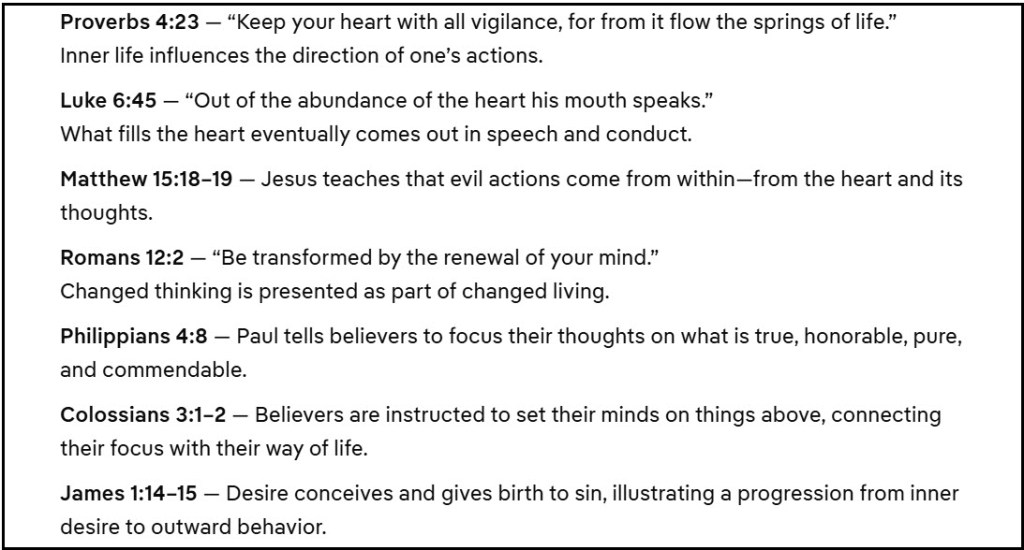
The scriptures (and real-life experiences) show that your philosophy, your beliefs, your thinking results in actions. Here are some examples:
Proverbs 4:23 “Keep your heart with all vigilance, for from it flow the springs of life.”
Luke 6:45 “Out of the abundance of the heart his mouth speaks.”
Matthew 15:18–19 Jesus teaches that evil actions come from within—from the heart and its thoughts.
Romans 12:2 “Be transformed by the renewal of your mind.”
Colossians 3:1–2 Believers are instructed to set their minds on things above, connecting their focus with their way of life.
James 1:14–15 Desire conceives and gives birth to sin, illustrating a progression from inner desire to outward behavior.
Sadly, I have helped many who had a belief structure that was inaccurate and oftentimes foolish. They base decisions on beliefs that are irrational and counterproductive.
If nothing else, Mr. Bahnsen’s first chapter is a call to examine what you believe. Then a wise person evaluates if their belief is correct based on more than just past experience, the advice of others, or a gut-feeling. Only then can you construct a strategy that will result in the rewards you expect when you invest your hard-earned dollars.
Action Steps for Consideration
- Write a set of beliefs that currently drive your investment strategy.
- Examine the beliefs. Where are the gaps? What isn’t considered that you want to ignore? Consider factors like diversification, market behaviors, inflation, and market volatility.
- If you have a philosophy of investing, do your investing behaviors mirror what you say you believe?
About the Author of Profit From the Profits
David L. Bahnsen is the founder, Managing Partner, and Chief Investment Officer of The Bahnsen Group, a national private wealth management firm with offices nationwide, managing over 10 billion dollars in client assets. Before launching The Bahnsen Group, he spent eight years as a Managing Director at Morgan Stanley and six years as a Vice President at UBS. He is consistently named one of the top financial advisors in America by Barron’s, Forbes, and the Financial Times. David is a founding Trustee for Pacifica Christian High School of Orange County and serves on the Board of Directors for the Acton Institute, National Review, and Hightower Advisors.
Seeking Alpha Subscription Information
Of all of the resources I use, the most helpful is Seeking Alpha Premium. The Seeking Alpha QUANT rating is a huge factor in my investment success. If you decide to explore a Seeking Alpha subscription, please use the following link. Seeking Alpha

SEEKING ALPHA INFORMATION AND Types of SUBSCRIPTIONS
There are several ways to subscribe to Seeking Alpha services. I use the “Seeking Alpha Premium” service. The other ones are 1) Alpha Picks, 2) Bundle Premium and Alpha Picks, and 3) Quant Growth and Income. The links for the promotions are on each of these four choices. I highly recommend “Seeking Alpha Premium” as a place to start.
You can also scan this QR Code to get the same information about Seeking Alpha Premium.

Past performance does not guarantee future results, Seeking Alpha does not provide personalized advice, and it is not a registered investment adviser.
We accept advertising compensation from companies that appear on our site. This website represents my opinions, which may not reflect those of Seeking Alpha, and does not constitute an investment recommendation or advice.
If you have any questions or problems getting connected to Seeking Alpha, reach out to them with this email address: subscriptions@seekingalpha.com

