

Someday Might Come

In this series I am exploring preparedness. Being unprepared for a car that breaks down when the temperature and windchill are killers is courting death by freezing. Being unprepared for the loss of your driver’s license while vacationing in Hawaii can be very stressful. (We know this from personal experience!) In general, being unprepared when you can prepare is silly. Our problem is often that we procrastinate or assume, “that won’t happen to me.” Perhaps the problem will go away if we ignore it. I have some good news and bad news for you. The good news is that you will probably retire. The bad news is that your retirement might be a struggle or very costly if you don’t prepare for those days.

How Long Will You Live?
Not everyone will retire but you have a pretty good chance you will make it that far. Do you think you might live to age 65? Using the U.S. population estimate around July 1, 2024: 340.1 million, approximately 0.215% per year, about 1 in 465 people die before reaching age 65 (on an annual-rate approximation). You are probably in the 464 group – but there are no promises. The question then becomes, are you prepared for that day?
What About the Married?
If you are married, and if you are a woman, there is a pretty good chance you will outlive your spouse. According to the US census, widows (women currently widowed) number about 10.6 million. Men, or widowers number about 4.0 million. So male or female, a large number of married people will be on their own at some point the future. This has costly implications. You might spend less as a single person, but you should also anticipate higher income taxes.
Inflation and Income Taxes
Two things can have a significant impact on your spending power: Inflation and Taxes. It pays to be informed and prepared. We will tackle inflation first because it will have a significant impact on your decisions about your investments.
Inflation
What is the average annual inflation rate including all possible sources of inflation? Using the broad consumer-price measure (CPI-U, all items, U.S. city average), the average annual inflation rate since 2000 is approximately 2.7% per year. That seems like a small number. Remember, however, that this is an AVERAGE and secondly that this compounds.
I know eggs at Aldi are currently about $1.65 or so per dozen. They were quite a bit higher in the recent past, but we can assume that the price of eggs won’t drop down to $0.99 per dozen. The price is likely to go up. That will be caused by many factors, and they all add up to inflation. If I go to Aldi today with $2.00 I can afford the eggs. But how much is $1 worth in twenty years if inflation averages 2.7% per year? One dollar would be worth about 71¢ in 20 years (in today’s purchasing-power terms), or equivalently you’d need about $1.71 in nominal dollars in 20 years to have the same purchasing power as $1 today. So my two dollars would be worth about $1.42 in 20 years. I could not buy those eggs in 2046 (of course I won’t be around then, but you might!)

Why This Matters – Your Action Today
Do you understand the mix of your investments in your retirement account(s)? Do you have an annuity without inflation protection? Do you have a high allocation of bonds and bond ETFs? Do you even know what the allocations are? It is relatively certain that these types of assets will seriously underperform over twenty years. The net result will be your spending power will be significantly less than it might have been with a different strategy.
You can use several tools to look at the total returns of an investment. I challenge you to do that with the investments in your portfolio. The tool I use is Seeking Alpha.
Taxes
The nature of your accounts can dramatically impact your income tax liability. Of course, if you have a higher income in retirement than what you need, then you might not be concerned with income taxes. I prefer to pay as little as possible so that our “spending” power is maximized. Higher adjusted gross incomes can trigger unexpected Medicare IRMAA tax increases. The change in your filing status can also have a significant impact on your spending power.
Your Married Filing Jointly Benefit Can Disappear
If your spouse died more than two years ago, you generally cannot file as qualifying surviving spouse—that status is only available for the two years following the year of death (and it’s not available in the year your spouse died). When Cindie or I die, and if we don’t remarry, Cindie or I will have to file as a SINGLE.
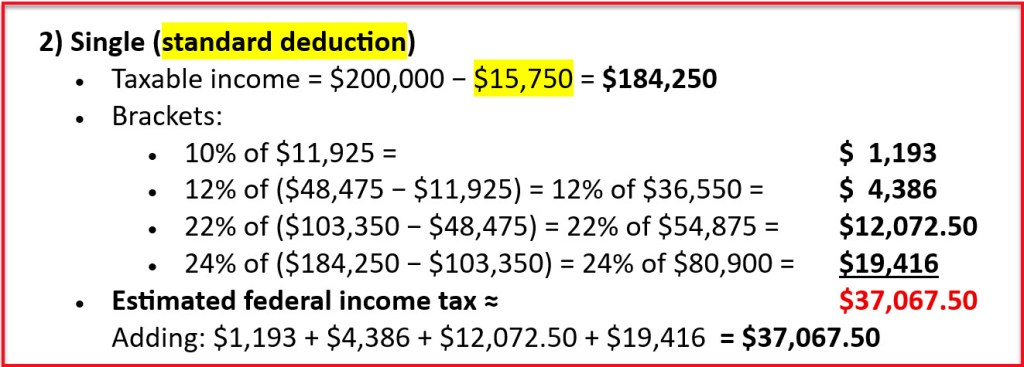
I asked AI about a hypothetical taxable income of $200,000. Assuming AGI = $200,000 and you take the standard deduction (and ignoring credits like child tax credit, and ignoring any itemized deductions/adjustments), the main difference between Married Filing Jointly and Single is the standard deduction, which changes taxable income and therefore the brackets you land in. The standard deduction amounts for tax year 2025 are: $31,500 MFJ and $15,750 single. In other words, you have less for a standard deduction as a single. We would probably itemize our deductions given our charitable giving, but I want to keep this illustration simple.
Here are three images to show the comparisons. If you are a single with an AGI of $200K, you wind up paying at least another $10K in taxes than if you were married filing jointly. Again, if your income is $200K you might not care. It does, however, impact your income EVERY YEAR.


Where You Live Matters Too
If your AGI is $200K then you might want to move.
These states are commonly flagged as not retirement-tax friendly because they tax Social Security (or don’t exempt it well) and also tax IRA withdrawals like ordinary income:
- California: retirement income broadly; high overall state tax burden for taxable income.
- Connecticut: Social Security and also taxes retirement distributions as income.
- Minnesota: Social Security; retirees often lose major tax-preferred treatment.
- Rhode Island: Social Security + applies income tax to taxable retirement withdrawals.
- Vermont: Social Security and taxes other retirement income as income.
- Maine: often ranked poorly for retirement tax friendliness less relief + retirement income taxed.
- Nebraska — taxes retirement income and tends not to provide strong relief at higher incomes.
A key reason these rank “worst” is that with $200K, you’re typically above most thresholds where states offer partial exemptions/deductions/credits for seniors—so the “relief” phases out (creating cliff effects where one more dollar can increase tax a lot). Wisconsin certainly isn’t the best, but at least it isn’t as bad as the crazy taxing states.
Why This Matters – Your Action Today
This can be very painful for taxable brokerage accounts, traditional 401(k) accounts, and traditional IRAs. Think about this when you plan your retirement contributions. In general, contributing to a ROTH IRA is the best long-term approach for conscientious savers and investors. The traditional IRA may save you some taxes today, but it usually will be at the expense of significantly higher taxes in retirement.
That is one of the reasons I have been am doing ROTH conversions every year. Even with the significant conversions, QCD giving, and RMD withdrawals, my traditional IRA balance remains stubbornly high. I know that is a nice problem to have, but it might not be so nice for my bride someday. And someday will probably come and maybe sooner that we imagine.
Action Items
- Review your investments. Do you have more than 5-10% allocated to bonds? You are not going to beat inflation with bonds.
- Be very skeptical of most annuity offers. If you add inflation protection they become very expensive and won’t usually offer the returns you desire.
- Although I did not discuss every state and their tax situations, think about your state of residence. Some states have absolutely crazy taxes. Don’t forget sales taxes, because they also eat away at true spendable income.
- Do your homework when it comes to income taxes. Realize that traditional IRA withdrawals are taxed as ordinary income. Realize that high RMD’s can trigger additional IRMAA Medicare taxes. Factor into your thinking the long-term implications of today’s choices. If you have questions, please ask and I will do my best to help and answer your questions.
Seeking Alpha Subscription Information
Of all of the resources I use, the most helpful is Seeking Alpha. The Seeking Alpha QUANT rating is a huge factor in my investment success. If you decide to explore a Seeking Alpha subscription, please use the following link. Seeking Alpha
SEEKING ALPHA INFORMATION AND SUBSCRIPTION

You can also scan this QR Code to get the same information.

Past performance does not guarantee future results, Seeking Alpha does not provide personalized advice, and it is not a registered investment adviser.
We accept advertising compensation from companies that appear on our site. This website represents my opinions, which may not reflect those of Seeking Alpha, and does not constitute an investment recommendation or advice.
If you have any questions or problems getting connected to Seeking Alpha, reach out to them with this email address: subscriptions@seekingalpha.com

