
Does It Matter?
Very rarely does it make sense to invest in an enterprise that cannot make a profit. Of course, in the early phases of a business, there may be losses as the work is done to build the business. One anticipates profit and so the business may have future value.
Profitability refers to a company’s ability to generate profit relative to its revenue, assets, or equity. It indicates how effectively a business turns resources into profit, which is essential for assessing financial health and making informed decisions. I prefer to buy shares of profitable businesses. One way to do that is to look for investments with dividend growth and a rational dividend payout ratio.
Portfolio Profitability
A key factor in determining if our investments are profitable is total returns. Price returns are nice to have, but they aren’t something you can use to buy groceries until you sell your shares. I own AMZN shares, but AMZN only has value if I can sell the shares for more than I paid for them.
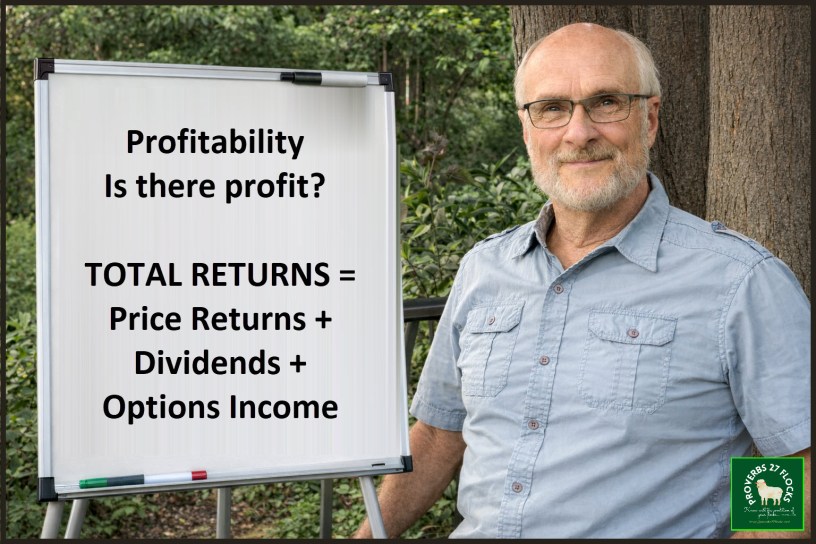
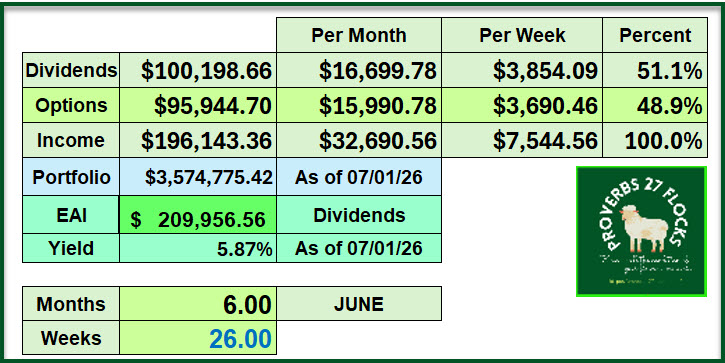
For many of our investments I want to see total returns. Total returns include potential price returns, dividends received, and any options income I can generate by selling covered call options contracts. Therefore, part of our total 2026 YTD returns is the $196K of income we have received from the investments we own.
Looking at AVGO as an Example
I currently own 400 shares of AVGO (Broadcom Inc). Those shares are currently worth about $147K. Since I bought the shares (at various times) they have appreciated in value by 80%. So my “price returns” at this moment in time are good. In addition to the potential profit from the shares, I have received $17,165 in dividends since March 2020.
I have been trading options contracts on my AVGO shares since 2021. Since then I have gained an additional $62,889 in income from just AVGO options trades.
Because I have bought and sold shares during these years, I gained an additional $29,813 in real profit from my AVGO holdings. This means my total returns are quite a bit more than what they might appear to be on the surface. Remember, you don’t have a profit until you sell your investments. What might look like a profit today could disappear tomorrow.
Using Seeking Alpha to Monitor Profitability
Before I buy shares of a company, there are several factors to consider. The dividend payout ratio is an indicator that tells a story. “A dividend payout ratio reveals the proportion of earnings distributed as dividends to shareholders, serving as an indicator of how a company allocates its profits.” – Investopedia
Notice the word “profits.” If the dividend payout ratio is 45%, then for every dollar of profit per share the company is giving you $0.45 per share as a dividend. As a general rule, I want the payout ratio to be between 20-70%. There are exceptions for investments like REIT’s and BDC’s.
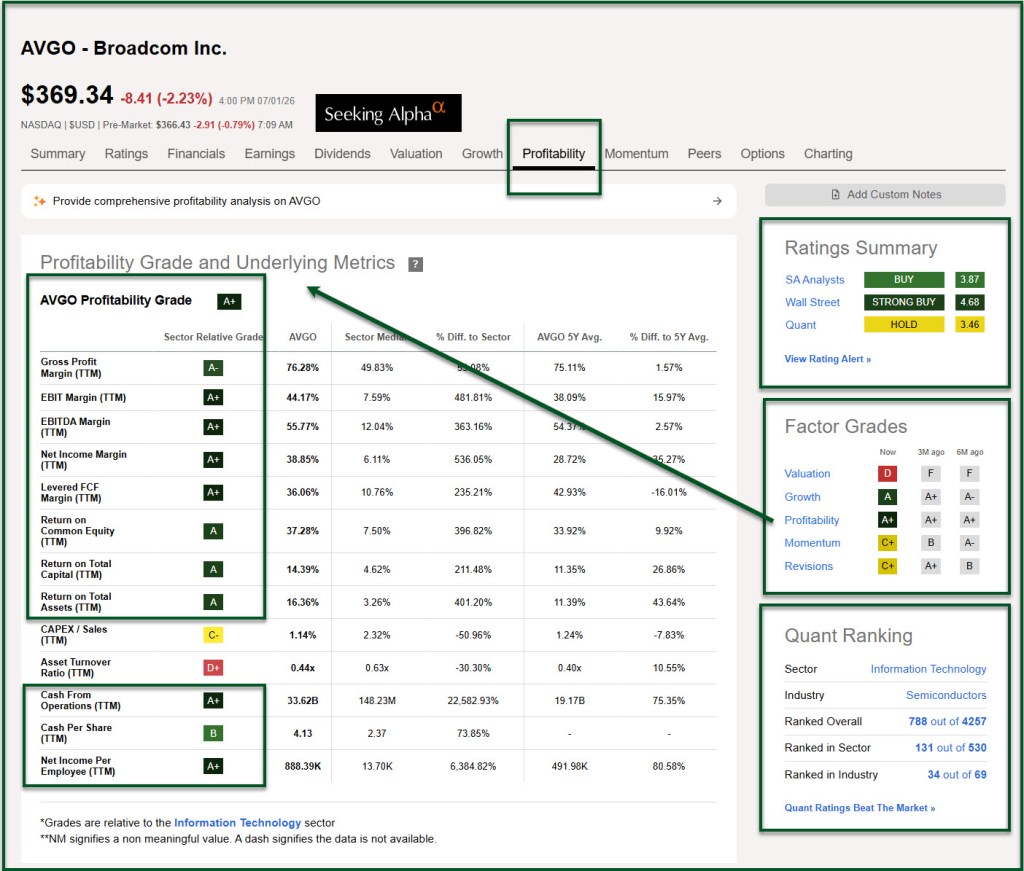
There is another way that is helpful. Seeking Alpha breaks out the elements of profitability by various metrics. The following image shows the Profitability view of investment AVGO.
Profitability By Account
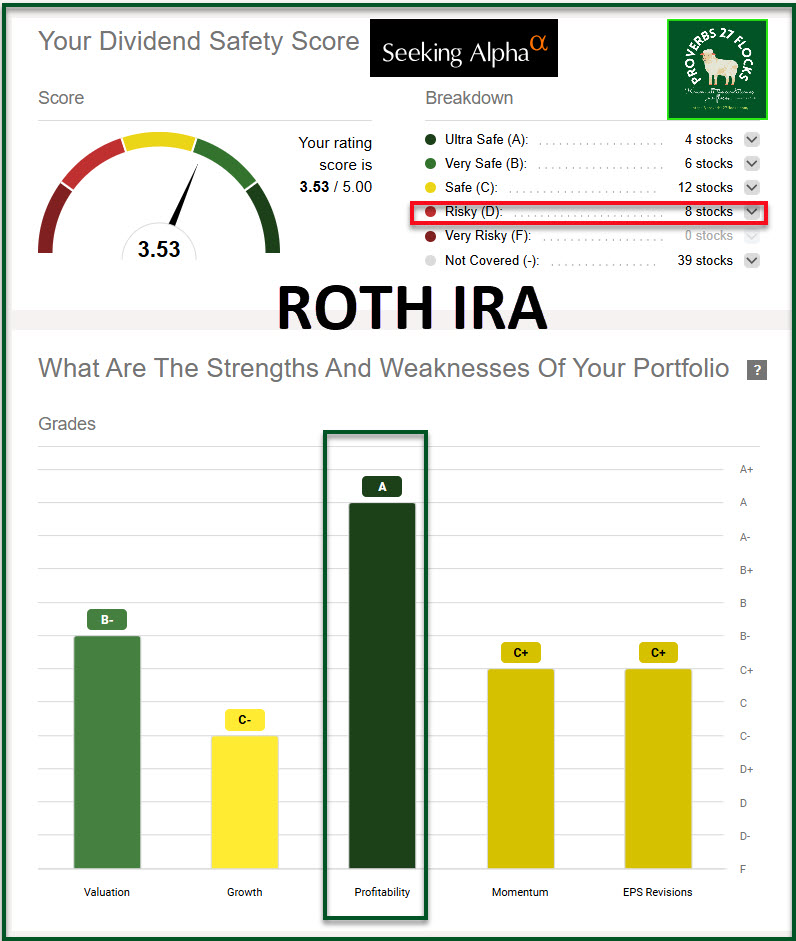
The next two images pertain to my two largest accounts: my traditional IRA and my ROTH IRA. Notice in both cases that the profitability bar is high. That isn’t to say there is no risk in my investment mix. As you can see ten stocks in my IRA are “risky” from a dividend safety perspective and eight stocks in my ROTH IRA are risky. Some are “not covered.” The reason is simple: several of my holdings don’t pay a dividend. Examples include AMZN, CRDO, FSLR, SMCI, UAL, CLOV, and SHLS.
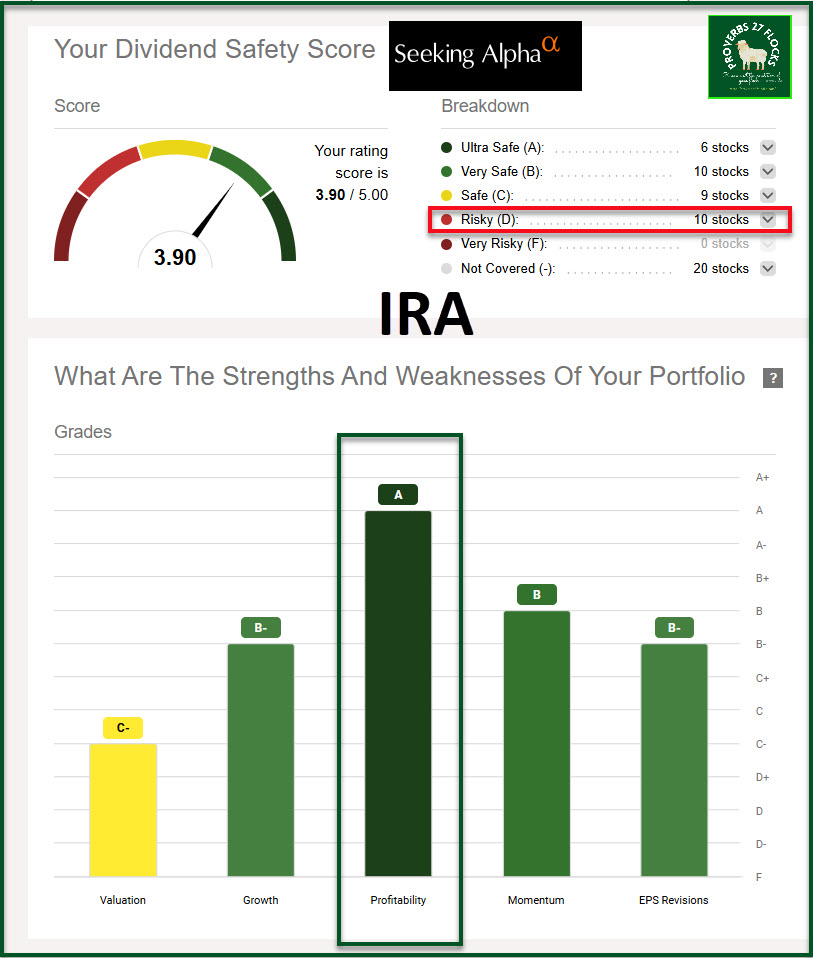
As a side note, Seeking Alpha says my traditional IRA is “in the top 26% of all portfolios” on Seeking Alpha. My ROTH IRA is “in the top 58% of all portfolios.” That is because I have more assets in my ROTH that have a “neutral” rating. Those investments include OKE, CSWC, VZ, HPQ, UPS, CDE, BMY, PFE, MRK, EOG, GAIN, CCL, CAG, SMCI, SMP, ARCC, AVXL, FTNT, FDUS, STAG, ABBV, PYPL, PR, SSRM, VICI, BCSF, OBDC, CLOV, IDVO, FG, GPIQ, GPIX, QQQI, QDVO, SFD, and GPTY.
Caution and Recommendation
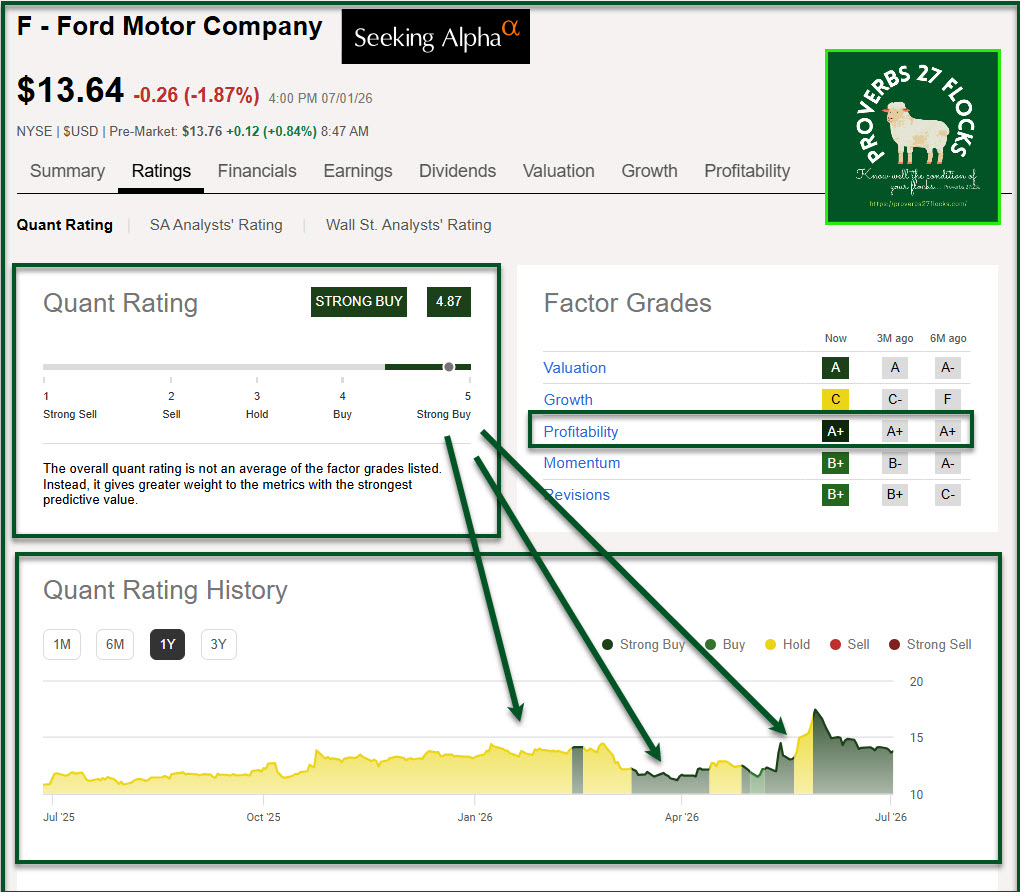
A QUANT rating that is positive is not a guarantee of profitability in the future. Furthermore, QUANT ratings change over time. Here is an example with Ford stock. Nevertheless, a key consideration for investing success will always be present or future profitability of the investment.
If you don’t pay attention to the profitability of your investments, don’t be surprised by your results. Investments must provide a profit and total returns always matter.
Seeking Alpha Subscription Information
Of all of the resources I use, the most helpful is Seeking Alpha. The Seeking Alpha QUANT rating is a huge factor in my investment success. If you decide to explore a Seeking Alpha subscription, please use the following link. Seeking Alpha

SEEKING ALPHA INFORMATION AND SUBSCRIPTION
You can also scan this QR Code to get the same information.

Past performance does not guarantee future results, Seeking Alpha does not provide personalized advice, and it is not a registered investment adviser.
We accept advertising compensation from companies that appear on our site. This website represents my opinions, which may not reflect those of Seeking Alpha, and does not constitute an investment recommendation or advice.
If you have any questions or problems getting connected to Seeking Alpha, reach out to them with this email address: subscriptions@seekingalpha.com

