
This podcast was created using a new feature of WordPress. “Pip” and “Mara” are the podcast participants. I am surprised by the quality of the final product. What do you think?
Pip: Know Your Flocks and Herds — where the ancient wisdom of tending your livestock turns out to be surprisingly solid advice for your brokerage account.
Mara: This episode covers a multi-part series from proverbs27flocks on avoiding bad investments — working through momentum, performance history, cutting through financial noise, counting hidden costs, and building a portfolio that generates both income and growth.
Pip: Let’s start with the core question the series keeps circling: how do you actually know if what you own is any good?
Momentum, History, and Cutting Through the Noise
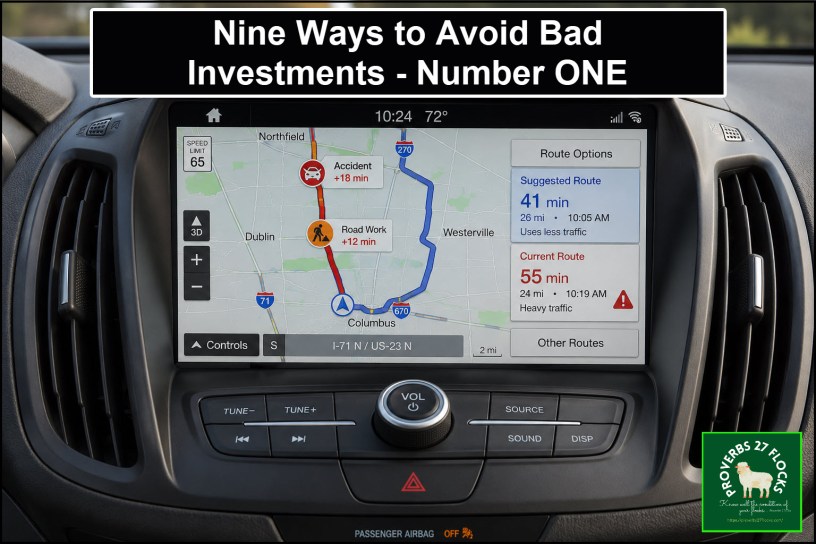
Mara: The series opens with a navigation metaphor — investing is like choosing a route, and you need multiple data sources, the way a GPS pulls from traffic sensors, crowdsourced speeds, and incident reports, before recommending a road.
Pip: Part Two sharpens that into something specific: upward price momentum. The post makes the case that a high share price is not a red flag — it is a signal. Here is the line: “It is best to buy an investment where the price is climbing the hill faster than the price of other investments.”
Mara: So the upshot is that a stock trading at seven hundred dollars is not automatically out of reach or overpriced — the price itself reflects demand. The post uses Micron Technology as the example, contrasting it with UMH Properties, which carries a momentum score of D-plus and, as the post puts it, “no real opportunity for positive price momentum.”
Pip: Part Three extends this into performance history — what the post calls MPI, or mileage per investment. The argument is that target-date funds and bond funds are the highway that looks smooth but quietly drains your tank. The post names funds like the Fidelity Freedom 2050 and a range of bond ETFs as investments prone to mediocre long-term returns.
Mara: And there is a striking data point from Investopedia cited in that post: only about sixty percent of thirtysomethings have retirement accounts at all, with a median balance of around thirty-three thousand dollars. Across all households in that age range, the median drops to six thousand.
Pip: Which reframes the whole bond-versus-equity debate — the bigger problem is not picking the wrong fund, it is not having a fund at all.
Mara: Part Four then addresses the noise problem directly. Financial media, social media, podcasts, mailers from wealth management firms — the post argues that the antidote is not more opinions but a tool with proven signal, specifically alert systems that flag rating changes so you can ignore the rest.
Pip: Tuning out the crowd turns out to require a system, not just willpower. And once you have that system, the next question is what it is actually costing you to run it.
Hidden Costs and the Income-Plus-Growth Model
Mara: Part Five is where the series turns to costs — and it is not just management fees. The post covers foreign dividend withholding taxes, the tax treatment of REITs in taxable accounts, and the long-term drag of traditional IRA withdrawals. Here is the direct quote: “Tax efficiency is a cornerstone to any well-balanced portfolio. To ensure you don’t pay more taxes than you have to, it’s important to consider moving some of your investments out of taxable accounts.”
Mara: What that means in practice is that where you hold an investment matters as much as what you hold. REITs generating ordinary income belong in a tax-advantaged account; options income in a Roth IRA is untaxed entirely. The post notes that year-to-date options income for 2026 has reached forty-five-and-a-half thousand dollars.
Pip: Part Six then challenges the assumption underneath most of this — that you have to choose between growth and income. The post argues that dividend-paying equities and ETFs like DGRO, SCHD, VIG, VYM, and VOO let you run both simultaneously, so you are not dependent on selling assets to fund retirement.
Mara: The practical consequence is behavioral as much as financial. The post points out that investors who see only account balance tend to panic-sell during downturns, locking in losses permanently. Investors watching a dividend stream that keeps arriving regardless of market conditions have a reason to hold.
Pip: The cow is worth less at the moment, but the milk is still on the table.
Mara: The throughline across all of this is attention — knowing the condition of what you own, in enough detail to act on it.
Pip: More installments are coming. The series is only at six of nine, so there are still three ways to avoid a bad investment we have not heard yet.

