
Sell What When and Why?
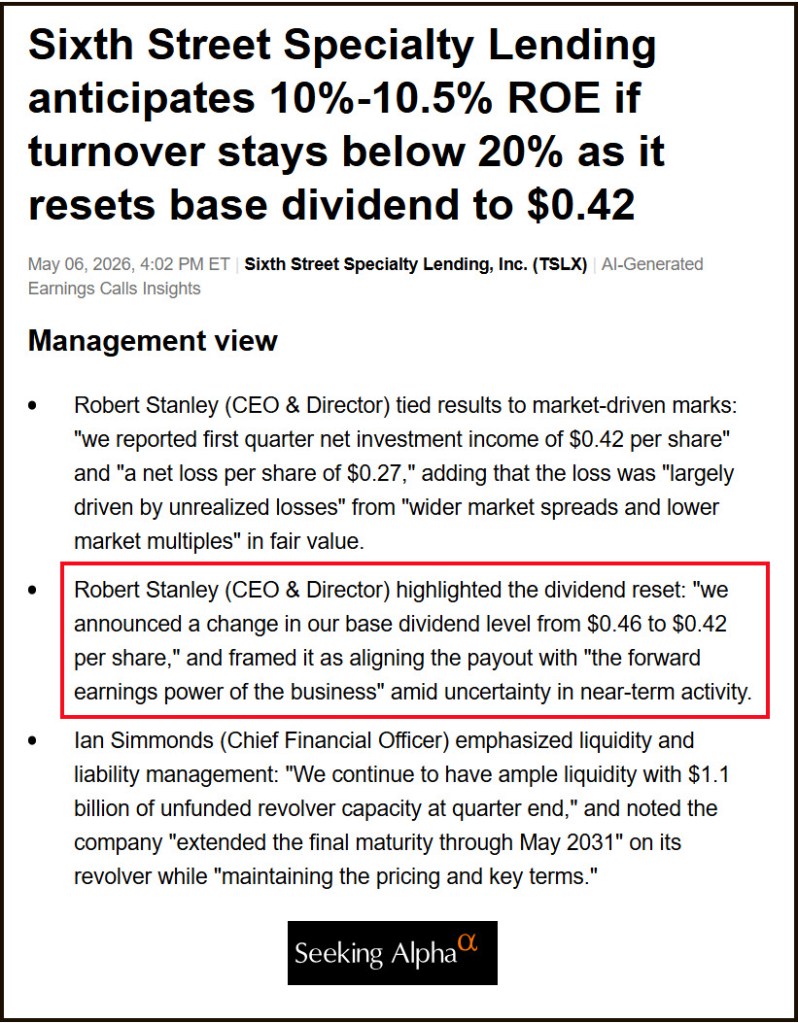
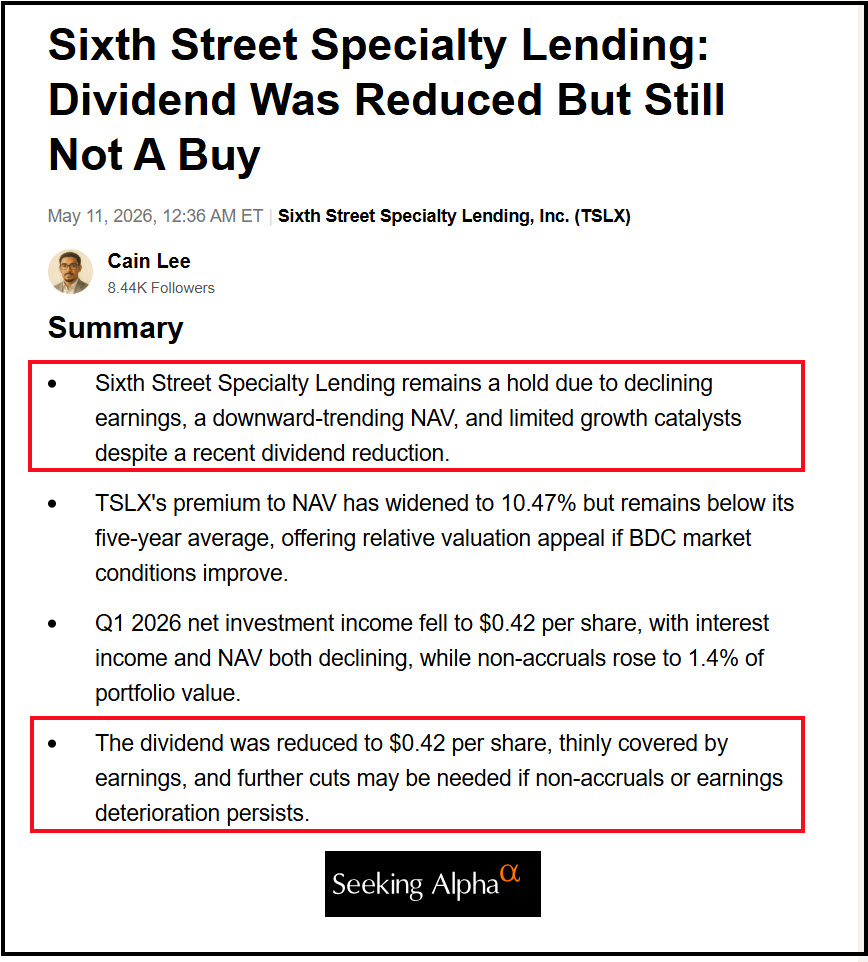
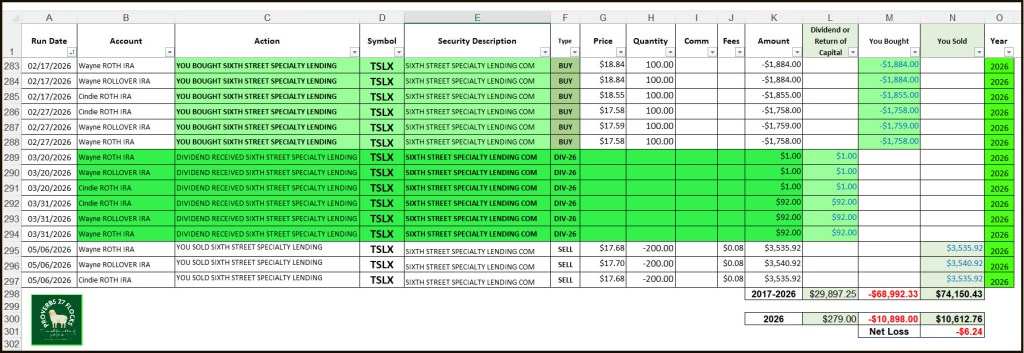
I sold all 600 of our shares of TSLX last week. I purchased the shares in February. There was a reason I sold our shares. The reason was that TSLX “reset” their dividend. That is a polite way of saying they reduced the dividend. As a general rule, when any investment cuts or suspends their dividend payments, I sell. There are rare exceptions, but I have found this rule serves me well.
Last week I also sold 100 of my 300 shares of NVDA. The shares were called due to an option contract that expired on Friday: CALL (NVDA) NVIDIA CORPORATION MAY 08 26 $215. Therefore, after the commission, I received $21,499.55. I paid $21,195.00 for the shares on May 7. This was a quick profit of $304.55 plus an option premium of $ 95.33. So in one day I earned almost $400 on the shares. That is a sweet “synthetic” dividend.
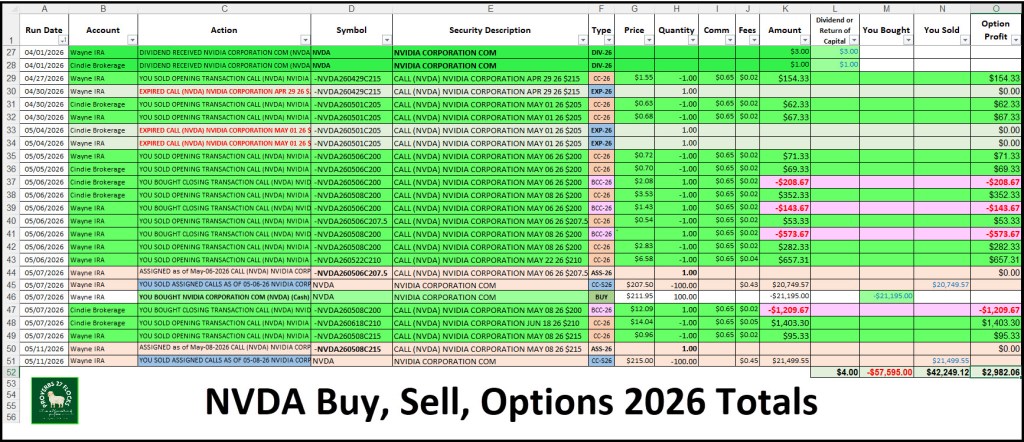
I still own 200 shares of NVDA. However, I have pending options contracts on those shares as well. One is NVDA May-22-2026 $210 CALL, and the other is NVDA Dec-15-2028 $200 CALL. I’m looking for opportunities to roll those contracts.
In addition, I bought 100 shares of NVDA this morning for $217.90 per share and then sold a covered call option on those shares for $220. (The contract ticker symbol looks like this: “-NVDA260511C220 filled at $0.75.” So I made almost $75 on this trade after the $0.65 commission. If the shares close today above $220, I will make an additional $200 after the commission.
Do You Have Good Reasons for Selling?
Why do many investors sell an investment? During bear markets or major “corrections”, many investors sell out of fear. The fear can turn to panic, which then feeds the fears of other investors. Others sell some investments to “rebalance” their investment portfolio. If an investor has a need for cash, and they don’t have a savings account, perhaps they lost their employment, and have no other way to cover an expense or life surprise, they often sell. This type of selling can be harmful to long-term success. We would do well to take inventory of some of the reasons we might sell an investment during a bear, bull, or flat market with little growth. Here are some considerations for selling any investment.
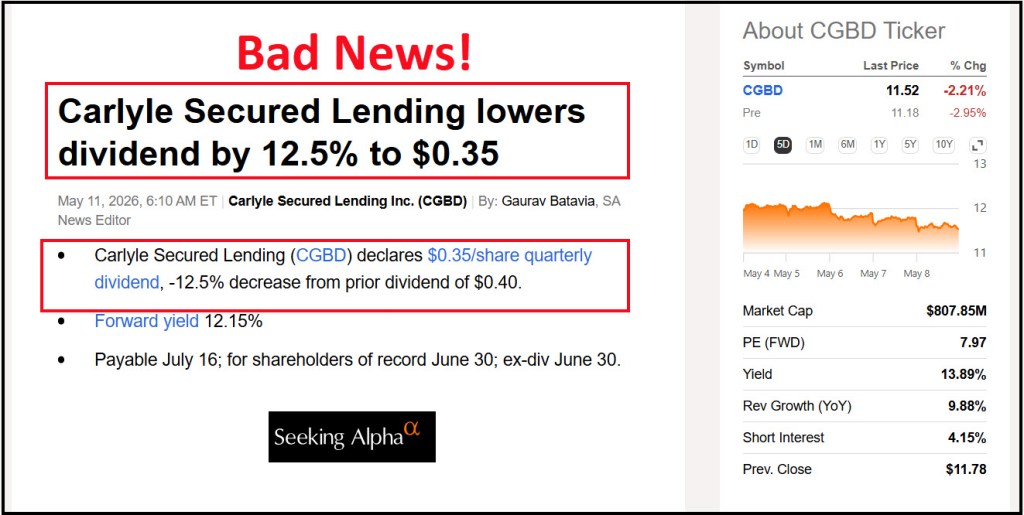
Dividend Reduced or Suspended – This is a warning flag for me. Companies know that reducing or suspending a dividend is not met with joy by investors. I don’t own shares of CGBD, but if I did I would sell them.
Sell to Diversify – Sometimes individual investments have done so well that they make up a large percentage of your total investments. This is generally true of individual equity investments but can apply to some ETF investments as well. So, for example, I would not hesitate to sell some of my shares of VYM to buy shares of DGRO or SCHD (or even an individual equity investment.)
Trim an equity position to diversify – I would say that most of my sell activity is to completely liquidate an equity position. It would be rare for me to liquidate a diversified ETF. I have owned shares of AVGO and still do, but I am willing to sell shares using covered call options to trim my position. Today I own 400 shares of AVGO with an average cost basis of $204.68. The shares are currently trading at about $424 per share.
One way to potentially sell an investment is to trade covered call options. This earns some immediate cash and creates an opportunity for more cash if the option contract expires “in the money.” For example, I have an open covered call contract (May-20-2026 $430 CALL) where I am willing to sell 100 of my shares for $430 per share. I have a second covered call contract for 100 shares (AVGO Jul-17-2026 $430 CALL) that would further reduce my holdings. If both calls are exercised, I would receive $86,000 that could be used for diversification in my traditional IRA.
Lock in Profits – If I buy 100 shares of an investment like CCL (CCL Carnival Corporation Ltd.) I might sell if a covered call contract is exercised. If I don’t have an option contract, and if the share price rises dramatically I like to lock in my profit. Often a skyrocketing investment comes back down, and I would prefer to have the cash and move on to other investments I am considering.
Sell to Raise Cash – some investments are sold to raise cash. Although I don’t generally do this, because we have sufficient dividend income to provide for our cash needs (along with Social Security), there are times when selling an investment is needed. One example is to have cash for a required minimum distribution withdrawal. This is the case for Cindie’s traditional IRA. The dividend flow will never be enough to satisfy the RMD required for this inherited IRA.
Sell Speculative or Weaker Positions – Some positions, are speculative. Sometimes I buy shares with no intention of holding them for the long term. That is why it is important to have buy and sell rules so that you make decisions based on predetermined guidelines and objectives.
Company Divestiture – Over time some businesses acquire shares, businesses or brands that they no longer see as core to their business success. When that happens they separate or sell their interest in the investment. They might also distribute the shares they own to shareholders. This happened with our shares of FNF. “Nov. 7, 2025 /PRNewswire/ — Fidelity National Financial, Inc. a leading provider of title insurance and transaction services to the real estate and mortgage industries, and F&G Annuities & Life, Inc. (NYSE: FG) (“F&G”) today announced that FNF’s Board of Directors has approved a special stock distribution (the “Distribution”) to FNF’s shareholders of approximately 16 million shares of common stock of F&G owned by FNF, a majority owned subsidiary of FNF, representing approximately 12% of the outstanding shares of F&G’s common stock.” – Company Release – 11/7/2025
As a general rule, when this happens, I sell the shares that are distributed to me. I don’t want the new business just because it was “given” to me.
Selling Considerations:
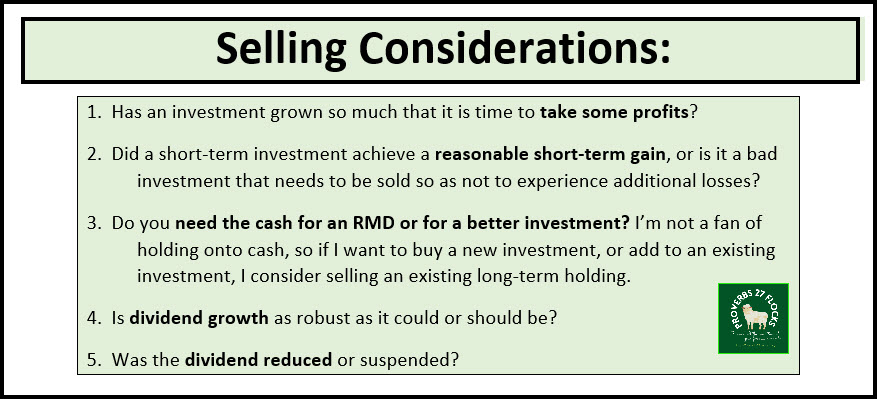
1. Has an investment grown so much that it is time to take some profits?
2. Did a short-term investment achieve a reasonable short-term gain, or is it a bad investment that needs to be sold so as not to experience additional losses?
3. Do you need the cash for an RMD or for a better investment? I’m not a fan of holding onto cash, so if I want to buy a new investment, or add to an existing investment, I consider selling an existing long-term holding.
4. Is dividend growth as robust as it could or should be?
5. Was the dividend reduced or suspended?
Traders are Creatures of Panic, Fear, and Greed
Many of the “investors” are not investors. They are traders. They want to buy and sell their investment(s) today. If they see the bottom falling out of their investment, they sell. If everyone is selling, then the fear and panic increase. The reverse is also true. Prices can be driven up by greed and the desire for a quick profit. Most traders lose more than they care to admit. Therefore, I think like an investor and try to keep my “trading” to a minimum.
The Herd will Turn if History is Correct
What does up will come down. What goes down often has a history of going back up. If I think about all of the different bear markets I have seen, including the Covid-19 scare. I remember something: it didn’t take long for our investments to recover and then to continue to grow. Selling would have been the wrong approach to the “pandemic” in my opinion.
History (Says You Cannot Time the Market)
No one really knows when the market will stop dropping, when it will turn, and when it will keep rising. Many studies have been done that seem to indicate that far too many investors are very poor decision makers and cannot time the market. Think about it, you really don’t know what tomorrow holds. Will World War III begin tomorrow? Will a new swine flu or massive plague begin in New York City? Will inflation skyrocket and eat away at your buying power? You and I don’t know. Timing the market is an impossible task.
The Sky Is Not Falling
There will always be pundits or experts who claim to know what is going to happen with the market or with a particular investment. I like to hear the opinions of experts and advisors, especially if they can back up their claims with a strange animal called DATA. Some experts are perma-bears. That is, they always think the sky is falling. Sometimes the sky may seem to be pushing you down, but don’t become the slave of expert advice. Know what you own, why you own it, and stay the course.
Smart Investors Buy during the Dips
The opposite of selling is buying. I have read books and letters by smart investors, including James B. Cloonan, Warren Buffett, and John C. Bogle. Cloonan’s Investing at Level 3 is a great resource. Bogle’s The Little Book of Common Sense Investing is required reading.
Summary
If you had a reason for buying an investment, and it was a good reason, and the reason still stands, don’t sell it just because the market is turbulent or “crashing.” Buy more. Recognize the storm for what it is and steer your investment ship through the storm. If you think otherwise, you will join a host of other disappointed investors and traders.
Seeking Alpha Subscription Information
Of all of the resources I use, the most helpful is Seeking Alpha. The Seeking Alpha QUANT rating is a huge factor in my investment success. If you decide to explore a Seeking Alpha subscription, please use the following link. Seeking Alpha

SEEKING ALPHA INFORMATION AND SUBSCRIPTION
You can also scan this QR Code to get the same information.

Past performance does not guarantee future results, Seeking Alpha does not provide personalized advice, and it is not a registered investment adviser.
We accept advertising compensation from companies that appear on our site. This website represents my opinions, which may not reflect those of Seeking Alpha, and does not constitute an investment recommendation or advice.
If you have any questions or problems getting connected to Seeking Alpha, reach out to them with this email address: subscriptions@seekingalpha.com

