
Does Making Excuses Work For You?
One thing I have noticed about people who come to me for help is that they are tired of making excuses for their past behaviors or lack of action. They regret not reading their investment statements. They regret assuming that their financial advisor is doing something in their best interests when they agreed to purchasing an annuity. (Some even let their advisor trade investments on margin, to their great regret and horror.) They regret waiting until age 60 to start to think about income for retirement.
Excuses don’t really solve problems. Oftentimes they just perpetuate serious problems. This is not only true of financial things, but also of eternal, spiritual matters. I am reminded of this by what the Apostle Paul said to the church in Rome. In Romans 1:18-20 Paul says, “For the wrath of God is revealed from heaven against all ungodliness and unrighteousness of men, who by their unrighteousness suppress the truth. For what can be known about God is plain to them, because God has shown it to them. For his invisible attributes, namely, his eternal power and divine nature, have been clearly perceived, ever since the creation of the world, in the things that have been made. So they are without excuse.”
God doesn’t care about our excuses. He apparently takes a very dim view of those who “by their unrighteousness suppress the truth.” That is, if you are thinking clearly, an understatement of the way we think, react, and behave. We do more than just suppress truth – we rebel against it. So my suggestion from a spiritual and a financial perspective is to stop making excuses.
Incremental Decisions Matter
Synonyms for “incremental” include gradual, cumulative, and step-by-step. These terms describe changes or progress that occur in small, successive steps. Building an investment portfolio is a series of incremental steps that should result in a portfolio of investments that works for you. In my case I call it my “Easy Income Strategy.” It is a wealth snowball. The more it rolls, the more it grows.
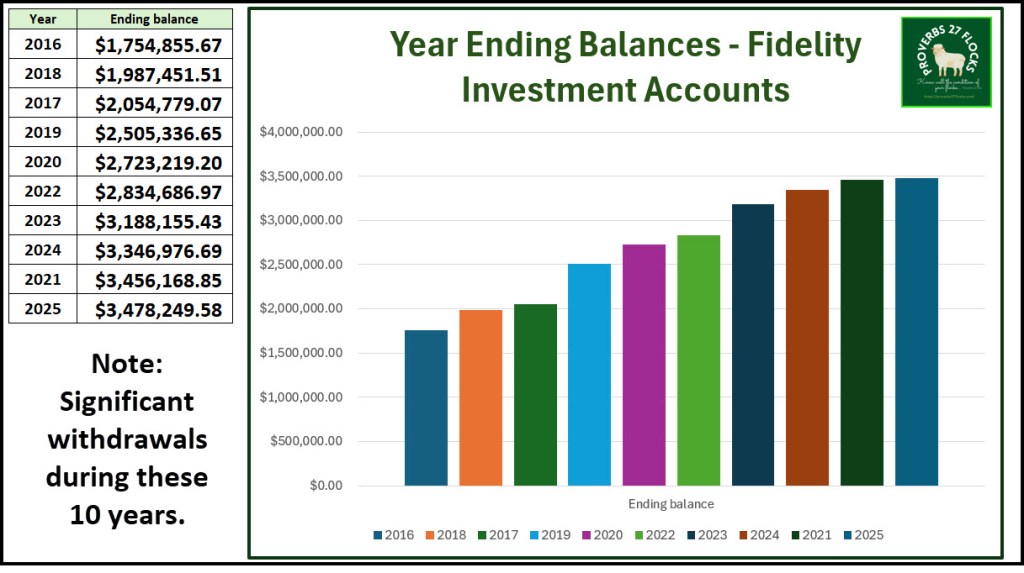
This image reflects the last ten years end balance for each year. Bear in mind that significant withdrawals have been made for QCD giving, income taxes, and taking our granddaughter’s on high school graduation trips to Hawaii and Costa Rica. I’m sharing this image, and the other images in the interest of clarity and transparency. I want my readers to learn something from this post from real life examples of investing strategies.
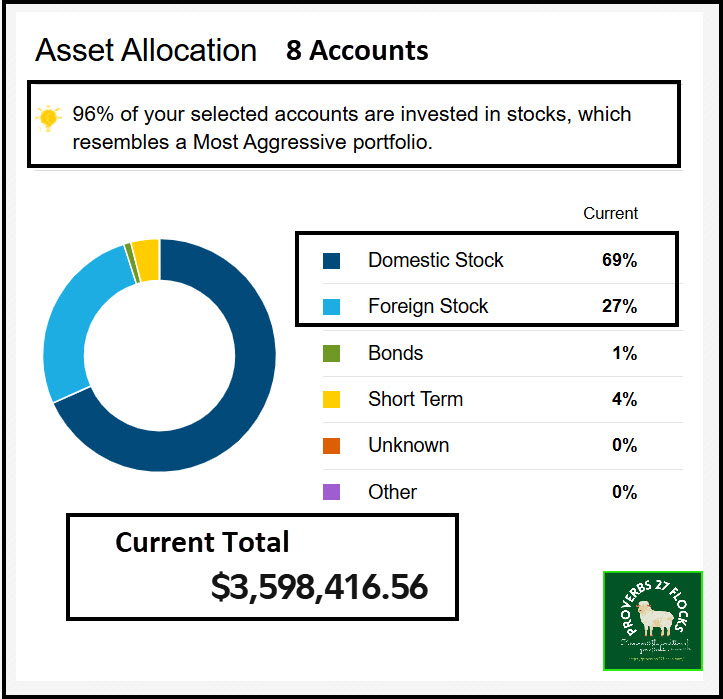
Fidelity Asset Allocation
Our allocation to stocks runs counter to just about every financial advisor’s recommendations. At my age (75) we should have at least 60% of our investments in bonds and bond funds. I think that is just plain nuts. The Rule of 72 and inflation argue against bonds.
Top Five Holdings
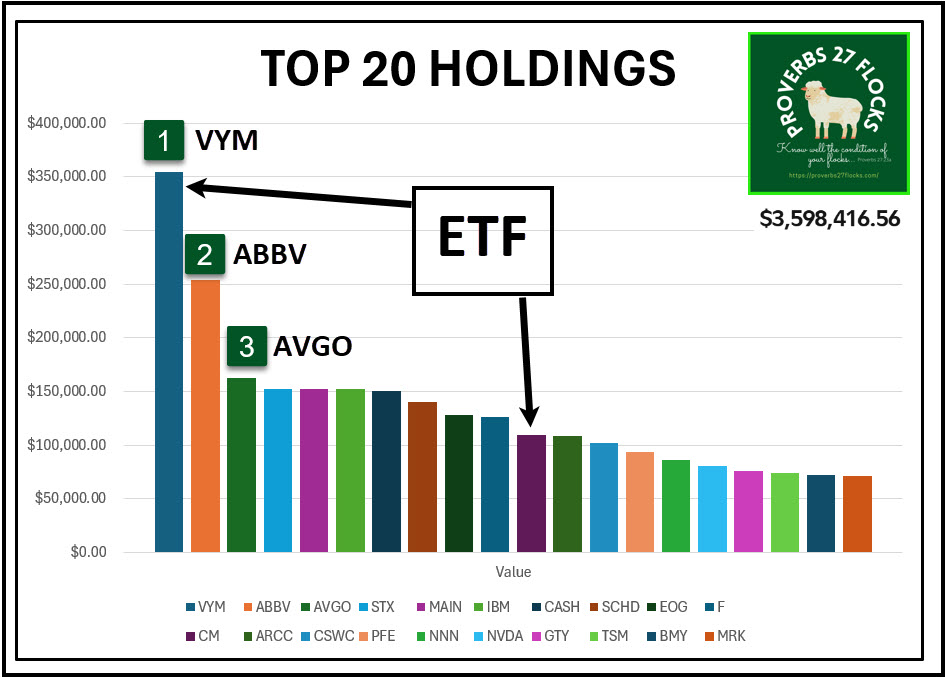
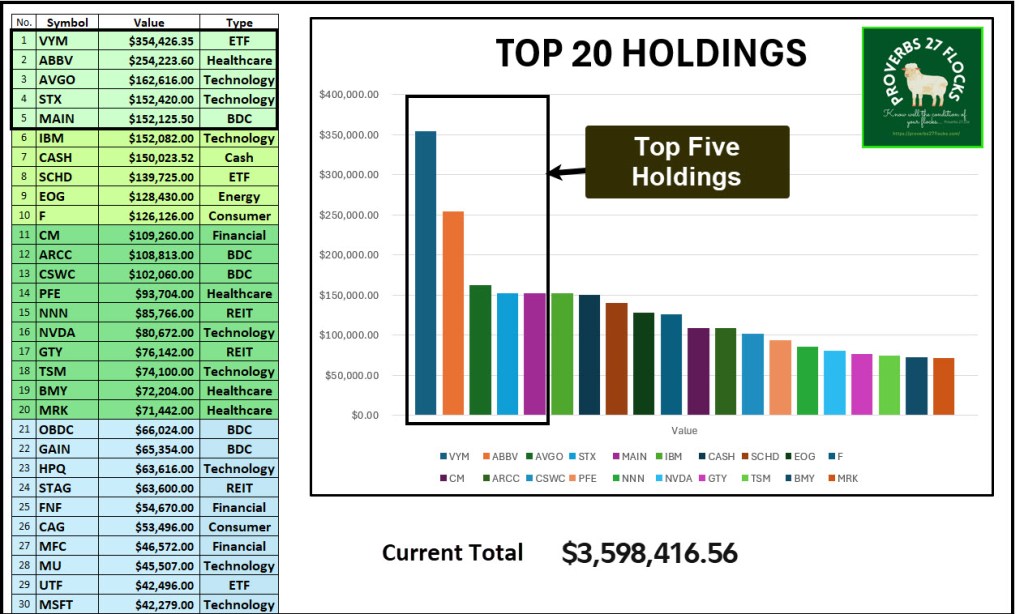
At the top of our top five is an ETF: VYM. But we also have some significant investments focused on good companies: ABBV, AVGO, STX and MAIN. These are health care, technology and financial stocks. MAIN pays a monthly dividend. Here are two images to show the top five and the top 20.
Sectors Matter
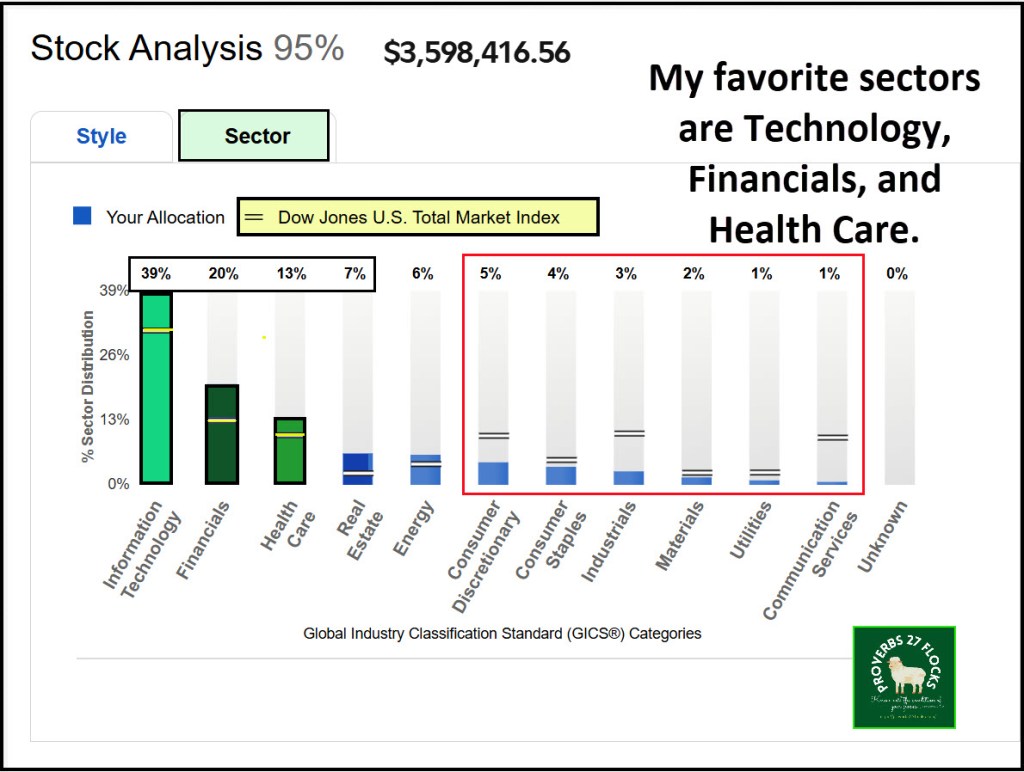
Some business sectors are not, in my opinion, worthy of significant investment dollars. The ones that are worth are Information Technology, Financials (banks, BDCs, insurance companies), health care (ABBV, PFE, BMY, MRK), and Real Estate (REITs). Utilities and Communication services are (generally) sectors I avoid or underweight.
Investment Quality Matters
There are two ways I evaluate quality. One is certainly the Seeking Alpha Quant score. However, Fidelity also has an “Equity Summary Score” (ESS)
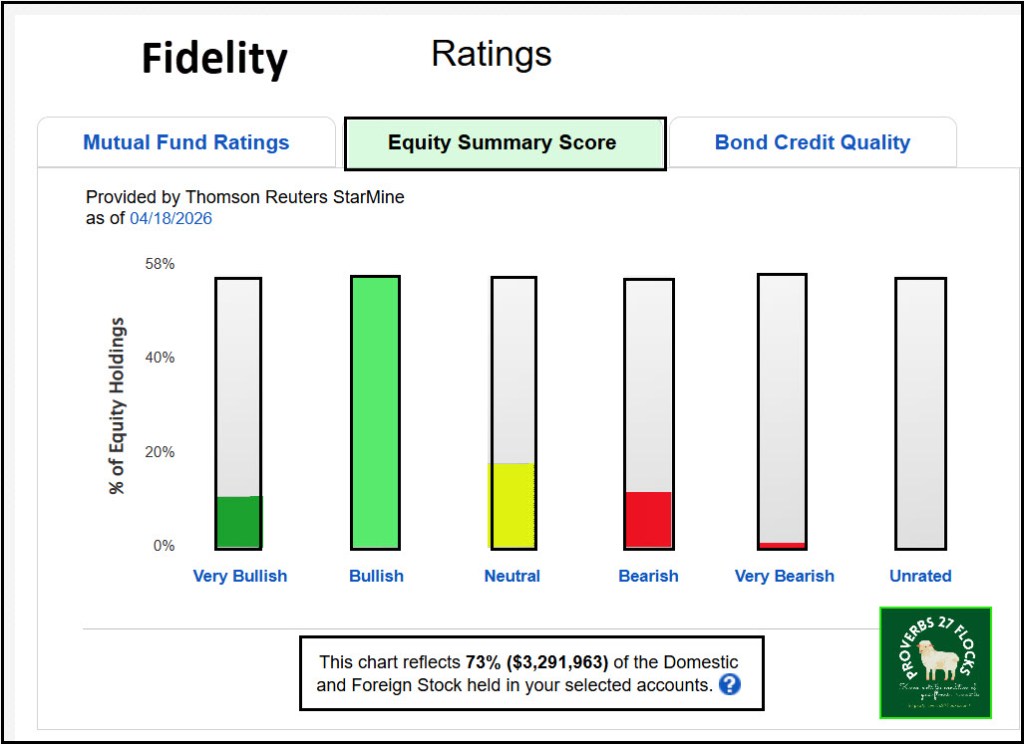
Fidelity says, “The Equity Summary Score (ESS) is a single score that combines ratings from several independent research firms to show their overall sentiment on a stock. It uses a model that weighs each firm’s ratings by their past accuracy and normalizes differences in rating styles. The score ranges from 0.1 (very bearish) to 10.0 (very bullish). You can find the ESS on Fidelity.com in places like:
- The stock’s Snapshot page under Analyst Opinions
- The Analyst Opinions page for detailed firm ratings
- The Opinion History and Performance page
- The Compare page with competitors
- The Company Research Highlights report
- The stock screener as a filter criterion
The score updates daily based on the latest research ratings.” Source: Fidelity Investments
I recommend most investors stay in the “Very Bullish” and “Bullish” realms. Neutral isn’t bad, but think twice before adding an investment with a very bearish or bearish rating.
Stock Style Weightings
You can invest in growth, blended valuation, or value stocks. You can also invest in Large-cap, Mid-cap, and Small-cap stocks and ETFs. Note that my allocations vary significantly from the “Dow Jones U. S. Total Market Index.” Because I want dividend growth, and many dividend growth investments are value stocks, I have 53% of our investments in large, medium and small-cap VALUE stocks.
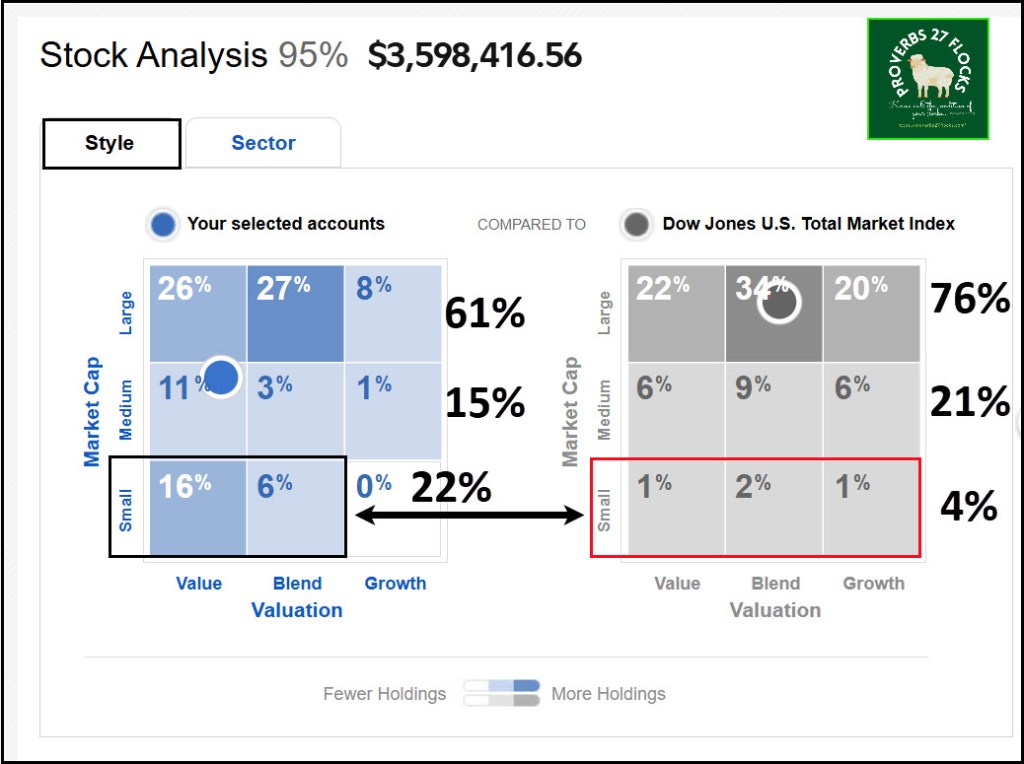
A value stock is a share of a company that appears cheap relative to fundamentals (earnings, book value, cash flow) — typically measured by low price-to-earnings (P/E), price-to-book (P/B), or high dividend yield compared with peers. Value investors look for companies that the market may be underpricing due to short-term problems, cyclical weakness, or low investor attention, expecting the market to eventually recognize their true worth.
A value ETF (exchange-traded fund) is a fund traded on an exchange that holds a basket of value stocks and tracks a value-oriented index or a rules-based value strategy. It gives diversified exposure to many cheap/undervalued companies in one trade, often using screens for low P/E, low P/B, high dividend yield, or other value signals.
Recommendation
The focus of this was educational. Don’t make your top five investments based on my top five. Having said that, excuse making and procrastination are not the best way for you to prepare for age 65. If you want to live off of Social Security, be prepared to be disappointed and to run out of income each month before you run out of days remaining in the month.
The Social Security inflation adjustments are a real joke. Remember that Medicare premiums are deducted from your Social Security income, and those costs are rising.
Seeking Alpha Subscription Information
Of all of the resources I use, the most helpful is Seeking Alpha. The Seeking Alpha QUANT rating is a huge factor in my investment success. If you decide to explore a Seeking Alpha subscription, please use the following link. Seeking Alpha

SEEKING ALPHA INFORMATION AND SUBSCRIPTION
You can also scan this QR Code to get the same information.

Past performance does not guarantee future results, Seeking Alpha does not provide personalized advice, and it is not a registered investment adviser.
We accept advertising compensation from companies that appear on our site. This website represents my opinions, which may not reflect those of Seeking Alpha, and does not constitute an investment recommendation or advice.
If you have any questions or problems getting connected to Seeking Alpha, reach out to them with this email address: subscriptions@seekingalpha.com
All scripture passages are from the English Standard Version except as otherwise noted.
 Know Your Flocks & Herds