
Dividend Income 2023-2026
For my followers, this may be repetitive. When I originally shifted to a dividend growth strategy, which I like to call my “Easy Income Strategy” the goal was two-fold. The first piece was to have increasing income that arrives with minimal or no work. That has proven to be very effective. This can be done without sacrificing portfolio growth, but it means you would minimize the use of bonds and bond ETFs as a part of the strategy. Bonds provide income, but they are poor from a dividend growth and total returns perspective.
The second piece of the strategy is based on a goal statement I created. All investors should have a goal statement for the year. The goal should be measurable and should be adjusted annually. If you don’t plan you can achieve nothing of meaningful value. If you read the following goal statement, I am pleased to report that the “age 75” goal has been achieved. I turned 75 in February, and it is likely that our dividend income in 2026 will be at least $205,000.
My Goal Statement
“Generate a steadily increasing stream of dividends paid by excellent, low-risk companies and dividend growth ETFs. The numerical objective for measurement: Grow dividend income to $200,000 in four years – when I am 75 years old. Dividends completely support the required minimum distribution (RMD’s) from the non-ROTH IRA accounts so that income-producing investments will not be sold to fund RMD’s.”
The dividend income from my traditional IRA in the first quarter of 2026 was sufficient to meet and exceed the 2026 RMD requirements. Thankfully, options income in the traditional IRA was also quite good, so there was never a need to sell any income-producing assets.
Three Statement Pages to Review (Out of 94)
Our Fidelity Investments Statement is 94 pages long. I never read every page, but there are a couple of pages I review. The first is page 3. There are four important sections: 1) An income summary for the month just ended and YTD income. Note that almost half of our March income was tax-free. 2) The top holdings across all eight of our Fidelity accounts. Obviously I have a lot of assets in STX and ABBV. I also trade covered call options on these positions.
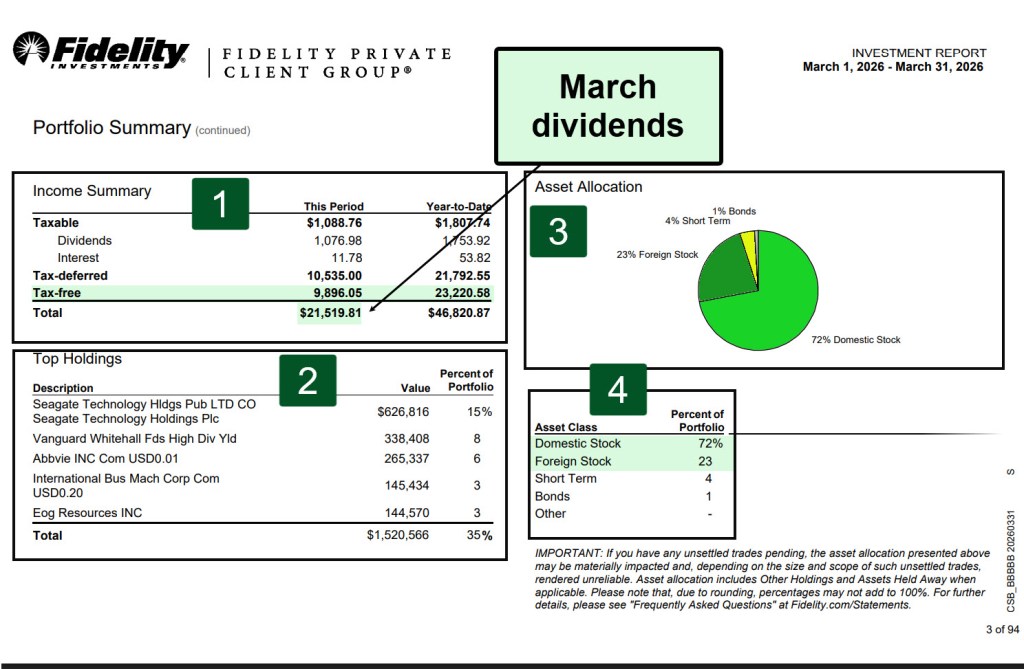
The third section is “Asset Allocation.” 3) The key takeaway is that I am not a fan of bonds or bond funds. Therefore, even though the conventional wisdom is to have 30% stocks and 70% bonds at my age, I don’t see much sense in that approach. Is the market volatile? Yes it is. But volatility isn’t necessarily risk. 4) Expressed as a table, you can see that most of our assets (95%) are in domestic and foreign stocks (and ETFs).
My Traditional IRA is the Big Boy
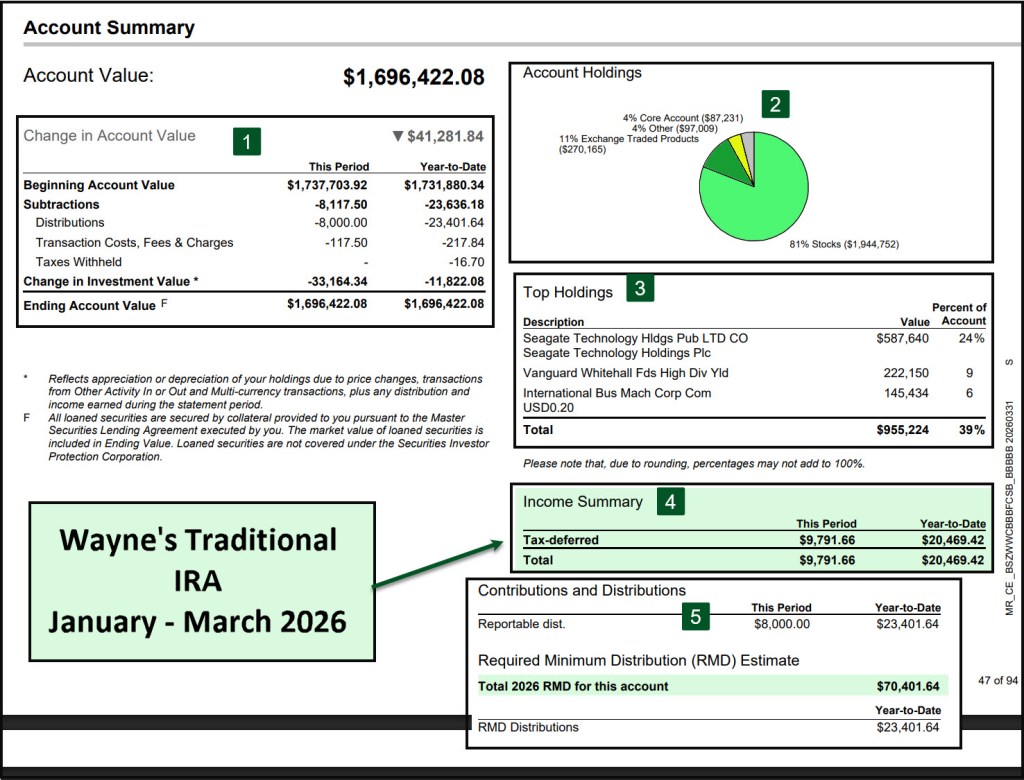
At about $1.7M in assets, my traditional IRA is the largest of our eight accounts. In fact, it makes up 49.5% of our total assets at Fidelity. I have gained $427K in this account by trading options since 2020. Many of the positions that used to be in this account have been moved to my ROTH IRA.
My ROTH IRA is Number Two
At about $1.2M in assets, my ROTH IRA is 35.1% of our total assets at Fidelity. Ten years ago, at the end of 2016, this account was a paltry $159,334.16. What caused the growth? It was threefold. First, I bought dividend growth investments. Then, the dividends were reinvested to fuel an easy income dividend snowball. After that, I continued to do ROTH conversions from the traditional IRA while keeping us in a reasonable income tax bracket. Finally, I trade options in this account.
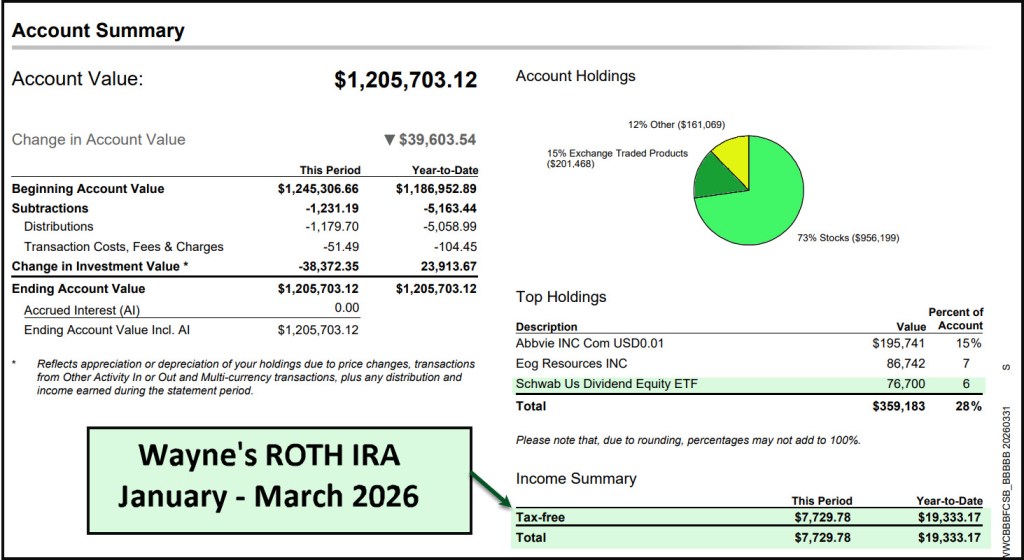
Since 2020, when I first started trading options in our accounts, I have gained an additional $117,165 in income from options trades. Just over $9,000 has been added in options income in 2026.
Cindie’s ROTH IRA is Number Three
Cindie’s ROTH currently has a balance of about $318K. This means her account is 9.7% of the total. Therefore, these three accounts make up 98% of our total investment portfolio. I use the same methodology for Cindie’s investments that I use for my IRA accounts. She also receives income from options trades, but her account balance does not lend itself to the same dollar amounts I can get trading options in my retirement accounts.
The March Results (2023-2026)
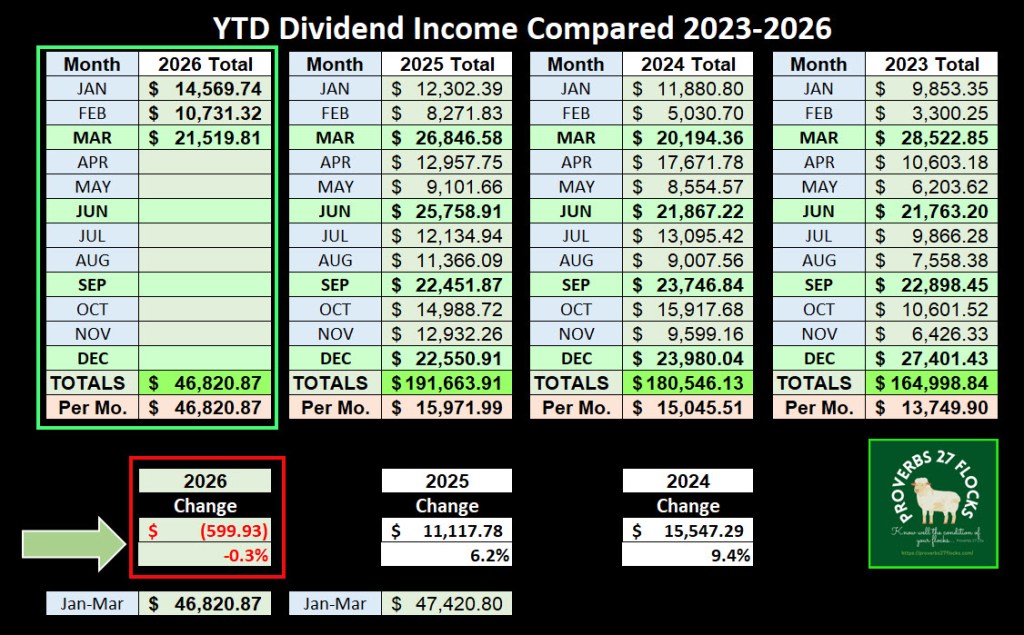
March is a volatile month for dividend income. Some of this is due to supplemental dividends that might appear in one year and not repeat the next. Nevertheless, the average monthly income from dividends for 2026 is $15,606. The average monthly income for the first three months of 2025 was $15,807. I’m a bit disappointed, but given the changes I have made in our investments, this is not totally unexpected.
Controlling the RMD and Keeping Income Taxes Rational
Part of the reason for my success in keeping my RMD low is the effort I have made in ROTH conversions. As a result of that effort, the tax-free income from my ROTH IRA has also increased dramatically. This year, like 2025, I need to satisfy my 2026 RMD before I can begin ROTH conversions. Given the fact that I can do QCD gifts of $111,000 this year, none of the RMD will be taxable.
How Do I Select Investments?
First of all, I use or current portfolio investments as the shopping list and add quality companies that raise their dividends if they meet the buy requirements I talk about in my blog posts. The list may be modified during the year by adding or dropping stocks or ETF investments after thorough analysis using my default criteria.
Secondly, I will evaluate ETFs using Seeking Alpha and the Fidelity Investments ratings. I refuse to buy junk investments and bonds.
Thirdly, I will consider low cost, index mutual funds using Fidelity’s tools. However, the cost of those funds needs to be less than 0.15%.
Finally, I will only buy stocks with reasonable metrics. Of course, having a Seeking Alpha QUANT rating that is Buy or better is desirable. This requires a subscription. The cost of the subscription is saved in dollars that aren’t wasted by terrible investments – in the long run.
Future 2026 Updates
Time permitting, I plan to continue to share ideas about investing and options trading using Fidelity’s Trader+ software. When I combine income from dividends with options income, the potential for additional charitable giving increases considerably.
Closing Thoughts
Do you have an investing goal that is something you can measure? Does it have a time element? Does it factor in the ultimate reality of RMD withdrawals? Does it ensure increasing income? If not, perhaps you won’t be satisfied with your results unless you have “luck” and things just go your way by chance.
Seeking Alpha Subscription Information
Of all of the resources I use, the most helpful is Seeking Alpha (SA). One of my favorite features is the ability to quickly see if an investment is likely to make a positive difference in our investment portfolio. The QUANT rating helps me avoid terrible investments and focus on the cream of the crop. Seeking Alpha
SEEKING ALPHA INFORMATION AND SUBSCRIPTION
You can also scan this QR Code to get the same information.
Past performance does not guarantee future results, Seeking Alpha does not provide personalized advice, and it is not a registered investment adviser.
We accept advertising compensation from companies that appear on our site. This website represents my opinions, which may not reflect those of Seeking Alpha, and does not constitute an investment recommendation or advice.


Wayne,
I was curious if you’d be willing to share, but I don’t know your background for employment and everything through all the years but when you were in your early 50s, where were you at in terms of your retirement accounts what I mean is what did you have for value compared to now almost 20 years later?
Were you investing as much as you possibly could at that time or was this something that happened more in the later half of this timeframe?
Sent from my iPhone
LikeLiked by 1 person
Those are good questions. I think I should write something about this so that others can see my investing journey. In the early years (1976-1999) I did not do several things with much knowledge when it came to investing. I learned a lot from my mistakes and from poor investment choices. I should write about that so that others can learn from my mistakes. The one thing that I did right was to take advantage of employer sponsored 401(k) plans and employer matching funds. That was huge. However, my choices in mutual funds were nothing less than stupid.
LikeLike