
Fear Erupts and Shakes – or Can Add Knowledge
If you weren’t asleep last week you may have heard the popping. When you blow up a balloon beyond its ability to contain your hot air, it will burst. It really doesn’t matter what is written on the balloon. It might say one of the following: Tech, Housing, Banking, Covid, War, Trade War or Uncertainty. It might be tariffs, inflation, interest rates or geopolitical tensions.
There is a wonderful thing called fear. You need to fear some people, events, and places. But our greatest need for fear is often the one we neglect. Proverbs 1:7 says, “The fear of the Lord is the beginning of knowledge; fools despise wisdom and instruction.” So while it may be understandable to fear a week of market turmoil, it is foolish to do that and not fear the Lord. Failure in that aspect of life leads to far worse outcomes than a market crash.
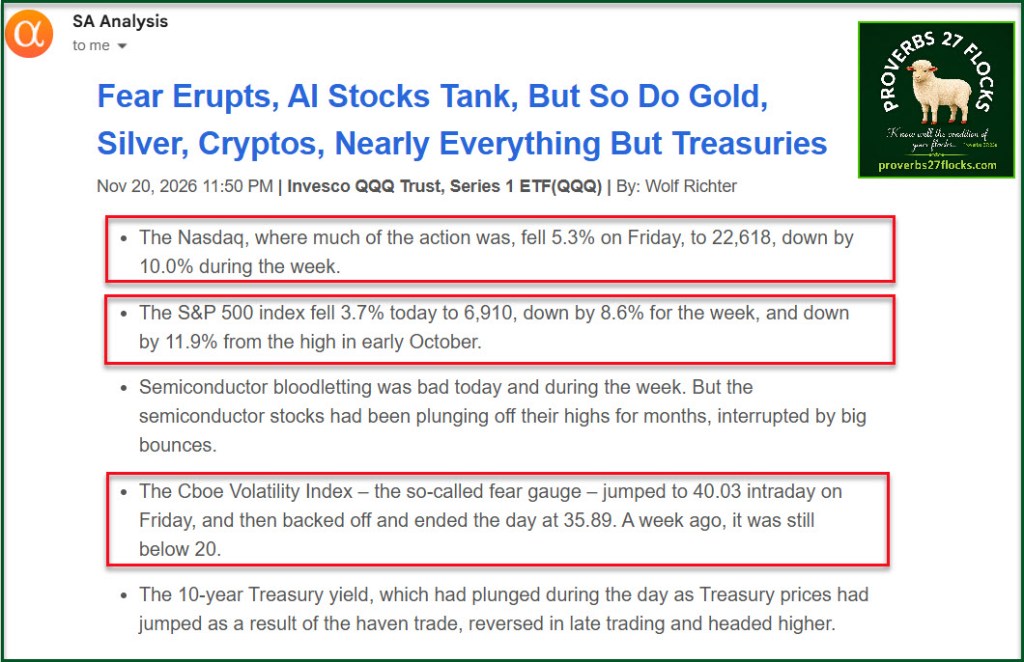
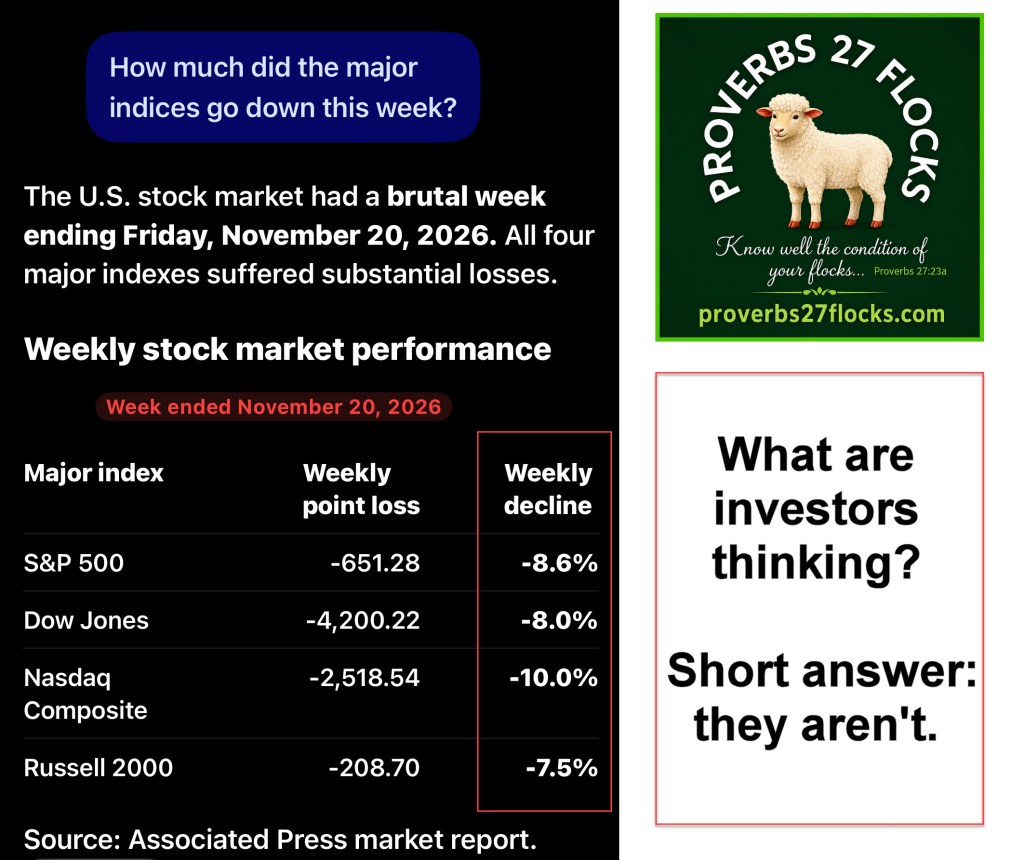
Sometimes you have to ask questions about crazy and emotional behaviors. This week is no exception. You can never assume that investors are thinking. Far too often the responses are at the core, emotional. Fear is a powerful motivator, but it is rarely a helpful emotion for those who invest wisely.
What Are Investors Thinking?
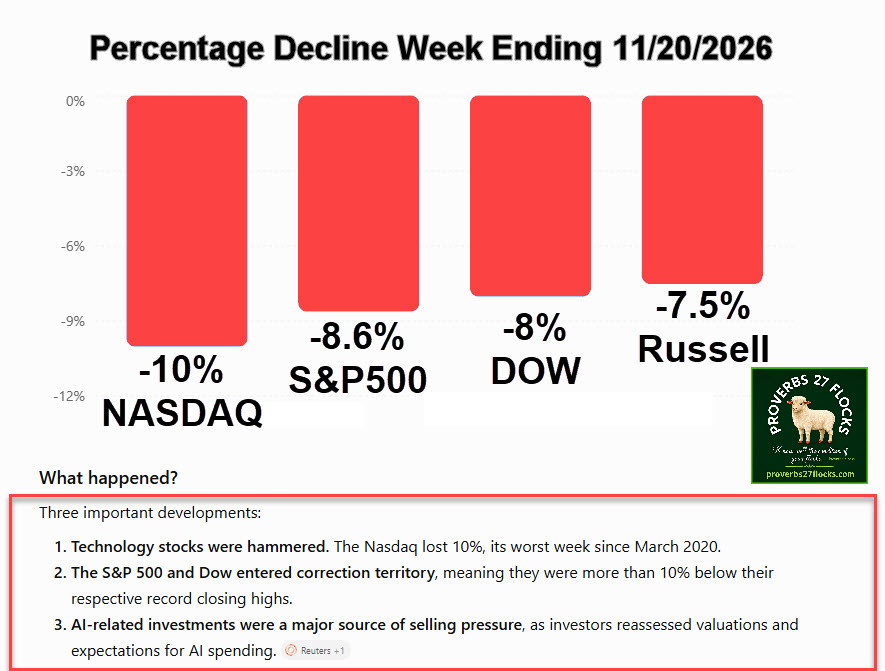
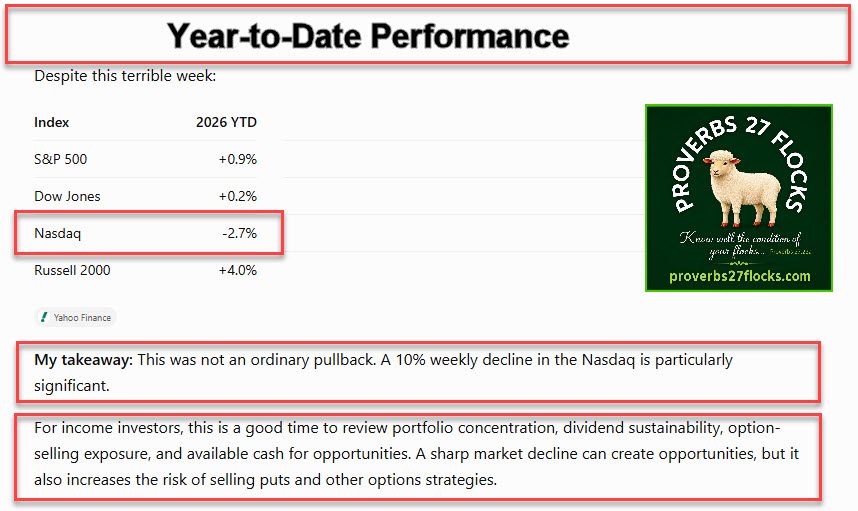
The losses shown in the following ChatGPT images are not indicative of the losses on our accounts. I have a different strategy than the herd. But even my strategy isn’t a guarantee of success or of “safety.” Many things, if not all things, are out of my control. But one thing I can control is my thinking and my behaviors. I can also keep my emotions in check. This post will help those who want to have a similar way of looking at last week.
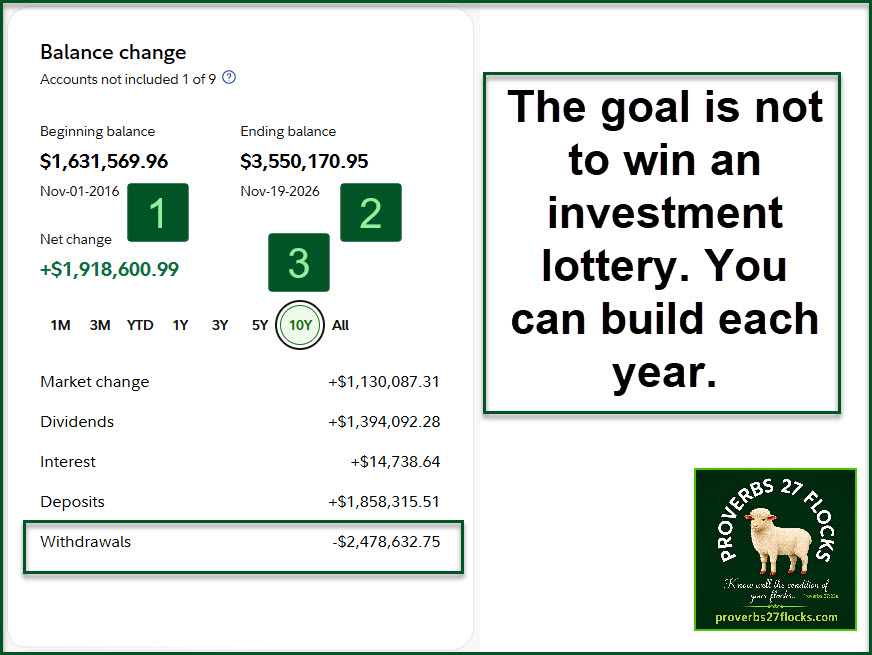
10-Year Balance Changes
Bear in mind that I have been retired for fourteen years. During those years we have withdrawn and given from our investments. This includes purchasing a 2020 Ford Escape, multiple trips with granddaughters (Hawaii and Costa Rica), traveling to Guatemala, and various home upgrades. We have also paid a lot of property tax and income tax during those years. Nevertheless, the account balances have grown, and our passive income has grown.
The Illusion of Safety: Bonds
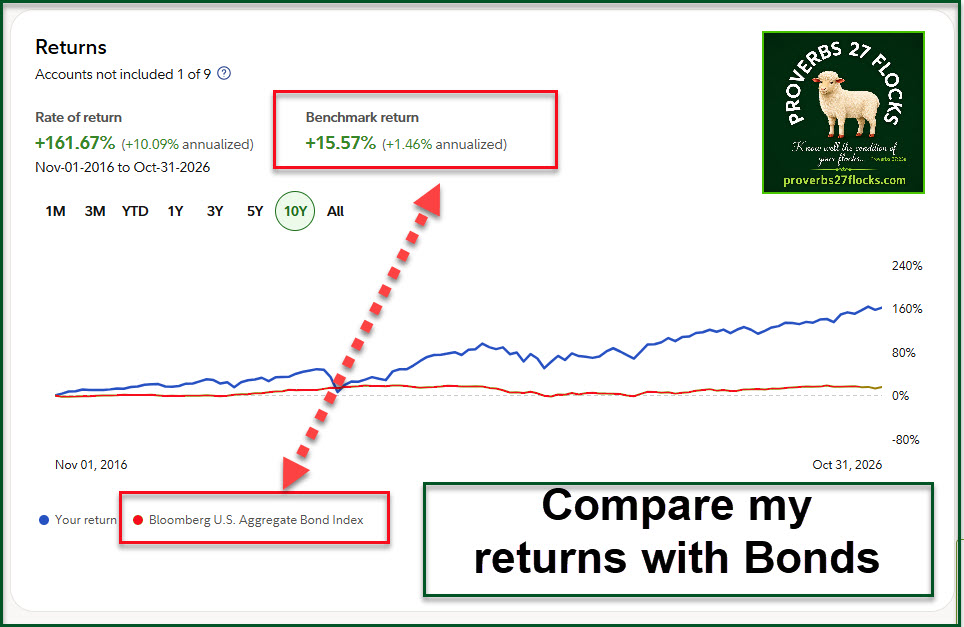
During downturns bonds start to look attractive to those who don’t understand them. If you know anything about bonds, you will discover that they are never going to keep pace with inflation. They are almost as bad as an annuity. Here is how bonds have performed over the last ten years. This is an average, but bear in mind some bonds are only slightly better, and some are much worse.
Am I Losing?
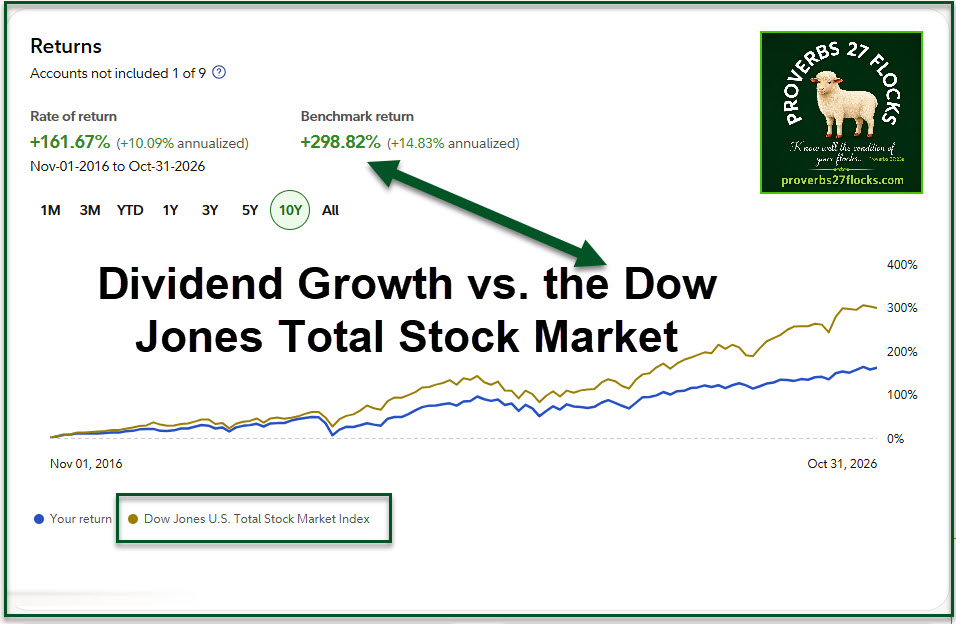
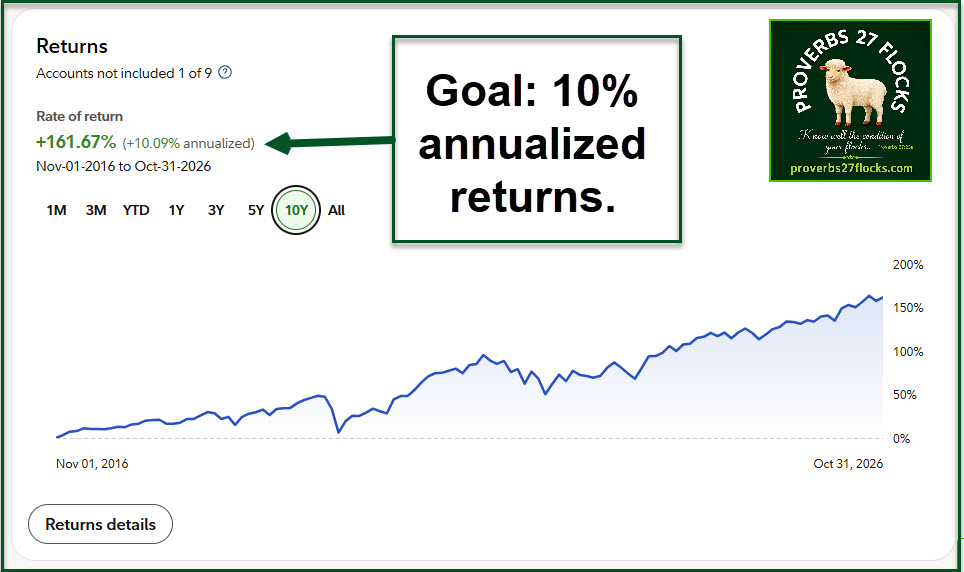
Some will be quick to point out that my returns compared to the total stock market returns lag by almost five percent. During the years we have realized 10.09% annualized returns, the Dow Jones U.S. Total Stock Market Index has delivered 14.83% annualized. There is merit in that comparison. But there is also a problem for the retiree. When you retire you cannot know when the NASDAQ will drop by ten percent in one week. That can make selling your investments to raise cash for your retirement living a less-than-ideal choice.
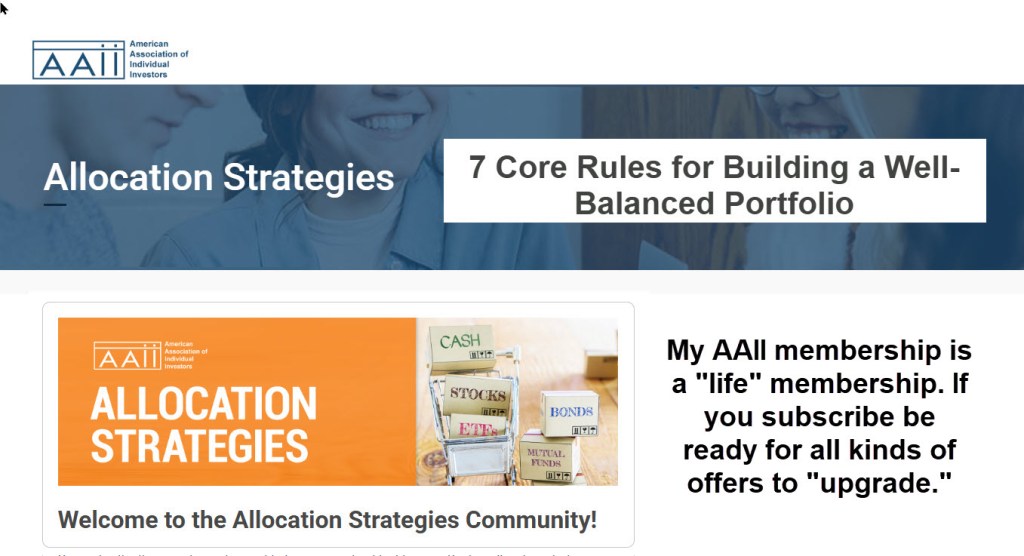
Perhaps the “Seven Core Rules” from a recent AAII Journal article would help you recenter your thinking in light of last week’s market correction. If that doesn’t help, I will conclude with what I rest in when the world and the stock market are shaken.
Here are Seven Core Rules (AAII)
What you might have as core rules for your investments and investing choices is based on a belief structure. If you think the world is flat you will behave differently than if you think it is a sphere. You will navigate investment waters with more confidence if you know where the reefs and harbors are. You will also learn that shallow water can set you aground, and that will make it difficult for your ship to move forward.
Rule #1: Have an Investing Plan and Stick to It
When the market goes down, you stick to the plan. When it goes up you stick to the plan. When it does anything you only consider adjusting your plan. Don’t discard or ignore your plan.
Rule #2: Aim to Remain Fully Invested
To be fully invested means to be invested in assets that are quality and can be reasonably expected to grow in value and provide total returns. Total returns are the increase in the price of the shares and the income derived from those investments.
Rule #3: Diversify Adequately
This should go without saying. Sadly, many think that because they have a lot of investments or a lot of mutual funds or ETFs they are diversified. That isn’t necessarily true. You can be diversified in the wrong assets, and you can also have too much riding on the top ten companies in the overall stock market. I’ve seen this in recent portfolios that I reviewed. Two ETFs held similar assets in their top ten.
Rule #4: Concentrate Your Holdings
Here is what the AAII article said: “It’s also important to consider concentration. Many investors don’t really manage their portfolios; rather, they collect stocks as they would coins or books without any thought to how they all fit together. Concentrating on a smaller portfolio may provide greater benefits.” It is better to have $10,000 invested in one solid ETF than $1,000 in ten different ETFs. Having more isn’t necessarily better.
Rule #5. Prune Losers and Let Winners Ride
Another friend has been holding on to an investment with the hope that it would recover. It might. However, I am not hopeful. You need to learn that taking a loss is a lesson. Don’t miss the lesson. The reason is simple. The future lesson will be even more painful than the present one.
Rule #6. Recharge Your Portfolio Regularly
You should have a watchlist of investments you want to add. Then, when you sell one of your losers or one (or a portion of) your winners, you can put the cash to work. Cash isn’t a bad thing. At the moment I’m sitting on a fairy large chunk of cash. As I get more cash from dividends and from options trading, I want to keep some for future investments and use most of the income for charitable giving and living expenses.
Rule #7. Be Careful When Mixing Stocks and Funds
Here is a wise example from AAII: “For instance, if 15% to 20% of your portfolio is in Apple Inc. (AAPL) and half of your portfolio is indexed to the S&P 500 index, your exposure to Apple is much higher than your individual stock position because Apple is one of the largest individual stocks, if not the largest stock, in the index. Your exposure gets to be doubled up pretty quickly, especially when it comes to the mega caps. While the S&P 500 is a broad market index, it is overweighted in mega- and large-cap stocks, so your mega- and large-cap exposure could be significantly higher than it appears.” This is often overlooked by novice investors.
I like ETFs, but I always examine the top ten stocks in each one before I buy. That way I understand if there is overlap with the stock investments I already hold.
Keep The Most Important Thing Front-and-Center
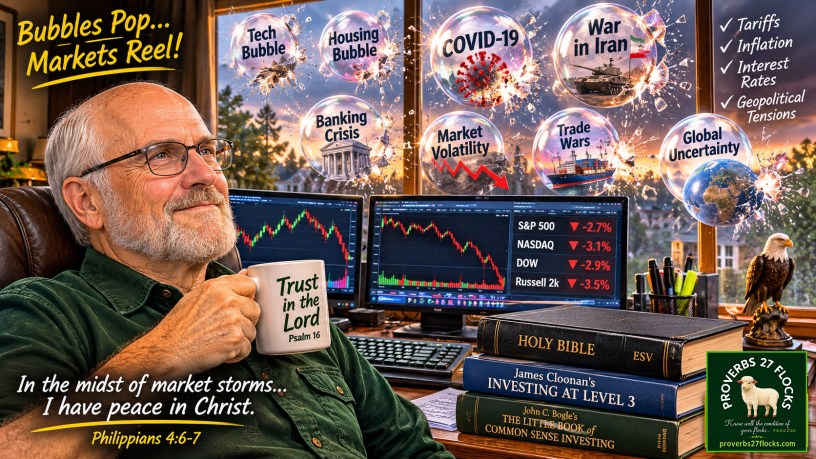
Were you “shaken” by last week’s market drop? I hope you noticed the coffee cup on the cover image. It says “Trust in the Lord” and it references Psalm 16. This kind of trust trumps all other trusts. Some trust in Wayne. Some trust in their political party. Some trust in their broker or financial advisor. That trust might be warranted, but it isn’t the most stable or lasting thing upon which your life can and should rest.

In Psalm 16:7-8 David sings, “I bless the Lord who gives me counsel; in the night also my heart instructs me. I have set the Lord always before me; because he is at my right hand, I shall not be shaken.”
Philippians 4:5-7 is also a helpful reminder. “Let your reasonableness be known to everyone. The Lord is at hand; do not be anxious about anything, but in everything by prayer and supplication with thanksgiving let your requests be made known to God. And the peace of God, which surpasses all understanding, will guard your hearts and your minds in Christ Jesus.”
Fundamental portfolio building tactics from my experience include the following.
1. Live within your means
2. No (Reduce to zero) Debt
3. Buy/Hold
4. Do not panic sell
5. Dividends: Dividends have been key to constructing my portfolio over the past 25 years.
6. Some cash on the sidelines is useful for emergencies and buying opportunities.
7. When a position doubles I consider selling half. Don’t spend time guessing about the future.
8. Use Seeking Alpha to research any and all investments. Recently a friend said he stopped using Seeking Alpha because it was expensive. After reviewing his portfolio, I concluded that not using it was far more expensive due to the losses he experienced. Had he used Seeking Alpha there were some investments he would not have purchased.
Eventually, the result is a portfolio which is essentially a private mutual fund with no (or low) management fees. It’s not rocket science.
All scripture passages are from the English Standard Version except as otherwise noted.
Seeking Alpha Subscription Information
Of all of the resources I use, the most helpful is Seeking Alpha Premium. The Seeking Alpha QUANT rating is a huge factor in my investment success. If you decide to explore a Seeking Alpha subscription, please use the following link. Seeking Alpha

SEEKING ALPHA INFORMATION AND Types of SUBSCRIPTIONS
There are several ways to subscribe to Seeking Alpha services. I use the “Seeking Alpha Premium” service. The other ones are 1) Alpha Picks, 2) Bundle Premium and Alpha Picks, and 3) Quant Growth and Income. The links for the promotions are on each of these four choices. I highly recommend “Seeking Alpha Premium” as a place to start.
You can also scan this QR Code to get the same information about Seeking Alpha Premium.

Past performance does not guarantee future results, Seeking Alpha does not provide personalized advice, and it is not a registered investment adviser.
We accept advertising compensation from companies that appear on our site. This website represents my opinions, which may not reflect those of Seeking Alpha, and does not constitute an investment recommendation or advice.
If you have any questions or problems getting connected to Seeking Alpha, reach out to them with this email address: subscriptions@seekingalpha.com

