

Slicing and Dicing Investments

I will start a new series of posts that are the result of a question one of my readers asked. Lisa asked for my thoughts about investment concentrations: “We certainly have some concentrations, but I have heard some analysts that encourage investing in what’s working (IT and health care) vs a set percentage in each. I am wondering if you have thoughts on that. I know you prefer highly rated, dividend producers, but also go for more volatile, highly optionable solid stocks that don’t pay dividends. Just curious your thoughts.”
First of all, this is an excellent question from a “student” who has made great progress in her investing journey – as has her husband. They eagerly learned how to trade options contracts and have had considerable success. She said, “Let me start with, thank you! We appreciate your time, materials, and encouragement to show us that we would be able to do this ourselves. We have a lot more to learn, but keeping it simple, we have had amazing returns compared to our previous decades.”
Secondly, while it is wise to look at the big picture, it is also wise to look at the pieces of the puzzle. Much as a chef puts together a recipe for a delicious meal, the wise investor adds ingredients to their portfolio and then looks at the results. Was the intended outcome realized, appetizing, and worth the effort?
I will break this out into a series of posts. The first one addresses Lisa’s inquiry about “highly optionable solid stocks” lacking a dividend component. Then I will talk about the same type of investments that pay a dividend and can be used for options trading. Future editions of this series will include BDCs, Alternative ETFs, Dividend Growth ETFs, REITs, and my current top ten investments. Let’s get started.
Highly Optionable Solid Stocks without Dividends

While I am primarily a dividend-growth investor, it would be wrong to say that is the only ingredient in our portfolio. We own REITs, BDCs, non-dividend paying investments, dividend growth ETFs and dividend growth stocks. In general, I think owning dividend-producing stocks that can also be used for options contract trades is the ultimate income-generating recipe for success. Having said that, we own stocks that don’t pay a dividend. Examples include AMZN, CRDO, SMCI, UAL, SEZL, and FSLR.
The following spreadsheet image shows all of our current non-dividend investments. Before I go any further, be aware that my holdings are NOT a recommendation. They are an illustration. However, there are some things you can learn from the illustration.
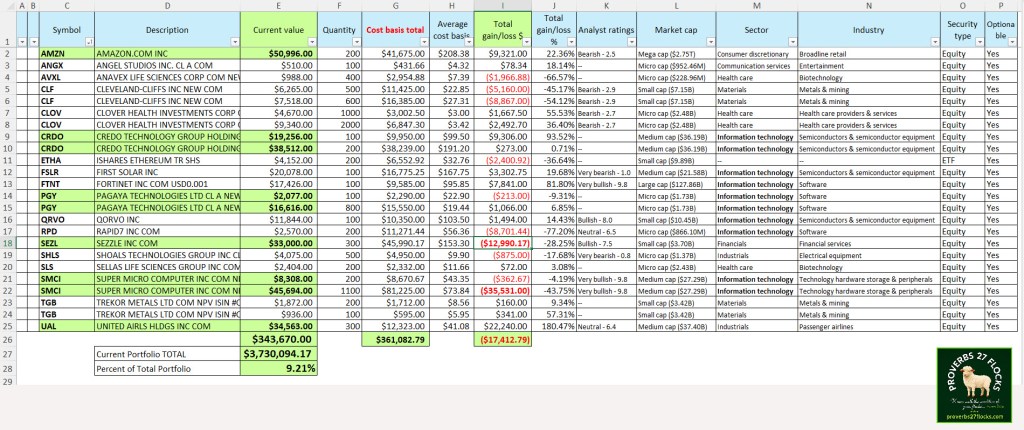
First of all, the non-dividend holdings are only 9.21% of our total investments. Secondly, the ones highlighted in green make up almost $250K of the $344K of non-dividend stocks/ETFs. Thirdly, it looks like I am losing money if you look at Column “I.” However, bear in mind that I trade options on these positions.
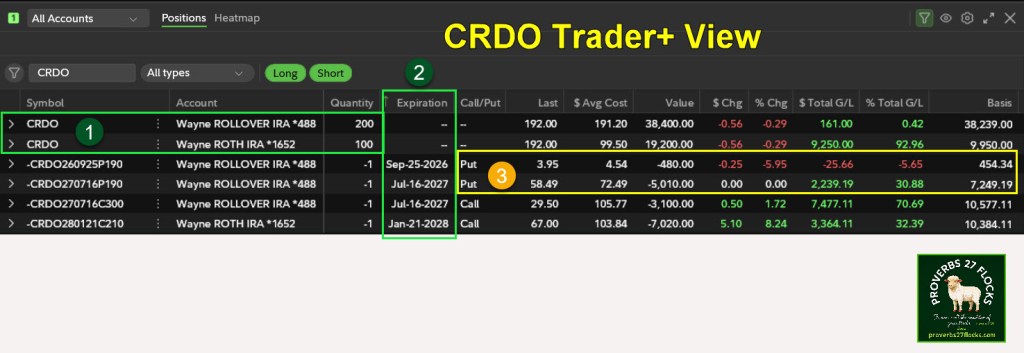
For example, (in only 2026 YTD, not previous years) I have earned $22,995 in call and put option trades with my CRDO investments. I have earned $3,597 trading options on AMZN. $6,474 has come in from trading options on SMCI shares. If you look at all of my options trades for 2026 YTD, I have earned over $144K trading options, so CRDO and SMCI have contributed to that total.
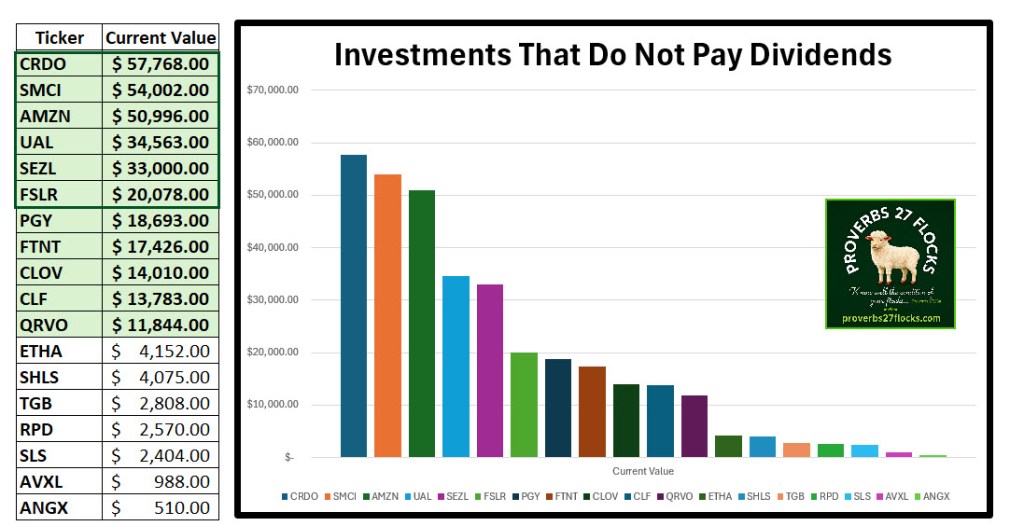
The other thing you should notice is that a large percentage of the holdings that don’t pay a dividend are technology stocks. $182K of the total is “Information Technology.” United Airlines is the one odd duck in the mix.
I don’t think it is in your best interest to try to “balance” your portfolio according to some template. Far better is the approach to buy quality investments in every sector. Having said that, I think Information Technology, Healthcare and the Financials offer the best opportunities.
The Short Answer I Gave Lisa
Concentrations are not necessarily bad or ill-advised. I do like stocks that don’t pay dividends. For example, I think CRDO is an excellent investment. I own CRDO and trade options on my shares.
The Longer Answer
You must be patient when selecting any investment. So, for example, my shares of SMCI have had a very volatile ride. Some days the shares bounce up on good news and other days the share price dives due to perceived bad news. The ideal, in my mind, is to find investments with an upward trajectory that pay a dividend and that can be used to trade weekly options. Having said that, there is significant income to be gained by including stocks that don’t pay a dividend.
I welcome questions and comments. They help me understand the needs of my readers.
Seeking Alpha Subscription Information
Of all of the resources I use, the most helpful is Seeking Alpha Premium. The Seeking Alpha QUANT rating is a huge factor in my investment success. If you decide to explore a Seeking Alpha subscription, please use the following link. Seeking Alpha

SEEKING ALPHA INFORMATION AND Types of SUBSCRIPTIONS
There are several ways to subscribe to Seeking Alpha services. I use the “Seeking Alpha Premium” service. The other ones are 1) Alpha Picks, 2) Bundle Premium and Alpha Picks, and 3) Quant Growth and Income. The links for the promotions are on each of these four choices. I highly recommend “Seeking Alpha Premium” as a place to start.
You can also scan this QR Code to get the same information about Seeking Alpha Premium.

Past performance does not guarantee future results, Seeking Alpha does not provide personalized advice, and it is not a registered investment adviser.
We accept advertising compensation from companies that appear on our site. This website represents my opinions, which may not reflect those of Seeking Alpha, and does not constitute an investment recommendation or advice.
If you have any questions or problems getting connected to Seeking Alpha, reach out to them with this email address: subscriptions@seekingalpha.com


Thanks for creating this series, I am looking forward to reading more
LikeLiked by 1 person