

Who Will Have Authority and Control?

In this series I am exploring preparedness. One thing most people don’t do well is prepare for things that happen to “somebody else.” So “someday” “somebody else” might face something that makes management of life (physical and mental) and decisions regarding finances and health difficult or impossible. That is the reason for the grasshopper on the whiteboard. Young grasshoppers hop, but they don’t know that some day they will drag themselves along the ground to get from one place to another. Of course, they cannot prepare for that day.
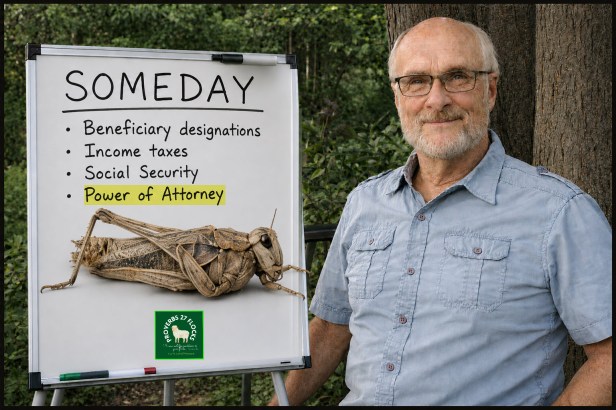
Every week I make decisions for and act on behalf of Cindie’s brother. Yesterday we visited him at Beehive Homes in Oregon (Wisconsin) and I asked him for his wishes regarding charitable giving from the small amount he receives from Social Security that isn’t already being paid to cover his living costs. He is still able to answer those types of questions, but he isn’t able to do any of the things I do for him. He cannot pay his bills, use the internet, manage his WisPact trust fund, or write a check. He doesn’t understand the rules for Social Security or Medicaid. He cannot perform even basic tasks on a computer, and a “smartphone” is too smart and complicated.
The same thing was true when Cindie’s mother was alive. Almost every day I was making financial decisions as her “Power of Attorney” for finances. I managed her bank account and her investment accounts at Fidelity Investments. I made decisions including the following. I “fired” her former advisors because they were high-cost. One was incompetent and his decisions were appallingly wrong-headed and destructive. Because I was her POA I was able to sell her car when she could no longer drive and invest the proceeds. We were able to enlist a realtor to sell her home in Milwaukee when she could no longer live on her own. I could also buy and sell investments on her behalf and pay all of her bills when she lived at her home, then in her apartment, and finally at Beehive in Oregon. Thankfully, she had Cindie and me join her at her attorney’s office BEFORE she could no longer make decisions.
It Won’t Happen to Me?
Why should you care? Do you know what will happen this week? The answer is “no.” In fact, only the good Lord orders your steps. Proverbs 16:9 says something most don’t want to hear: “The heart of man plans his way, but the Lord establishes his steps.”
The goal isn’t to give up, but to think realistically. Ecclesiastes 11:8 “So if a person lives many years, let him rejoice in them all; but let him remember that the days of darkness will be many. All that comes is vanity.” So live rejoicing in God’s willingness to have you live a long life, but don’t live in a way that will make life painful and difficult for you and for the ones you love.
What might happen that is not under your control? Many things. Actually all things are really out of your control. But you can grant power to those who love you and who can help you in the future. Perhaps a dose of reality is needed. Here are some things to think about.
Strokes: This isn’t just OLD People!
While it is true that most of the people who have a stroke are older, and stroke risk increases with age, strokes can—and do—occur at any age. According to the CDC, “In the US, stroke is a leading cause of serious long-term disability—and more than 795,000 people have a stroke each year (about 610,000 first/new strokes and 185,000 in people with a prior stroke).” – CDC
The CDC reported that in 2014, 38% of people hospitalized for stroke were less than 65 years old. Think about the things you cannot do if you are immobile or if you are struggling. Everything you do in a normal day could be altered by your new limitations.
Other Causes Can Be Limiting or Debilitating
Think about the events that might limit your ability to make decisions or take action with a clear mind. In addition to a stroke, cancer, extreme pain, an accident, or a disease like Alzheimer’s or any cognitive decline. You might lose your hearing and/or your vision. These things happen to many somebodies, and you might join their ranks. There is a way to reduce the difficulties.
Power of Attorney – This is the authority to act on behalf of a person in certain specified matters, such as financial dealings, or in general. It I a legal document granting such authority within specific limitations or parameters of your choosing. This gives someone you trust the legal authorization to act as your agent. Without these authorizations, you are at the mercy of people you don’t know and who might not take care of you the way you desire.
A durable power of attorney is a legal document that allows a trusted individual to make financial or health care decisions on your behalf even if you become unable to handle your own affairs.
This document provides long-term safeguards, ensuring your affairs are managed without court intervention.
Durable POAs are commonly used in estate planning, health care planning, and financial management. They give family members and trusted individuals the legal authority to step in when needed without having to go through lengthy court proceedings. Because the agent may have broad powers, choosing the right person is crucial. Abuse of POA authority does happen, so it’s best to select someone trustworthy and, if possible, have checks and balances in place.
A Financial Power of Attorney in Wisconsin is a legal document that allows someone you trust to manage your financial affairs if you become unable to do so yourself. This document can grant your agent the authority to pay bills, manage investments, and make other financial decisions on your behalf. It is best to check the rules for your state or engage an attorney to help you set up the POA for both healthcare and finances.
If you don’t have a healthcare POA (Power of Attorney for Health Care)
- Hospitals and clinicians can’t rely on “family says so” for major decisions. Without a Wisconsin Health Care POA, someone you choose doesn’t automatically gain legal authority to speak for you if you can’t.
- Family may need court involvement in serious situations. In many cases, your family would have to pursue legal authority (often through guardianship) so a judge can approve who can make healthcare decisions.
- Your wishes may still be partly available if you have other documents. For example, a Wisconsin Living Will/Declaration to Health Care Professionals can give specific instructions for limited end-of-life scenarios, but it does not name an agent to make broader decisions. Also, a Wisconsin DNR (if you qualify and complete it) can address resuscitation preferences.
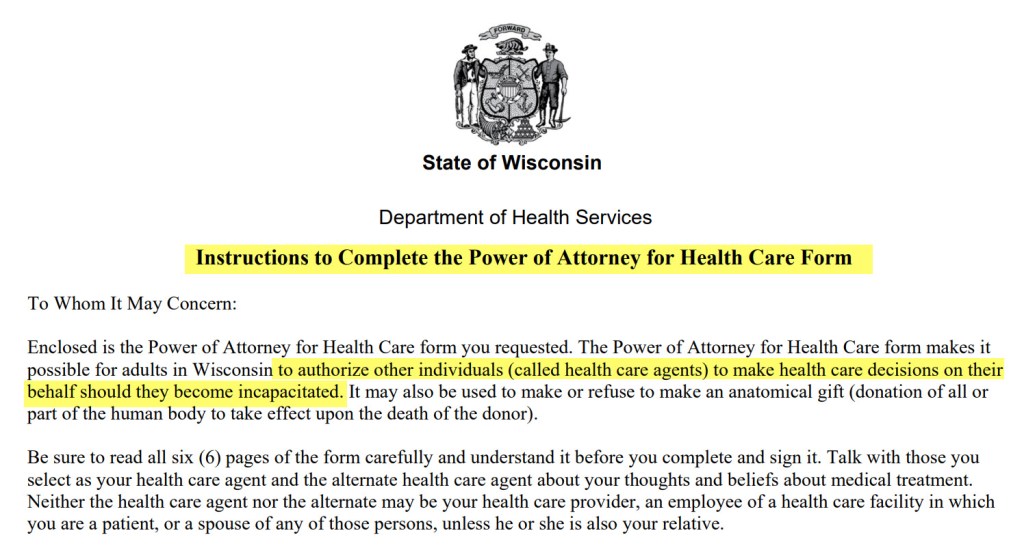
If you don’t have a financial POA (Power of Attorney for Finance and Property)
- Nobody chosen by you can automatically manage your finances. If you become unable to handle financial matters, there typically isn’t an “automatic” substitute authority just because a spouse/child is involved.
- Your family may need a court process to handle finances. Your family may have to seek court appointment of a guardian/conservator (or other court-ordered decision-maker) to manage finances. This is slow and may be very expensive. Furthermore, if you don’t act and have multiple family members, you can make the family struggle to know who really is in charge.
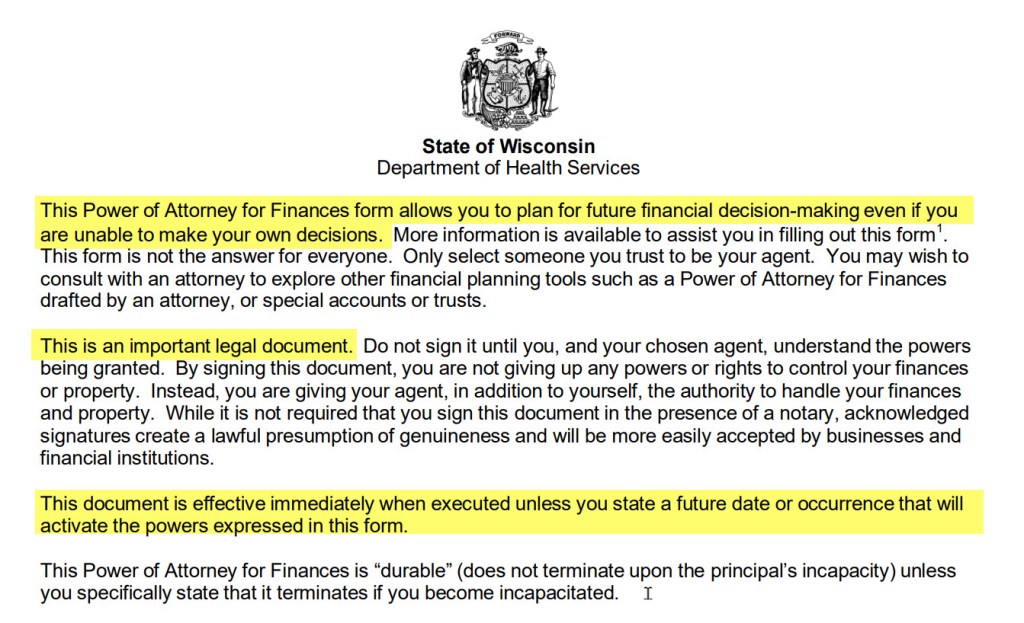
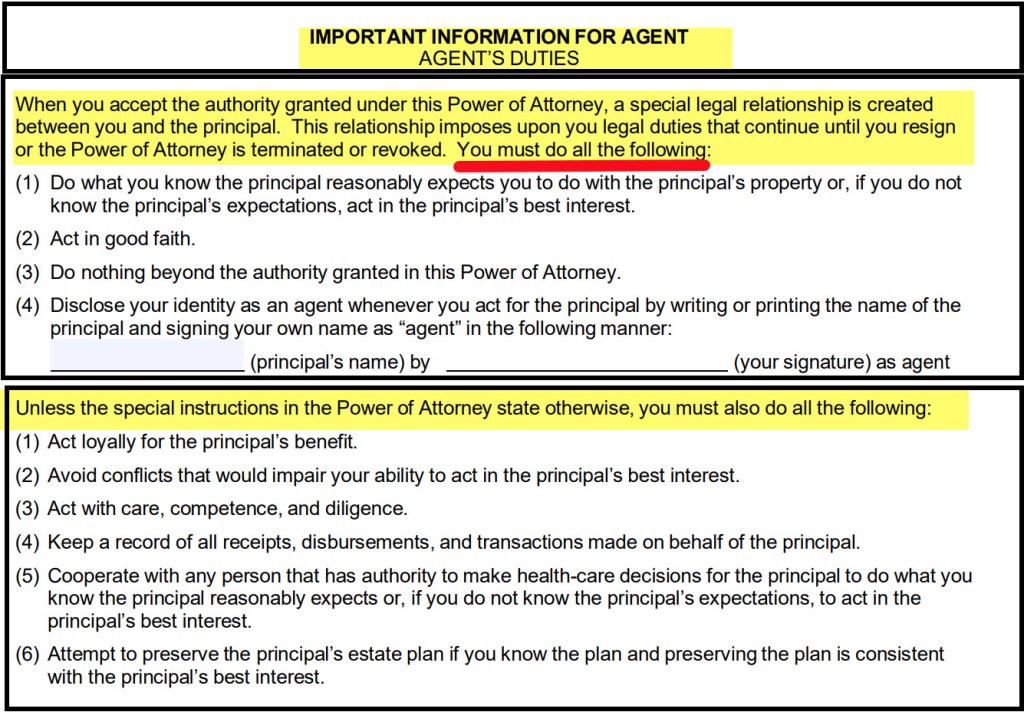

What you can do now (actionable)
- If you want control, the key move is completing Wisconsin-specific forms:
- Power of Attorney for Health Care
- Power of Attorney for Finance and Property
- Make sure your chosen agents have copies and your clinicians/facilities can find them.
An advance directive describes, in writing, treatments you want or don’t want. It tells others what to do with your care if you get injured and can’t express your wishes. You can complete an advance directive if you are 18 or older and of sound mind.
Wisconsin Department of Health Services (DHS) has advance directive forms online. These forms are meant for you to complete without needing help from an attorney. However, you may have a situation or concern where you do want to seek legal advice from an attorney.
The forms we have include:
- Declaration to Health Care Professionals (Wisconsin Living Will)
- Power of Attorney for Health Care
- Power of Attorney for Finance and Property
- Authorization for Final Disposition
You may also get these forms, or similar forms, from your attorney, doctor, or hospital.
The Poetry of Aging
One final reminder from King Solomon’s book of Ecclesiastes. Some day you might not spring out of bed. You might not see clearly, and your hearing might go away. (It is difficult to talk to the person who does your income taxes if you cannot hear the questions they ask.) You will be like an old grasshopper. Have you seen an old grasshopper? They don’t hop, they drag themselves with their front legs. Here is Ecclesiastes 12:1-8.

Why This Matters – Your Action Today
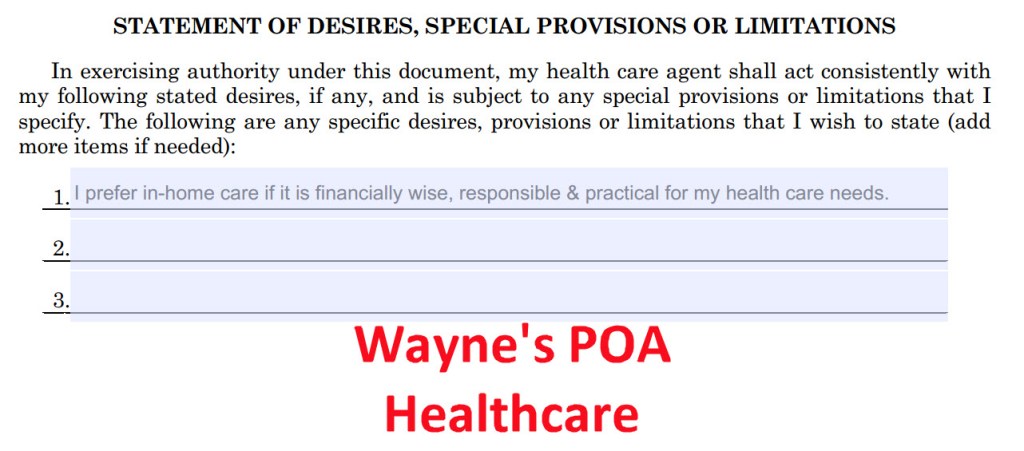
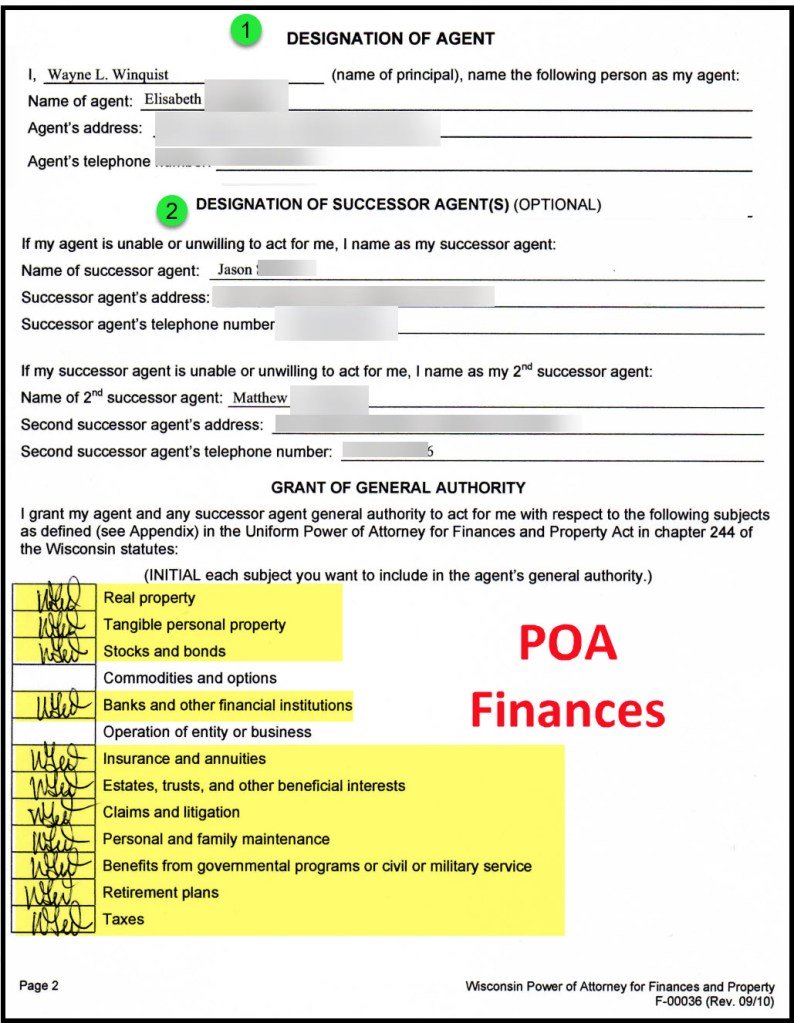
Cindie and I have POA directives. These images are from my actual POA forms. Note that I gave a “STATEMENT OF DESIRES, SPECIAL PROVISIONS OR LIMITATIONS” about a preference for in-home care if it is financially wise, responsible & practical for my health care needs.
Action Items
- If you don’t have POAs for healthcare and finances, don’t drag your feet. Someday you might be dragging your feet, and you will need someone to help you navigate your financial and healthcare life.
- Have a conversation with family members or the person(s) you want to help you if (when) the time comes. Make certain that they have a copy of your POA directives.

