
Covered Call Option Contract Roll
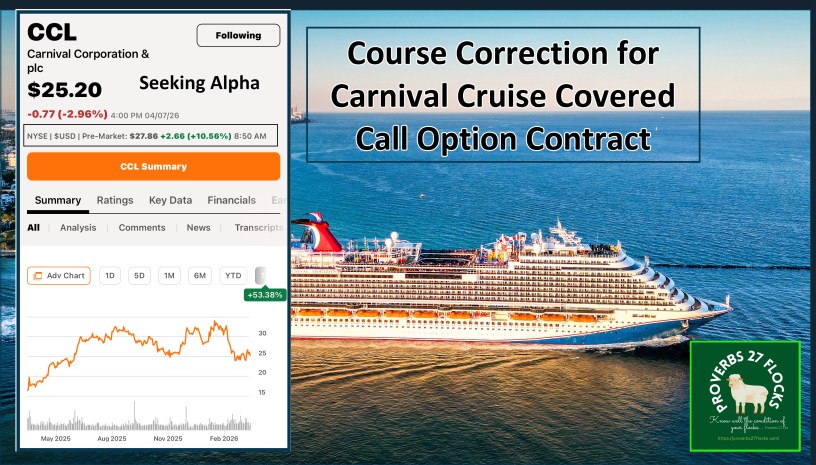
Yesterday the stock price for Carnival Corporation experienced a big upward movement of 11.23%. This was due to the “good news” that the Strait of Hormuz might open to traffic. The entire stock market seemed to celebrate short-term news of hope of an end to that conflict. This caused me to think about my CCL cash covered call option contract. I took action.
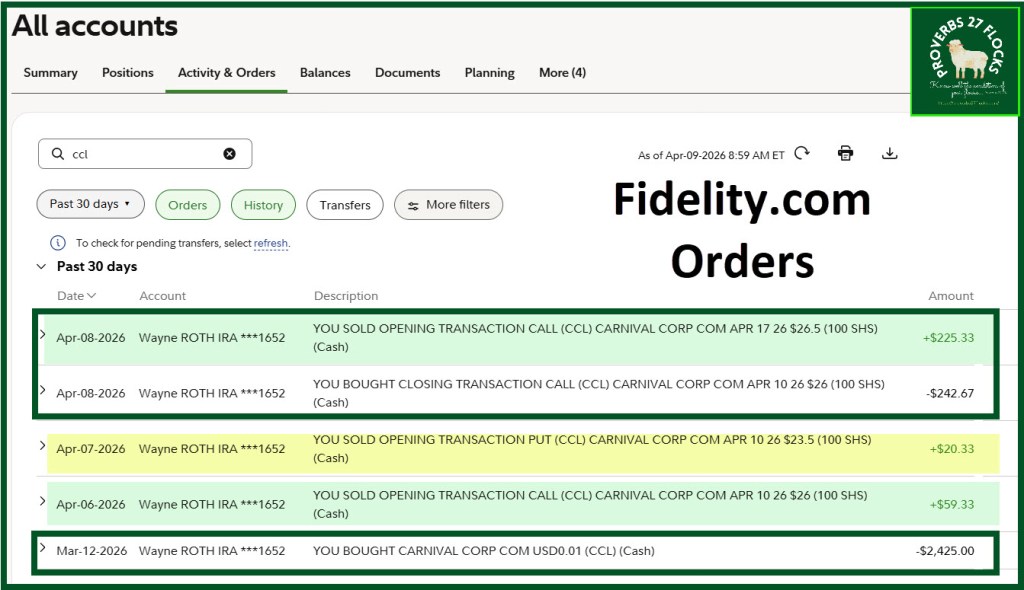
I have two options contracts for CCL. One is a cash covered put that expires tomorrow and is priced at $23.50. Given the upward price movement, I probably won’t be buying those shares at that great price. However, I do get to keep the $20.33 premium that I received for doing that trade. No action is needed for that contract.
The cash covered put is a different story. The good news is that I purchased the 100 CCL shares on March 12 for $24.25 per share. The “bad” news is that my covered call option was for $26 per share. Given the current share price of about $28, you can see why someone was willing to pay me $60 (I received $59.33 after Fidelity’s commission) to be able to purchase my shares at $26. They might be happy, but I have a way to change course. It is called rolling the contract to a higher price and to an expiration date farther into the future.
Covered Call Roll
When I was in the US Navy, if the ship was rolling it was possible to get seasick. Thankfully that only happened to me during my first time at sea on the USS Bagley (DE-1069 or FF-1069). After that I got used to rolling with the ocean swells.
I’m also used to rolling covered call options contracts. The goal in a roll is to raise the price for my shares and to make some money doing so. Because the contract priced at $26 was going to be called on Friday, I decided to roll the price up to $26.50, guaranteeing another $50 of profit on my 100 shares. However, it cost me $17.34 to buy back my $26 contract and sell a new covered call contract at $26.50.
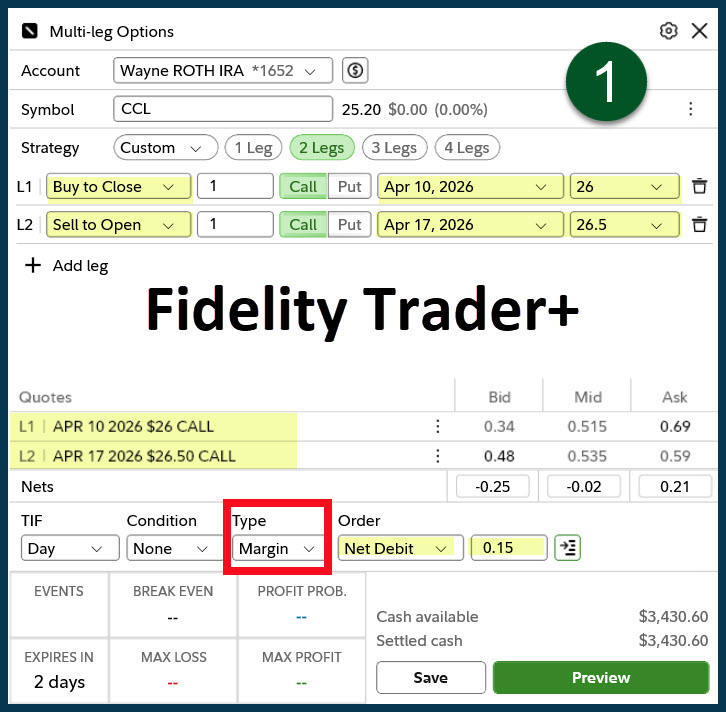
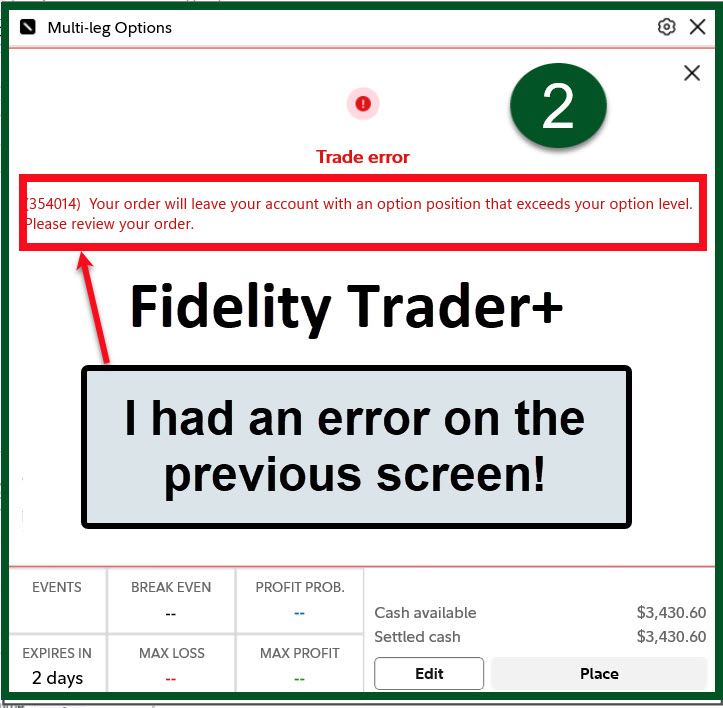
You don’t want to use Margin when investing. That adds cost and significantly increases your risk.
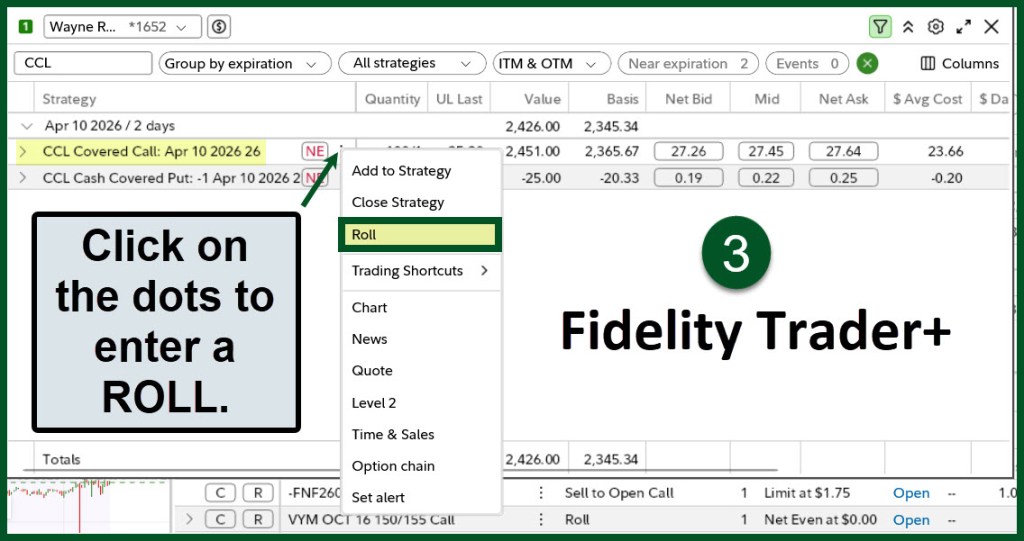
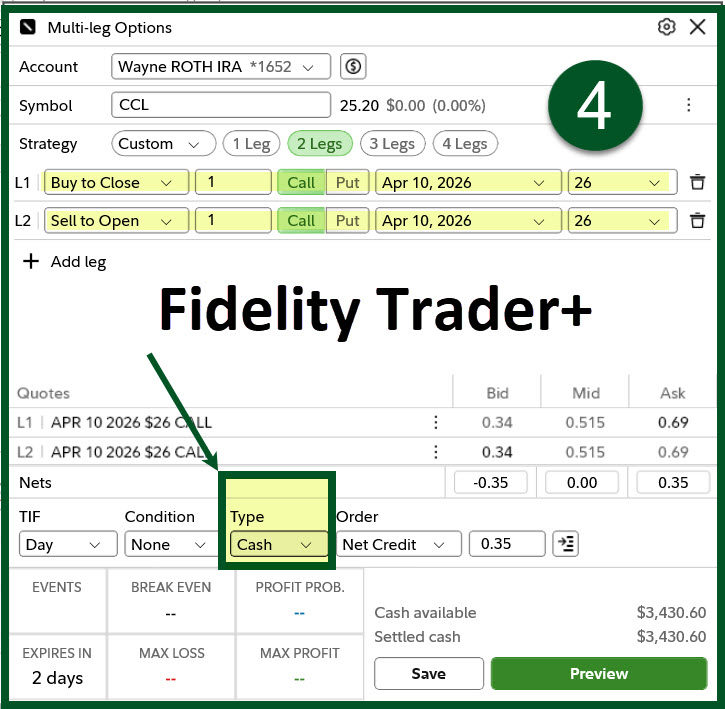
I want to roll the original $26 CCL Covered Call Contract.
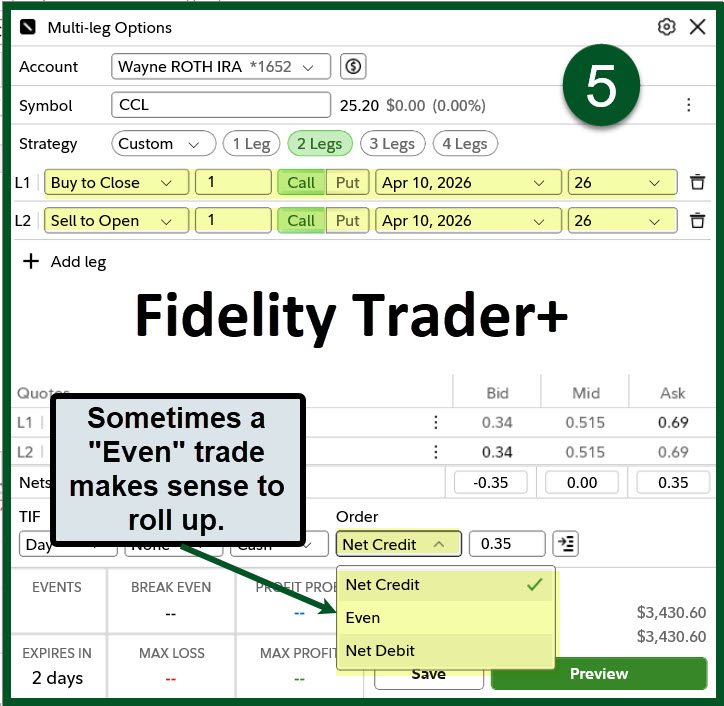
You can choose the type of ROLL you want to do. Even is often a good choice. You almost break even with that choice except for Fidelity’s small commission. The best choice is NET CREDIT. Read the section about net credit and net debit at the end of this post.
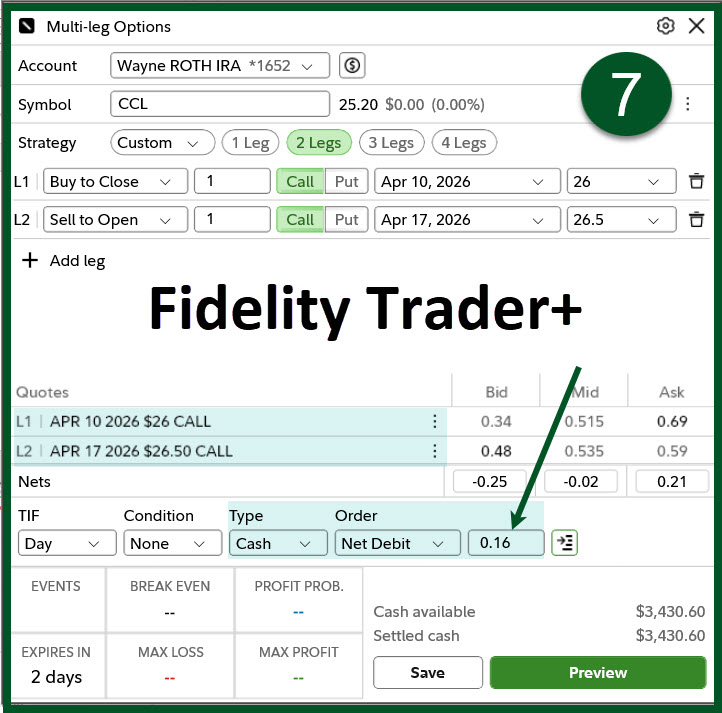
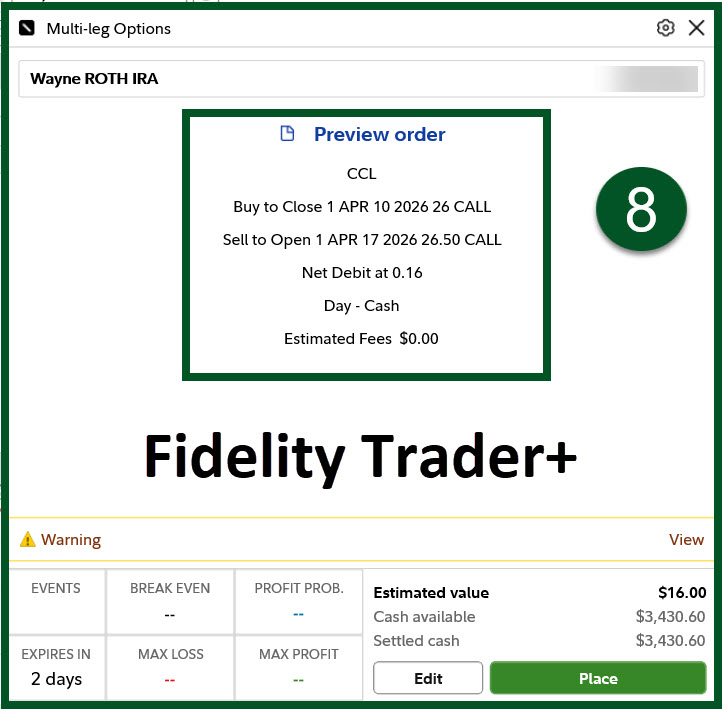
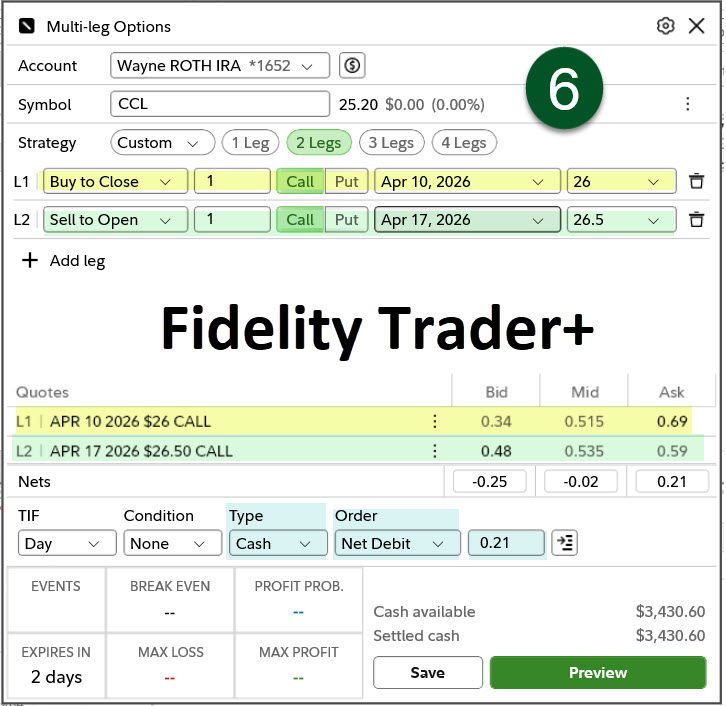
I was willing to pay (NET DEBIT) to roll the contract up from $26 to $26.50. This also delays the expiration of the contract.
What The Roll Accomplished
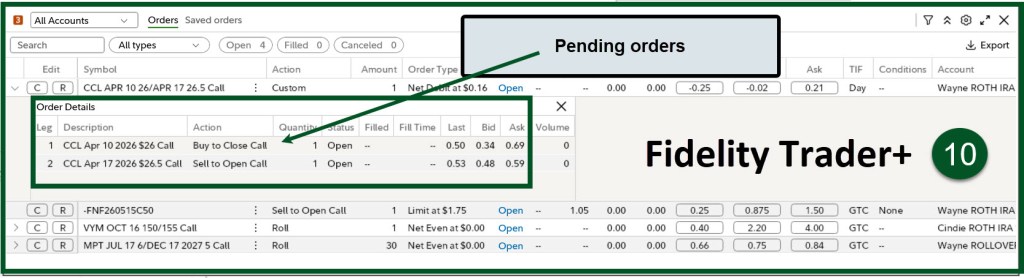
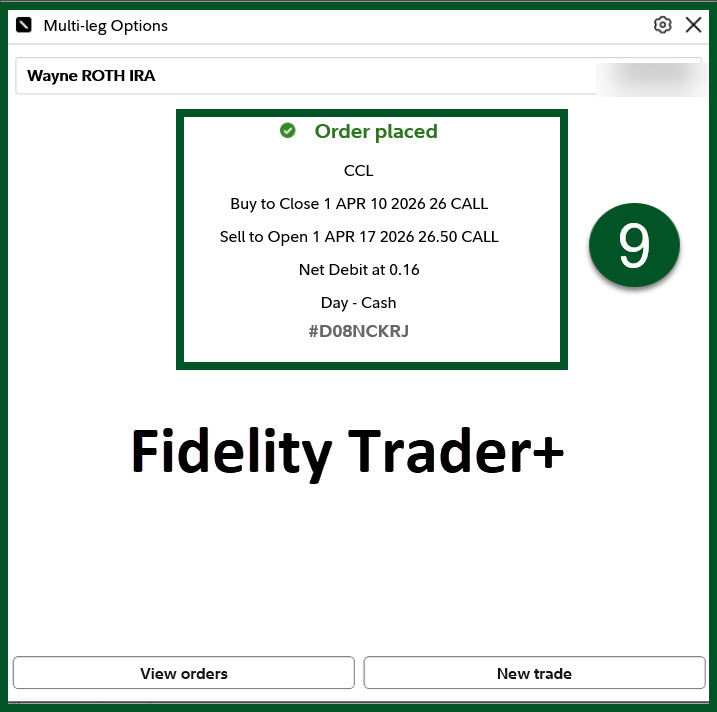
Any contract roll consists of two separate orders that Fidelity submits simultaneously. The first trade is a “BUY TO CLOSE” the $26 contract scheduled to expire April 10. The second, submitted at the same time and linked to the buy to close is a “SELL TO OPEN” a new covered call contract at $26.50. Clearly, if I had to pay $17.34 to execute this roll trade, my net increased profit is not $50. It might be $32.66. But there is another factor to consider. The new covered call contract expires Friday, April 17. Given the fluctuation in the market due to various factors, like the war in Iran, the price of the shares could dip below $26.50. That opens more opportunities for additional trades.
If you follow this line of reasoning, you will also realize that my original option profit of $59.33 is reduced by the $17.34 I spent to roll the contract. However, I am still in positive territory, and I believe I can leverage this going forward. In fact, as I type this the price of CCL shares has fallen to $27.68. The stock market (traders) can be very fickle. The war isn’t over.
Options Lingo: What is a Net Debit?
Net debit refers to the total cost to complete a transaction, specifically in options trading, where it is calculated as the amount paid for buying an asset minus the amount received from selling an option. It represents the out-of-pocket expense and is also considered the break-even point for the transaction.
Options Lingo: What is a Net Credit?
Net Credit in an options contract refers to the amount received when selling an option, which is higher than the amount paid for buying another option, resulting in a positive cash flow at the initiation of the trade. This is a key feature of credit spreads, where the total premium received exceeds the total premium paid.
Seeking Alpha Subscription Information
Of all of the resources I use, the most helpful is Seeking Alpha. The QUANT ratings is especially helpful for avoiding terrible investments. If you decide to explore a Seeking Alpha subscription, please use the following link. Seeking Alpha

SEEKING ALPHA INFORMATION AND SUBSCRIPTION
You can also scan this QR Code to get the same information.

Past performance does not guarantee future results, Seeking Alpha does not provide personalized advice, and it is not a registered investment adviser.
We accept advertising compensation from companies that appear on our site. This website represents my opinions, which may not reflect those of Seeking Alpha, and does not constitute an investment recommendation or advice.
If you have any questions or problems getting connected to Seeking Alpha, reach out to them with this email address: subscriptions@seekingalpha.com
 Know Your Flocks & Herds
Thanks Wayne,i experienced a similar action with CRDO yesterday after market opening. On Monday of this week I sold a 115 strike covered call for 1.15 to expire 4-10. On Wednesday I rolled to the 117 strike for next week for a net credit of 1.75 I expect CRDO may do well in the coming months with their settling the TE issue. I will watch them next week and roll again if needed.I’m satisfied with the two transactions as I dont feel i got greedy and am comfortable with the 117 strike.,have a good weekend.
LikeLiked by 1 person