

Why Three and Not Just One?

Inflation is usually defined as, “A persistent increase in the level of consumer prices or a persistent decline in the purchasing power of money.” – The American Heritage® Dictionary of the English Language, 5th Edition. In other words, the quarter I had when I entered the candy store as a child in 1958 is not worth much in 2024. But there are a couple of related types of inflation that go unnoticed and that are also harmful.
Inflation Number One: The Cost of Goods and Services
This is the inflation that most of us think of and see regularly. A recent post on X by former President Trump shows one set of numbers. I did not verify them for accuracy, but I can say that our car insurance premiums have skyrocketed. The cost of groceries and eggs have also gone up considerably. The bottom line is that the typical Social Security “Cost of Living” increase is not keeping up with real inflation.

Inflation Number Two: Less Product
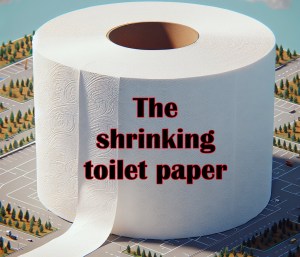
Most people don’t see this one, but it happens all the time. I’ve seen it with coffee, strawberry jam, soft drinks, snacks, and toilet paper. There are many other examples. When a producer or manufacturer sees their costs rising for labor and materials, they have to either increase their prices or give you less of the product. In the case of toilet paper, you get less Charmin to squeeze. In the case of strawberry jam, you make fewer sandwiches.
Here is a link to an interesting article about the history of toilet paper costs.
The Sources of These Two Are Government Policy Driven



If the government prints more money, then there is more money available. This creates a cycle of increasing inflation. We get the government we deserve when we elect officials who have no economic sense. There is no balanced budget and there will continue to be both increasing federal debt and interest payments on the debt.
According to Forbes, (May 20,2024) “U.S. Passes $1 Trillion Quarterly Interest On The Public Debt.” That means just the interest payments on our national debt are $4 Trillion dollars. If you don’t think that creates more inflation, you are sadly mistaken. There are, of course, economists who claim there is no relationship between the national debt and inflation. I think that is wishful thinking.
Inflation Number Three: No Satisfaction
This one has to do with what we treasure. Far too often our focus is on things that don’t last and that only satisfy for a very short period of time. Food is that way, as is the shiny new car, or the vacation to a luxurious resort. The Bible reminds us that satisfaction can be temporary. We have inflated desires but the ways we seek to find satisfaction are less than satisfactory. It takes more of the same to satisfy, and there is never enough.
Here are two reminders about this type of catastrophic inflation:
“The leech has two daughters: Give and Give. Three things are never satisfied; four never say, ‘Enough’: Sheol (the grave), the barren womb, the land never satisfied with water, and the fire that never says, ‘Enough.’” – Proverbs 30:15-16
“And he (Jesus) told them a parable, saying, ‘The land of a rich man produced plentifully, and he thought to himself, ‘What shall I do, for I have nowhere to store my crops?’ And he said, ‘I will do this: I will tear down my barns and build larger ones, and there I will store all my grain and my goods. And I will say to my soul, ‘Soul, you have ample goods laid up for many years; relax, eat, drink, be merry.’” – Luke 12:16-19
Sadly, this parable ends with the rich man dying. He did not, however, have lasting treasure. This is a reminder for investors: Don’t stockpile your wealth in this short life. Store up treasures in heaven. That isn’t my advice, that is the recommendation of Jesus.
All scripture passages are from the English Standard Version except as otherwise noted.
 Know Your Flocks & Herds
Wayne,
I have a question unrelated to inflation. You have shared that you have UGM Accounts for children and grandchildren. My wife and I now have 2 grandsons born in the last couple of months. We’d like to help them. We’ve considered 529 accounts or UGMAs. What should we consider in deciding? Obviously we’re talking to our children about what might be more helpful in their particular case, but what factors should we consider? Do you have a post comparing these accounts?
Thanks for your help,
Pete
LikeLiked by 1 person
Good Morning Pete! The primary considerations are income taxes and how our grandchildren will pay for higher education, if they decide to go to college. College loans take into consideration assets, so a UTMA account is considered as an asset when applying for federal loan programs. Our oldest granddaughter is 20, and she is paying for her college as she goes without loans. In general, the income tax implications are minor, as teens generally don’t have much income. I spoke with our children and their spouses before opening the UTMA accounts. I believe our son and his wife also opened 529 accounts for their two daughters. One of those daughters just left for college and she did a small withdrawal from the UTMA account to help with those costs. I don’t know if she is going to use loans or not, but she is a diligent worker and student. I don’t think I ever discussed the choice between the 529 and UTMA in any blog posts. However, I think the UTMA is far superior because of the investment choices. Furthermore, if the child does not go to technical school or college, the UTMA account is a far better option in my opinion. Hope this helps. Wayne
LikeLike