

My Name is Bond, James Bond – not really

If your “word is your bond” you do what you say you are going to do. Sometimes we hear the word “bond” and we think “James Bond.” He was a reliable fictional force for good. But a bond isn’t always good. Bonds can be bad.
A bond in the investing world is really just a loan that is made by an investor to a borrower. This can be a loan to companies, municipalities, states, and sovereign governments to provide them with cash for their projects and purposes. In a real sense, the borrower is saying they will pay you interest and will return your principal at some point in the future.
Bonds can become worthless. Just ask the bond holders of General Motors what they got for their bonds when the government stepped in to help the company and the labor unions. They weren’t happy with the solution. In 2009 the bankruptcy of GM resulted in disaster for stockholders, but it really wasn’t a good deal for bondholders either. Bonds are not always “safe.”

The question investors must ask is “what is my total return on this investment?” Far too many novice investors think the wrong things when it comes to investing. One of the fallacies, I believe, is to think that bonds provide a safety net for a portion of their investing dollars. They are convinced that bonds will help them preserve their wealth over the long haul. It is my belief that the poor returns and inflation cause bonds to be a poor choice for most investors. To own a “balanced” portfolio often includes both stocks and bonds. If an investor has more than ten percent of their funds in bonds, I believe they are ignoring some fundamentals about the investing world.
Sanity From AAII for Historical Performance of Asset Classes
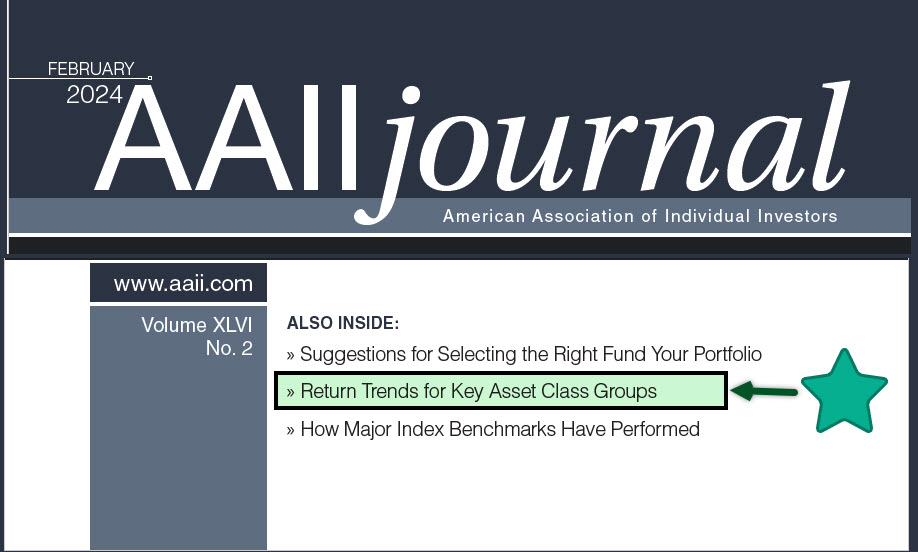
One of the things I want to do as an investor is make sane decisions. Insanity and investing don’t mix well. Each year the AAII team produces a review of the different asset classes over time. For February’s Journal, one article caught my eye: “Returns for Asset Class Groups: Large-Cap Stocks Rebound Back Into the Lead.”

Their methodology makes sense. They look at some major mutual funds to get a sense of the returns of seven important asset classes. This chart is a nice summary. Then I will share some observations.
As of December 2020, the following funds are used to calculate historical performance:
Vanguard 500 Index Admiral Shares (VFIAX)
Vanguard Admiral Mid-Cap Index Fund Admiral Shares (VIMAX)
Vanguard Small Cap Index Admiral Shares (VSMAX)
Vanguard Developed Markets Index Fund Admiral Shares (VTMGX)
Vanguard Emerging Markets Stock Index Admiral Shares (VEMAX)
Vanguard Intermediate-Term Treasury Investor Class (VSIGX)
Vanguard Short-Term Treasury Admiral Shares (VFISX)
Prior to December 2020, the following mutual funds were used as proxies for calculating historical performance:
Vanguard 500 Index Investor Class (VFINX), BNY Melon Mid Cap Index Investor Class (PESPX), Vanguard Small Cap Index Investor Class (NAESX), Schwab International Index, Schwab International Index (SWISX) and Vanguard Emerging Markets, Stock Index Investor Class (VEIEX), Vanguard Intermediate-Term Treasury Investor Class (VFITX) and Vanguard Short-Term Treasury Investor Class (VFISX). Source: Morningstar.
My Observations About Bonds
First, look at the yellow boxes that represent the returns on short-term bonds. Five out of ten years they finished dead last. In only three of the last ten years did they make it to the top three, and even then the returns were less than admirable.
The gray boxes highlight the returns of “Intermediate bonds.” Six out of ten times bonds fell in the bottom three, and when they didn’t their best returns were not acceptable for the long-term investor.
What About Stocks?
Only once, in 2022, did the large-cap investor feel some serious pain. As the blue boxes show, while some years were better than others, if you consider the returns of large-cap stocks over the long haul, they are probably your best place for growing your retirement nest egg.
The mid-cap (Green) and small-cap (Red) are also a good place for some portfolio dollars. I would argue that it is better to sell your bond holdings, and assuming you already have large-cap exposure, buy more large-cap stocks or ETFs, and then buy some small-cap and mid-cap investments as well. This can be done very easily with small and mid-cap ETFs.
Please note that I don’t necessarily recommend any of the mutual funds listed above, but the Vanguard funds are usually the best choice for most investors. I prefer ETFs like VYM, SCHD, and DGRO to gain exposure to all three asset classes and receive dividend growth.
AAII’s Suggestion is Disappointing
In this article, AAII says, “Longer periods of time smooth out the year-by-year fluctuations you see in the heat map. Over longer periods, stocks provide long-term growth of capital while bonds—particularly when held to maturity—provide preservation of capital. This difference allows them to complement each other within the context of a diversified portfolio.” – Charles Rotblut, CFA, AAII Journal editor, February 2024 AAII Journal, page 4.
It is true that some bonds can preserve capital at a huge cost. But the problem with this approach after ten years of holding a bond is that the $5,000 you invested and that will (hopefully) be returned to you when the bond matures, is now lacking spending power. If inflation averages three percent, you have lost a considerable amount of true buying power or value over the course of the ten years.
Do I Follow My Own Advice?

There is only one bond remaining in my brokerage account. It is worth $5,000 and pays tax-free interest. However, if I had to do it over again, I would not have purchased the bond.
I favor long-term investments in a mix of large-cap, mid-cap, and small-cap stocks using both individual stocks and dividend growth ETFs. Using this approach I beat bonds every time every year.
The only reason to “preserve” capital is to have an emergency fund and sufficient cash in savings to cover what your stock dividends won’t cover.
 Know Your Flocks & Herds
Wayne, are you saying stay out of bonds and bond funds all together?
LikeLiked by 1 person
I find it very difficult to recommend bonds or bond funds to any investor who thinks inflation is real. The long-term returns are poor and the safety is an illusion. However, fearful investors often think bonds help create balance in their portfolio. I think quality dividend growth stocks offer far better income, income growth, and asset growth. I will never say never, but I find it hard to say that I would recommend bonds to most of the people I know.
LikeLike