

Another Reader’s Question

Bill said, “Still trying to learn these options! I’m starting slowly but getting there. (…It) seems like maybe I am too close to in the money as a lot of my calls can be called away so I have had to roll quite a few pretty far out. Any words of wisdom to getting more premium with less getting called away?” What Bill is saying is “am I setting my share price too low when I trade a covered call option?” He doesn’t want his shares called away so he extends the expiration date to raise the price for the call when he rolls a call.
Who Will Win?
When you enter into any contract, there is usually an understanding of the term (in days, months, or years) and dollar amount involved. The buyer wants a good deal as does the seller. All contracts involve some type of “risk,” but you want to minimize the risk for all parties.
Let’s say I buy 100 shares of company XYZ for $10 per share. I am willing to sell my 100 shares for $12 per share, but only for the next 30 days. You want my shares, and you think $12 is a fair price, so you offer me $0.10 per share ($10) for an opportunity to buy my shares thirty days from today.
I take the ten dollars (less Fidelity’s commission) and the clock starts ticking. It becomes apparent that the shares are going to go to $14 per share, but you will still be able to purchase my shares for $12 due to our contract. I’m disappointed, because I was hoping that the share price would stay below $12. What can I do? First of all, remember that even if I do nothing I am making a profit. Don’t forget that key element.
How To Increase the Potential Profit
Sometimes, however, it makes sense to exit the $12 contract (buy back the contract) and roll up to $14 or $15 with an expiration date that is six months out. Let’s assume I do that and can make some additional money with this contract “roll.” If I roll to $15 per share, I have now increased my potential profit from $200 (the difference in my purchase price of the 100 shares and the $12 contract price) to $500 per share. I also keep any profits I made from the original contract and the contract roll. In either case, however, I am making a profit.
Remember that it might make sense to have the shares called away at $12 per share. The buyer of the contract is happy, and I am pleased that I made a profit of $200 plus the $10 I received from selling the covered call option. This is a win-win, but I might still feel like I did not price my original contract with a higher price – like $15 per share.
Remember the Total Picture
It is easy to just focus on the capital gains portion of your investment. If the 100 shares also pay a dividend and the dividends come into your account during the time you own the shares, that is part of your total profit. So, for example, Ford (F) pays a quarterly dividend of $0.15 per share. That means every three months I also can receive $15 in dividends or $60 per year. The buyer of your contract also knows about the dividend and the dividend yield.


Another piece to remember is that the price of an investment can vary widely over time. In the case of my 6,500 shares of Ford in my traditional IRA, the share price has ranged from $8.44 to $14.80 in the last 52 weeks. I had an open covered call contract for my shares with an expiration date of June 18, 2026 and a price of $12/share. At one point not long ago the share price kept edging up close to $15 per share. If I did nothing, it was likely that I would have to sell my shares for $12. However, the war in Iran and other factors changed the market’s view of Ford. The share dropped suddenly to around $12.15 per share. This was both surprising and helpful.
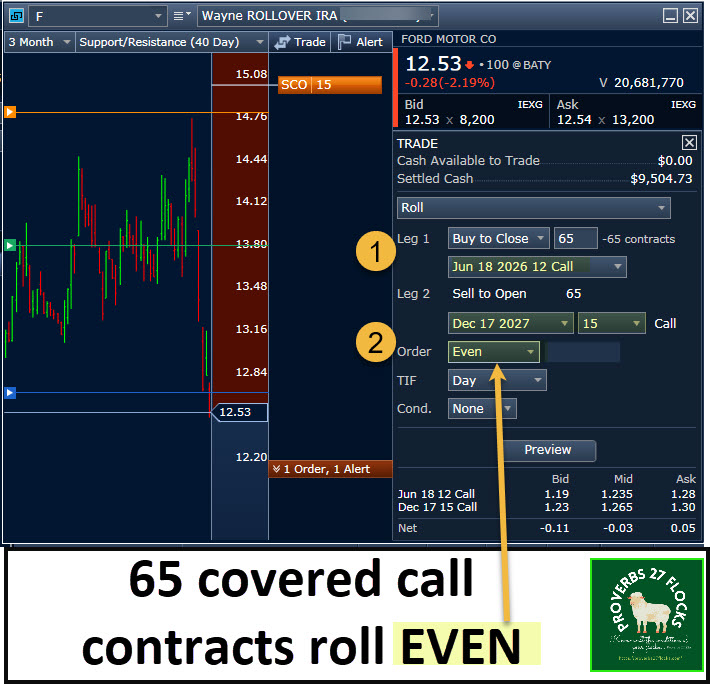
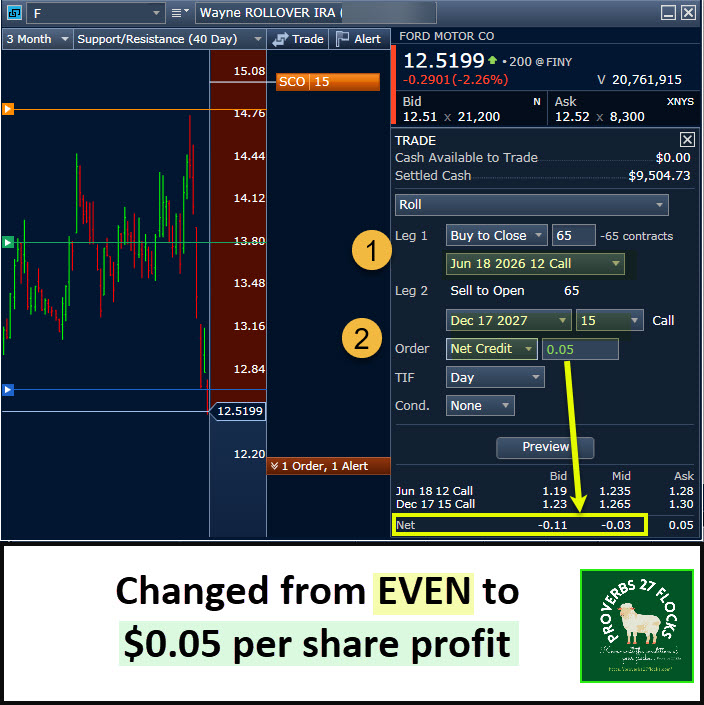
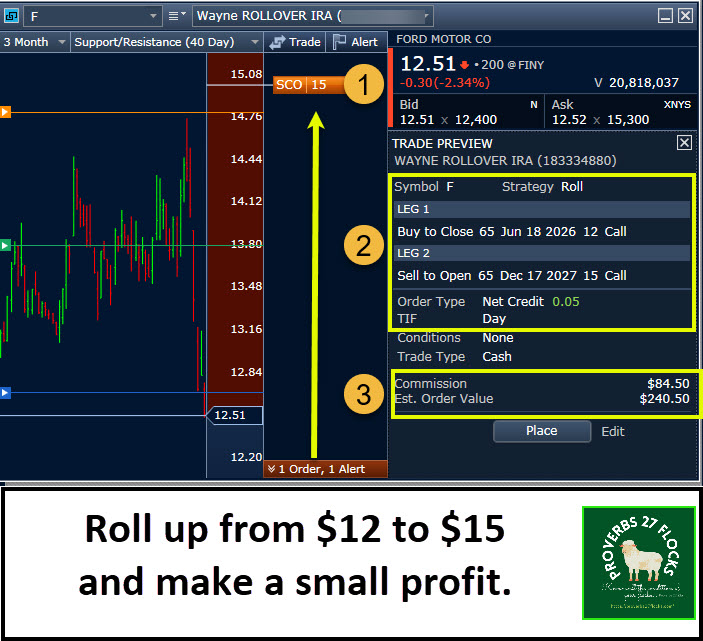
This opened a window of opportunity. I was able to roll the contract up to $15 by extending the contract expiration to December 2027. At first I would have been happy with an “even” trade where I did not make any money on the contract roll. However, it became apparent that I might be able to make $0.05 per share to roll the contracts, so I entered the covered call roll to see if I could find a buyer. I did, and that increases my potential profit significantly. In addition, there are several dividend payments between now and December 2027 (if Ford keeps paying the dividend) to sweeten the pot.


Lessons to Remember
First of all, don’t set your contract price too low. It is better to have a smaller options income for each options trade than to lose your shares due to trying to increase your options income. This is especially true for your long-term holdings that offer good dividend growth.
Secondly, remember that dividend income is a piece of the puzzle. Pushing the contract date out farther is a strategy that can add to your total dividends and your ultimate total returns. That is certainly true of my 6,500-share investment in Ford.
Finally, remember that the buyer of your contract is an optimist who thinks they can get your shares at a good price at some point in the future. That would be a win for them, just like the options income and capital gains are a win for you.
REMINDER
You cannot depend on options income to be considered a guaranteed income. Dividends are like a salary. You can usually depend on receiving that with little or no work. Options income, by way of contrast, is like getting a commission for selling an insurance contract. A cash covered call is one kind of “insurance” obligation and a cash covered put is a different kind of “insurance” for the buyer of your PUT contract. However, you can “get out of” (or delay) a contract if you roll the option.
Conclusion
It is best to avoid an initial covered call options contract that goes out more than thirty days. However, when it is expedient to roll a contract, don’t let the thirty days be set in stone. This is especially true of stocks and ETFs that pay a dividend.
Additional Resources
Fidelity Investments Options Trading FAQs
Seeking Alpha Subscription Information
Of all of the resources I use, the most helpful is Seeking Alpha. If you decide to explore a Seeking Alpha subscription, please use the following link. Seeking Alpha

SEEKING ALPHA INFORMATION AND SUBSCRIPTION
You can also scan this QR Code to get the same information.
Past performance does not guarantee future results, Seeking Alpha does not provide personalized advice, and it is not a registered investment adviser.
We accept advertising compensation from companies that appear on our site. This website represents my opinions, which may not reflect those of Seeking Alpha, and does not constitute an investment recommendation or advice.
If you have any questions or problems getting connected to Seeking Alpha, reach out to them with this email address: subscriptions@seekingalpha.com
 Know Your Flocks & Herds