

Dividend Growth Plus Reinvesting Works

One of the reasons I like the dividend growth strategy is that it provides additional cash for additional investment. This creates a growing snowball of more dividends.
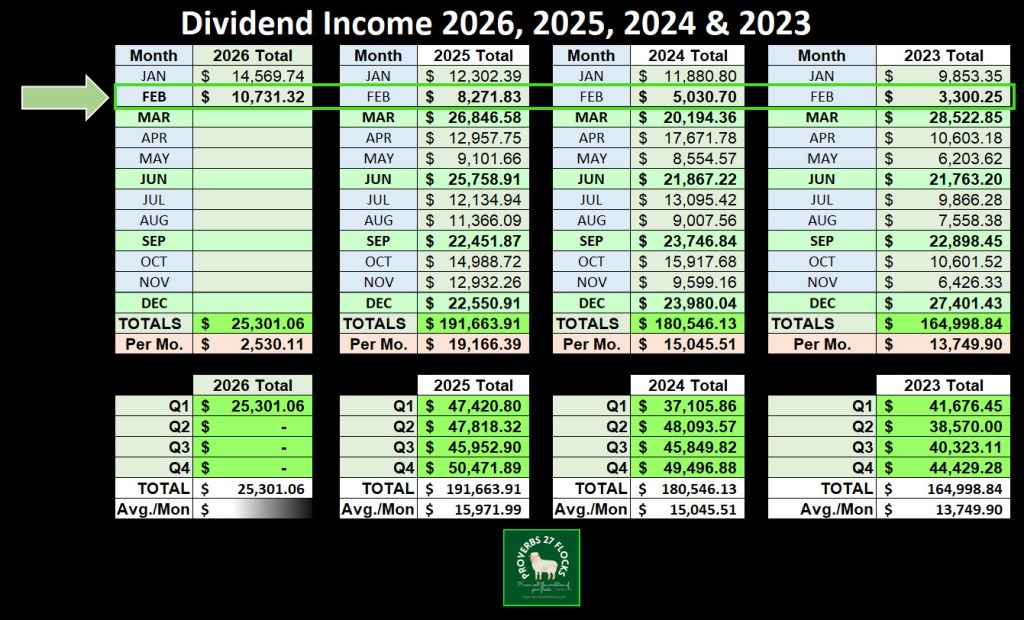
Although January and February are not the months where we see the most dividends, it is obvious that February 2026 shows increased dividend income over February 2025. This is due to several factors, including consistent dividend-paying stocks and taking some of the income from options trading and dividend income to buy more investments when the market drops.
Although one size fits all probably isn’t wise when it comes to dividend reinvesting, I will detail my view. My list is sorted from things I am least likely to do to those that I prefer. All of them are viable and worthy of consideration.
This paragraph from Motley Fool summarizes some of the choices: “When you own dividend-paying stocks, you face a fundamental choice: what to do with the cash? You have several options depending on your investment strategy. You could spend it to supplement your income, save it to fund a future expense, invest it by combining the dividend with other cash to buy shares of a different company or fund. Or you could reinvest it, using the money to buy more shares of the same company that paid the dividend.” The Motley Fool
Reinvest Automatically
For some types of investment this is the easiest way that requires little or no action on your part. If you are a Fidelity Investments customer, there is a place on the web where you can set this up according to your individual needs. You start by going to the “MORE” menu and then you select “ACCOUNT FEATURES.” In the “Brokerage and Trading” section there is an choice for managing “Dividends and Capital Gains.”
For example, I have my ROTH IRA to “Pay to Cash” any dividends from all of my dividend-paying stocks and ETFs. If I selected “Reinvest in Security” the dividends would be automatically used to buy more shares of that stock or ETF.
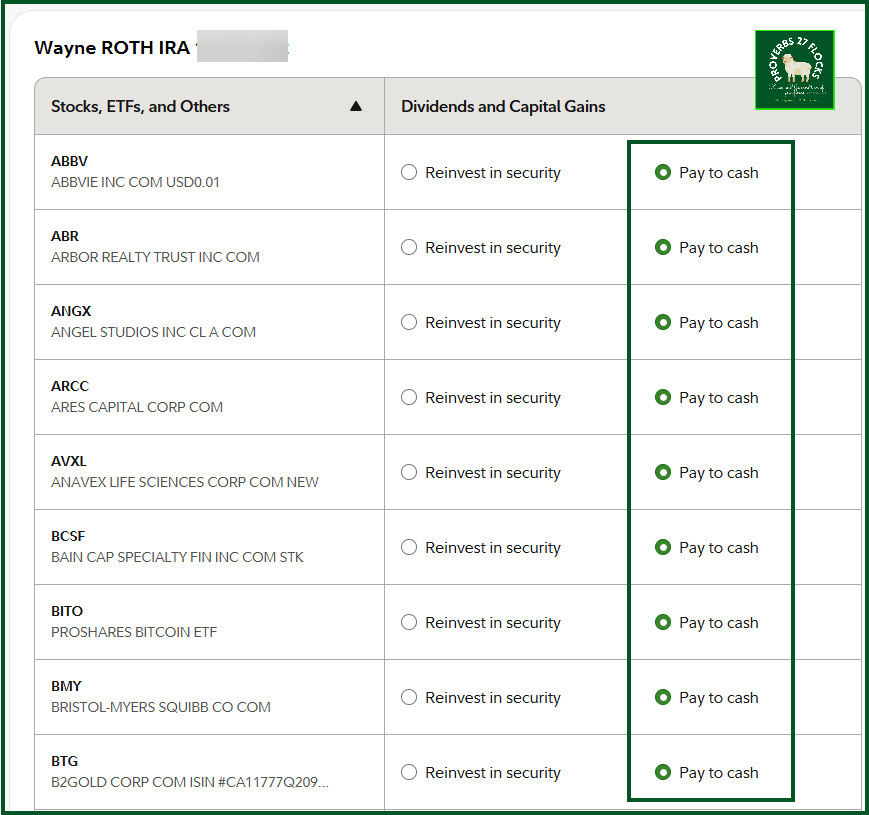
“Stocks, ETFs, and Others must have the same distribution settings for dividends and capital gains. Mutual funds may have different instructions for dividends and capital gains. Note: Positions will appear 1 business day after your trade is settled.” – Fidelity Investments
I use this feature for some of the investments in the UTMA accounts for our grandchildren. They own shares of DGRO and VYM, so those were set to “Reinvest in Security” just to simplify my management of their accounts. Today I turned on automatic reinvestment for their shares of SCHD as well. However, other positions that are not ETFs are set to “Pay in Cash.”
Reinvest with Buy Limit Orders
I like this better than automatic reinvestment. Because I like “Pay to Cash” so that I receive cash from the stocks and ETFs, I can decide what I want to do with the dividends and what price I am willing to pay for more shares. It isn’t unusual for prices to go up and down even within a single day. I’d prefer to tell the market what I am willing to pay for more shares of any investment I own.
When you reinvest dividends, you typically purchase additional shares at the current market price on the dividend payment date. But what if that isn’t the best price? For example, ABBV (AbbVie Inc.) is one of our dividend-paying investments. If the dividend was paid yesterday, the price I might pay to buy additional shares would be $233.86. However, yesterday the price of ABBV shares varied from $230.24 to $235.71. I’d rather reinvest dividends at a price lower than $233, especially since we own 1,220 shares and the quarterly dividend is $1.73 per share. That is $2,110.60.
If I bought more shares of ABBV at $230 per share using those dividends, I could get nine more shares. However, during the last month the share price has been lower than $230 per share. It isn’t unusual for it to fall below that price. Why pay more for an investment than you have to? Therefore, I might be tempted to enter a buy limit order to purchase five shares at $220/share.
Wait for a down day and reinvest the dividends.
This requires a bit more work, but I think it is often worth the effort. A more proactive approach involves setting a price alert to tell me if ABBV drops below $220/share. If that happens I can log into my account and enter a buy order to get an even better bargain.
Buy something else to expand your portfolio.
If you already have a ton of ABBV stock, perhaps your best option is to diversify your portfolio into other health care stocks or just expand you investments in ETFs like SCHD, DGRO, and VYM. Because ABBV already makes up a sizable dollar amount of our total investments ($285K) I really don’t want to grow that position with more shares.
Forward the Dollars for Eternal Rewards.
Where is your heart? It can be identified quite easily. Just look where your treasure is. Because I am old enough, I can use the dividends from my traditional IRA to fuel qualified charitable distributions to our church and other charities. That is where my heart is.
Matthew 6:19-21 says, “Do not lay up for yourselves treasures on earth, where moth and rust destroy and where thieves break in and steal, but lay up for yourselves treasures in heaven, where neither moth nor rust destroys and where thieves do not break in and steal. For where your treasure is, there your heart will be also.”
Vanguard’s Reinvesting Policy
I suspect most brokers are similar to Vanguard.
When reinvesting dividends, Vanguard Brokerage Services combines the cash distributions from the accounts of all clients who have requested reinvestment in the same security, and then uses that combined total to purchase additional shares of the security in the open market. Vanguard Brokerage will attempt to purchase the reinvestment shares by entering a market order at the market opening on the payable date. The new shares are divided proportionately among the clients’ accounts, in whole and fractional shares rounded to three decimal places. If the total purchase can’t be completed in one trade, clients will receive shares purchased at the weighted average price paid by Vanguard Brokerage Services.
Plan Your Strategy Today
Do you reinvest your dividends? It pays to have a strategy for your dividend income.
Actionable Items
- Evaluate your investment holdings. Do you want more shares of any of them? What is the best way for you to add shares?
- Are your dividends from February 2026 greater than your February 2025 dividends? If not, why is that so?
- Proverbs 16:3 “Commit your work to the Lord, and your plans will be established.” This means that those who trust the Lord should look to him for wisdom in the decisions that are made today.
Conclusion to Chapter Eleven

Autopilot is a great feature for some things in life. However, it is assuring when the pilot takes control of the passenger jet. He or she can make more thoughtful decisions about the flight path, takeoff and landing. I suggest that you think more like the pilot and less like the automated systems.
Seeking Alpha Subscription Information
Of all of the resources I use for long-term thinking related to investing, the most helpful is Seeking Alpha. Mutual funds do not have QUANT ratings. This makes them less likely for me to recommend as a part of your investment portfolio. If you decide to explore a Seeking Alpha subscription, please use the following link. Seeking Alpha

SEEKING ALPHA INFORMATION AND SUBSCRIPTION
You can also scan this QR Code to get the same information.

Past performance does not guarantee future results, Seeking Alpha does not provide personalized advice, and it is not a registered investment adviser.
We accept advertising compensation from companies that appear on our site. This website represents my opinions, which may not reflect those of Seeking Alpha, and does not constitute an investment recommendation or advice.
If you have any questions or problems getting connected to Seeking Alpha, reach out to them with this email address: subscriptions@seekingalpha.com
All scripture passages are from the English Standard Version except as otherwise noted.
 Know Your Flocks & Herds