

A Put Contract is Like a Simple Puzzle
Do you think you could assemble a puzzle with ten pieces in less than five minutes? I suspect most people can. That task is similar to the difficulty of selling a cash-covered put option. You think I’m kidding, but I’m not. While brain surgery is indeed brain surgery and being a rocket scientist requires a lot of time and attention to details, trading cash covered puts is not anything like those two disciplines. I’m convinced that if you know how to create a grocery shopping list and then how to find the groceries in the store, you can successfully trade options.

Credo Technology Group
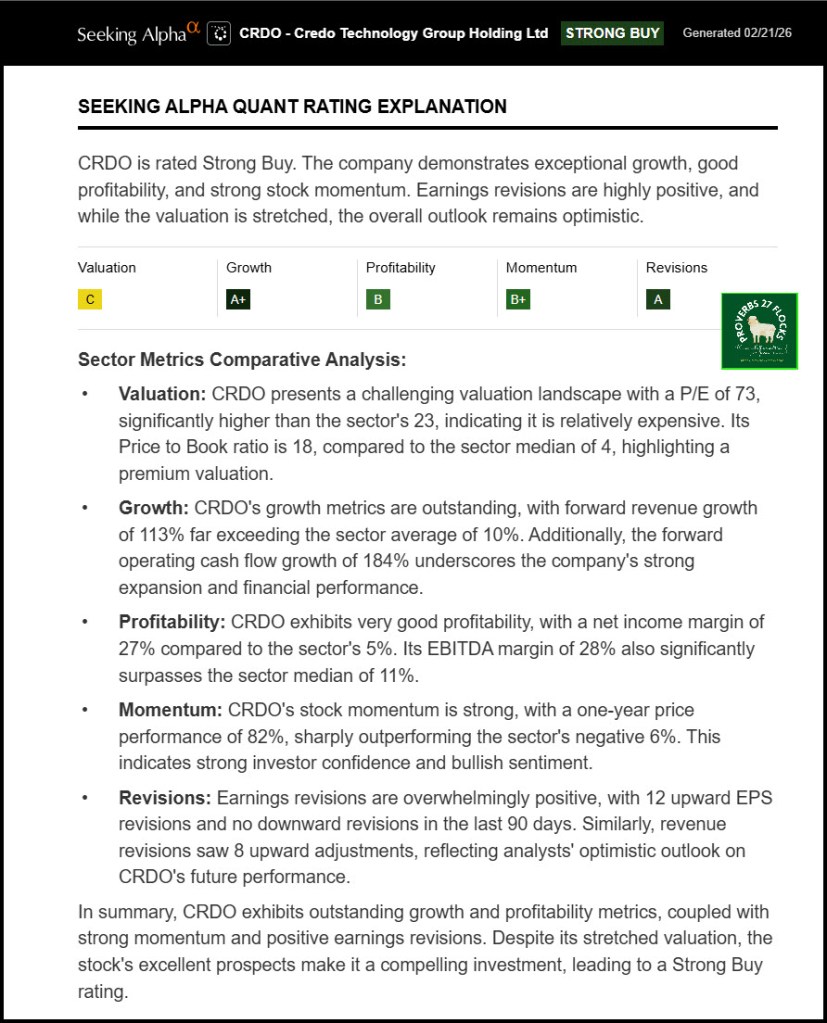
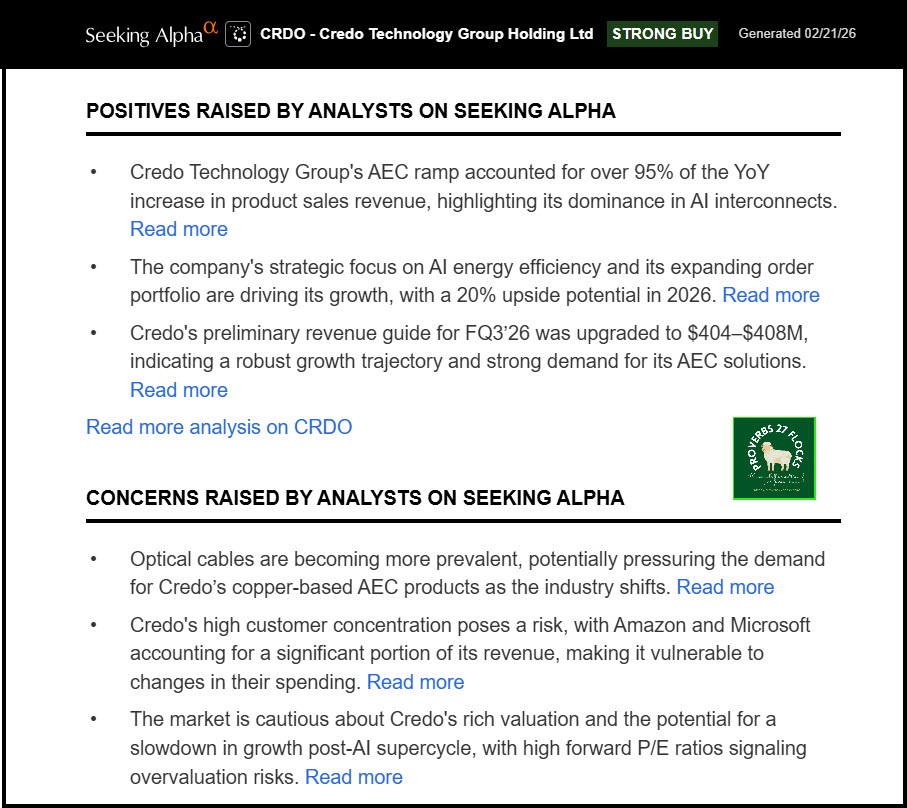
CRDO is an investment I would like to own but I don’t want to pay today’s price. The current Seeking Alpha QUANT rating is a Strong Buy (4.86 out of 5.00 at the time I write this) and the earnings estimates for this year, 2027, and 2028 appear to be very encouraging. Credo is in the semiconductor space, and it is located in the Cayman Islands. Credo provides various high-speed connectivity solutions for optical and electrical Ethernet, and PCIe applications in the United States, Taiwan, Mainland China, Hong Kong.
My first serious look at CRDO was on January 27, 2026. Back then the price per share was just over $129. Since then it has gone as low as $96.95 and as high as $134.72. I did not buy shares, but I decided to enter a cash covered put option to potentially buy the shares at $130. As the price dropped I entered option contracts to roll the contract price and the expiration date. This image shows all of the PUT trades for this single stock with the most recent trade at the top. I made over $300 for five minutes of puzzle work. If I was working a 9-to-5 job making $37.50 per hour, I’d have less time for other things and far less income after deductions.
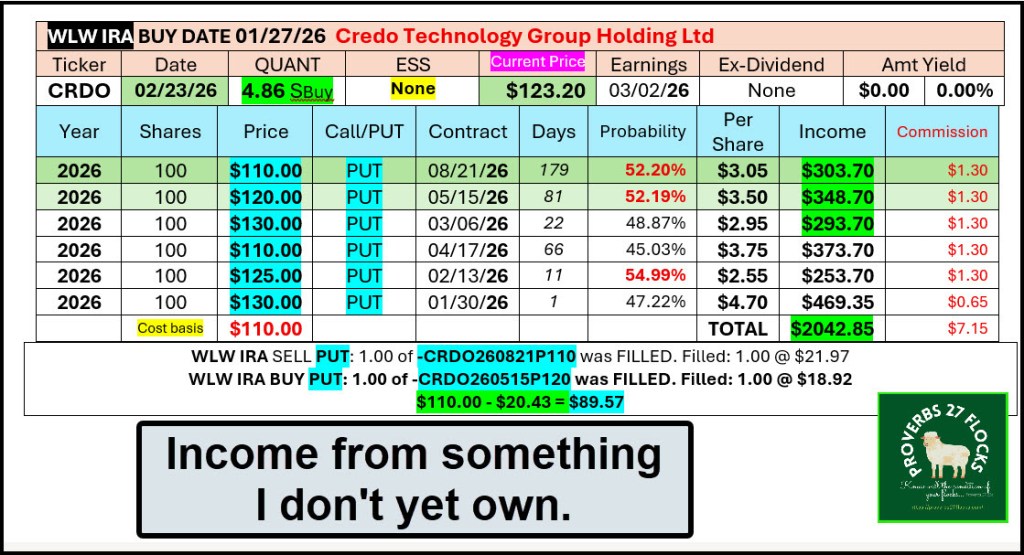
YTD income from the CRDO cash covered puts is $2,042.85. That is roughly $680 per week. My most recent trade was for the put price of $110 with an expiration date of August 21. However, the story isn’t over. Let’s assume that the price of CRDO shares is $100 per share on August 21. If so, I really will have paid $89.57 to buy the shares when you subtract the income I have already received from the options trades. So, instead of paying $12,900 for 100 shares on January 27, I may be able to buy those same shares for $11,000 (less the $2,042.85 I have already received. That means my true cost basis per share will be less than $90.
Bear in mind that I am continuing to earn dividends on the $11,000 in my traditional IRA that is being held as the cash to cover the put. I don’t miss out on interest because the cash is still mine until the option is called. If it expires, the cash is no longer held, and the option is no longer placing a hold on the covered put.
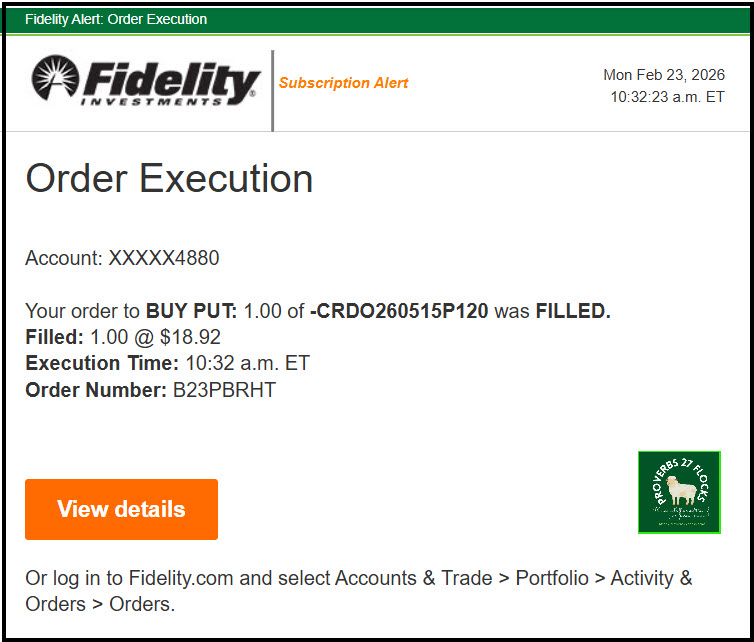
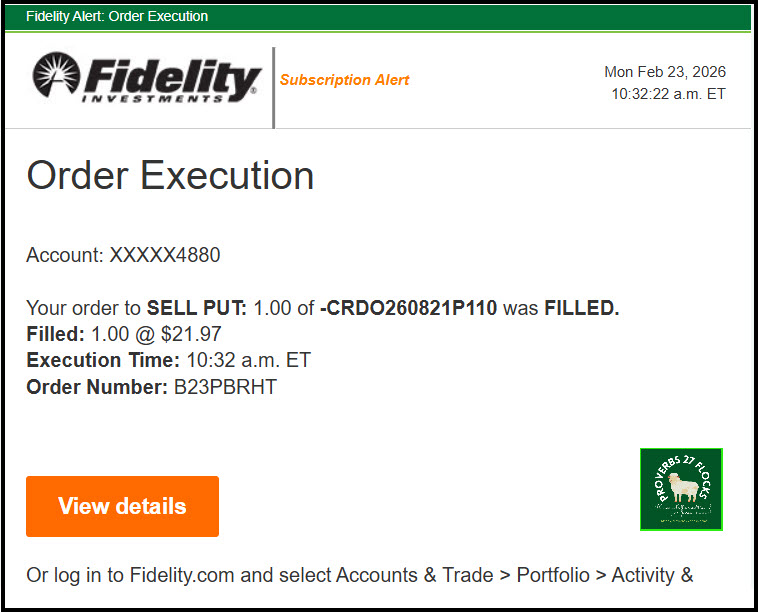
These images are the emails I received when I bought back my original CRDO put contract and sold a new one.
What is a Put Option?
In the simplest terms it is a contract. It is an agreement between you and some other unknown investor that you are willing (but not always required) to buy one hundred of their stock or ETF shares on a predetermined date and a share price you both think is to your individual advantage. You hope the share price stays about the contract share price. If it doesn’t you are required to buy their shares at the contracted price. You keep the money they originally gave you and you now own 100 shares of the stock in question. Of course, this should be for an investment you want to own, not for one that has questionable value.
The good news is that you can change your mind. Often this means you can make more money be buying back the original contract and selling a new one with a different share price and expiration date. That is called rolling the contract.
What is a Roll?
A cash-covered put option roll is a way to extend or adjust a cash-secured put position instead of letting it expire or taking assignment. It is buying back the original contract and selling a different one. This only requires that you enter a single order. You don’t have to enter one order to buy back the original contract and sell the new one.
What does it mean to “roll” a put? To roll a put means you: 1) Buy back your current put (closing it) and then simultaneously 2) Sell a new put at a different expiration, strike, or both. This is done as one combined trade, often for a net credit. You usually can make money doing this.
So what is a cash-covered put roll? It’s simply rolling a cash-secured put while still keeping enough cash reserved to cover the obligation. You’re saying: “I don’t want this put to expire yet—I want to move it forward or adjust it.”
Types of Cash-Covered Put Rolls
The first type is to roll out further in time with the same share price but a later expiration. That trade can earn you additional income and delay your obligation to buy the shares based on the previous expiration date of the put contract.
The second type is to roll down to a lower price but keep the same expiration date. This will usually cause you to have to pay for this, so I prefer to avoid that option.
The most common choice is the one I usually make: Roll the price down and the expiration date out beyond the date of the original contract. This is best done with stocks that trade weekly options. The upside is that I make more income by kicking the can down the road.
Why would someone roll a cash-covered put?
The common reasons should be obvious by now. I wanted to avoid spending $12,000 and keep earning interest on those dollars. I wanted to earn an additional premium, and I adjusted my risk down to $11,000.
Options Income is Variable
You cannot depend on options income to be considered a guaranteed income. Dividends are like a salary. You can usually depend on receiving that with little or no work. Options income, by way of contrast, is like getting a commission for selling an insurance contract. A cash covered call is one kind of “insurance” obligation and a cash covered put is a different kind of “insurance” for the buyer of your PUT contract. However, you can “get out of” (or delay the impact of) a contract if you roll the option.
Conclusion
My total time invested in trading CRDO is less than 15 minutes. The risk, in my opinion, is fairly low. The dollars involved (given the size of my traditional IRA) is also low. Finally, the $11,000 is still earning money market dividends while the option is pending. Would you be willing to learn to trade options and make $2,000 in fifteen minutes? It is as easy as assembling a ten-piece jigsaw puzzle.
Seeking Alpha Summary Information for CRDO
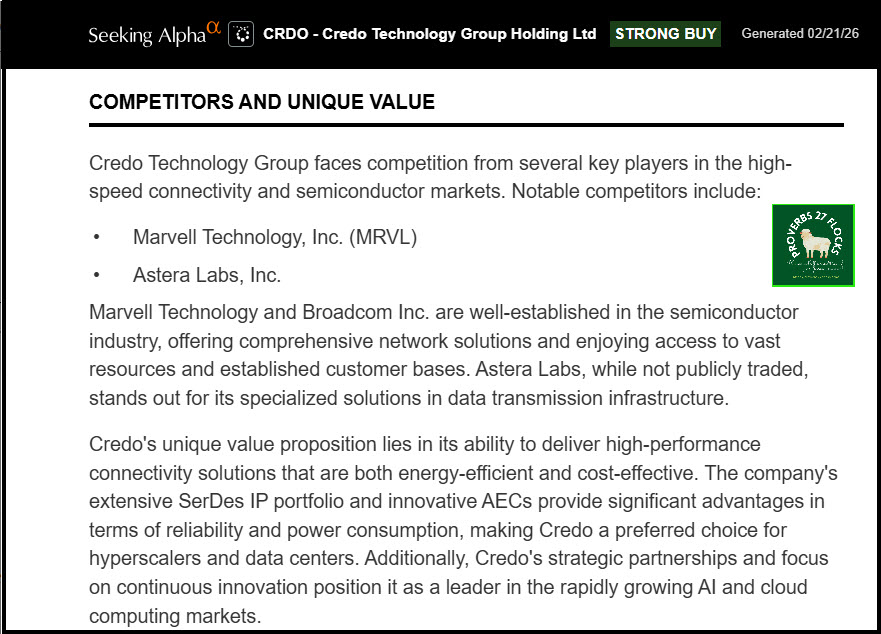
These images help explain why CRDO is of interest to me.
CRDO Company Profile
Credo Technology Group Holding Ltd provides various high-speed connectivity solutions for optical and electrical Ethernet, and PCIe applications in the United States, Taiwan, Mainland China, Hong Kong, and internationally. It provides HiWire active electrical cables solutions, including HiWire CLOS, SPAN, SHIFT, and SWITCH; optical PAM4 digital signal processors; low-power line card PHY; serializer/deserializer (SerDes) chiplets; and SerDes IP, as well as integrated circuits. The company also offers intellectual property solutions consist of SerDes IP licensing. In addition, it offers predictive integrity link optimization and telemetry; PCIe retimer solutions; and support and maintenance, engineering, and royalties services. The company sells its products to hyperscalers, original equipment manufacturers, original design manufacturers, and optical module manufacturers, as well as into the enterprise and HPC markets. Credo Technology Group Holding Ltd was founded in 2008 and is based in Grand Cayman, the Cayman Islands.
Seeking Alpha Subscription Information
Of all of the resources I use, the most helpful is Seeking Alpha. If you decide to explore a Seeking Alpha subscription, please use the following link. Seeking Alpha

SEEKING ALPHA INFORMATION AND SUBSCRIPTION
You can also scan this QR Code to get the same information.

Past performance does not guarantee future results, Seeking Alpha does not provide personalized advice, and it is not a registered investment adviser.
We accept advertising compensation from companies that appear on our site. This website represents my opinions, which may not reflect those of Seeking Alpha, and does not constitute an investment recommendation or advice.
If you have any questions or problems getting connected to Seeking Alpha, reach out to them with this email address: subscriptions@seekingalpha.com
 Know Your Flocks & Herds
Hi Wayne,
Thanks for the great info. I noticed that tri-weekly options are now available for some equities. Is that something you’ve partaken in or is that something to avoid? Were you planning on a post regarding tri-weekly options?
LikeLiked by 1 person
I have taken advantage of the tri-weekly options for my wife’s brokerage account. She has 100 shares of NVDA.
Are you aware of a list of stocks that have this opportunity? I’d like to write about it.
LikeLike
AAPL, AVGO, META, NVDA, GOOGL, AMZN, MSFT, TSLA, SPY, QQQ, IWM, IBIT.
There might be more but that’s what I found on a quick search.
LikeLiked by 1 person
Thanks. I was having a hard time finding more than AAPL, TSLA, AMZN, NFLX and NVDA. I tried using AI to find more and will see if I can ask the question a couple of ways to find more.
Do you have some favorites for weekly options?
LikeLike