
A Word from High School: Ameliorate
One of the words I learned in high school was “ameliorate.” The word ameliorate comes from the Latin verb “ameliorare,” which means “to make better.” Overall, ameliorate conveys the notion of improvement and positive change. Something that is torn or broken needs to be mended.

This has implications for our lives. Overall, the notion of being torn resonates with the idea of inner conflict, emotional struggle, and the desire for redemption. We all need mending. We are torn between sinning (hatred, coveting, fighting, gossiping) and loving others.
In the scriptures there are two ways the mending occurs. The first is by justification and being sanctified. The second is an ongoing sanctification. Justification is what God does when someone hears the gospel and responds appropriately to what they hear. Sanctification is what God does and our participation in what God is doing.
What Has Been Done: Sanctified (Made Holy)
“Consequently, when Christ came into the world, he said, ‘Sacrifices and offerings you have not desired, but a body have you prepared for me; in burnt offerings and sin offerings you have taken no pleasure.’ Then I said, ‘Behold, I have come to do your will, O God, as it is written of me in the scroll of the book.’”
“When he said above, ‘You have neither desired nor taken pleasure in sacrifices and offerings and burnt offerings and sin offerings’ (these are offered according to the law), then he added, ‘Behold, I have come to do your will.’ He does away with the first in order to establish the second. And by that will we have been sanctified through the offering of the body of Jesus Christ once for all.” Hebrews 10:5-10
Also, in 1 Corinthians 1:1-3: “Paul, called by the will of God to be an apostle of Christ Jesus, and our brother Sosthenes, To the church of God that is in Corinth, to those sanctified in Christ Jesus, called to be saints together with all those who in every place call upon the name of our Lord Jesus Christ, both their Lord and ours: Grace to you and peace from God our Father and the Lord Jesus Christ.”
What Should Happen: Ongoing Mending
There should be gradual transformation through faith in Jesus Christ. The positional sanctification was accomplished at the moment of salvation. Believers are declared hold in God’s sight through faith in Christ. However, they are not practically holy.
Progressive Sanctification refers to the ongoing process of spiritual growth and maturity, where the believer continually seeks to grow in holiness and Christlikeness (2 Peter 3:18; 1 Thessalonians 4:3). This involves daily choices, reliance on the Holy Spirit, and transformation of character.
1 Thessalonians 4:3-5 “For this is the will of God, your sanctification: that you abstain from sexual immorality; that each one of you know how to control his own body in holiness and honor, not in the passion of lust like the Gentiles who do not know God…”
What Will Happen: Complete Restoration
Ultimate Sanctification refers to the final state of believers when they will be fully sanctified in the presence of God. Believers will be free from sin. We won’t be torn between sin and righteousness. 1 John 3:2 says, “Beloved, we are God’s children now, and what we will be has not yet appeared; but we know that when he appears we shall be like him, because we shall see him as he is.”
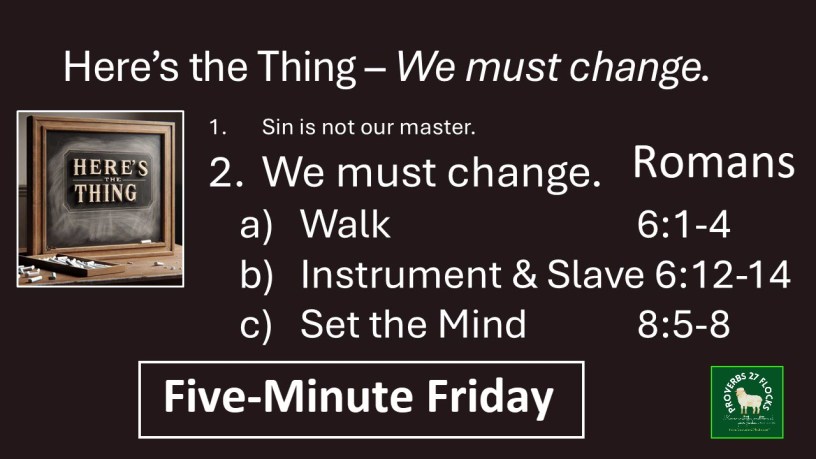
Sanctification is thus both God’s definitive act and a continual journey where true Christians make decisions. These decisions involve an ongoing mending of our minds, a determined effort to control our bodies as temples for the Holy Spirit, and a careful use of our mouths to mend our language.
How to Identify a Follower of Jesus
“A man without self-control is like a city broken into and left without walls.” Proverbs 25:28
Romans 8:1-6 “There is therefore now no condemnation for those who are in Christ Jesus. For the law of the Spirit of life has set you free in Christ Jesus from the law of sin and death. For God has done what the law, weakened by the flesh, could not do. By sending his own Son in the likeness of sinful flesh and for sin, he condemned sin in the flesh, in order that the righteous requirement of the law might be fulfilled in us, who walk not according to the flesh but according to the Spirit. For those who live according to the flesh set their minds on the things of the flesh, but those who live according to the Spirit set their minds on the things of the Spirit. For to set the mind on the flesh is death, but to set the mind on the Spirit is life and peace.”
Five Minute Friday
This post is part of the weekly Five-Minute Friday link-up.
All scripture passages are from the English Standard Version except as otherwise noted.
 Know Your Flocks & Herds