
First: Review of the Six Previous Rules: 10, 3, 4, 5, 22, and 27
This “lesson” is the most important one I can teach about investing. It has to do with ownership. Before I talk about the importance of the number 100, it would be wise to review my previous rules I attempt to live by. I suggest these rules to help in making good decisions regarding both life and investing.
Number “10”: The first rule was based on the number ten. Save at least 10% of your income each year. Give at least 10% of your income to your church as a tithe (or to a charitable organization). Finally, select investments that grow, on average, 10% per year.
Number “3” and Inflation: The second number was the number three. It was a reminder of the impact of inflation on the buying power of each dollar. Some investments won’t keep up with inflation. I talked about the Three Bad Categories of Investments – BAT. These are bonds, annuities, and target date mutual funds.
Number “4” for Retirement Withdrawals: The 4% rule is a good rule for the average person when it comes to how much of your retirement account you can withdraw each year in retirement. If you have saved $50K, then don’t withdraw more than $2,000 from your retirement account each year. If you have $500K the number would be $20K.
Number “5” and Diversification: My rule of thumb is this: avoid having more than five percent invested in any single stock unless you have a very good reason for doing so. If you like Apple, or Microsoft, or Google, don’t go crazy and own more than 5% of any of them. You are dramatically increasing risk unnecessarily.
Number “22” and Setting a Goal: The 22 Times Rule helps you determine what your goal should be for your total investment balance before you retire. I suggest that you take the amount of income needed in retirement (in excess of Social Security and/or a pension) and multiply it by 22. That will tell you what you might want to strive to achieve during your working years. If you need $40K per year, then multiply $40,000 by 22 and start saving towards the goal of $880K.
Number “72” and Doubling Your Money: The rule of 72 calculation is a quick way to estimate how long it will take for an investment to double in value. This rule helps you with many decisions, including the types of investments you include in your retirement account and the importance of ROTH conversions if you have a traditional IRA. Assets like CD’s and bonds will not double in value in any reasonable amount of time.
Something Important Is Still Missing
If you are successful with all of the rules and you live long enough, then you will be able to live life after you stop working in your nine-to-five job. But as good as those rules might be, there is one reality that most ignore. It has to do with ownership and death. Ignore this to your own peril.
The Number 100 and Ownership
My name is on my traditional IRA and on my ROTH IRA. Cindie has her name on her accounts. We have some accounts that are in the Winquist Revocable Trust. It is normal to think of these accounts as owned by us. From a legal perspective, we do own them. I am the 100% owner of my accounts – or am I? At some point my “ownership” ends abruptly. This is 100% certain.
The reality is that I own nothing today even with my name on the accounts. I am only the temporary manager. God owns everything. You can disagree with me, but this is a fundamental theme throughout the scriptures. Various scriptures highlight His sovereignty over creation, the earth, and all that is within it. Once we understand these truths, then we will be able to make decisions based on the implications of God’s ownership. Sadly, some (many) Christians live like they own everything, and God is just their servant. They got the relationship reversed. That is called the “Prosperity Gospel.” It is a false religion.
If the Bible is true and is God’s Word, then it bears reading what God says about ownership. Here are some passages from the Old and New Testament scriptures.
Psalm 24:1-2 “The earth is the Lord’s and the fullness thereof, the world and those who dwell therein, for he has founded it upon the seas and established it upon the rivers.” We instinctively know that creators have ownership. Artists own their paintings. Song writers own their lyrics and the musical sequences. Inventors own the rights to their inventions.
Deuteronomy 10:14 “Behold, to the Lord your God belong heaven and the heaven of heavens, the earth with all that is in it.” If you can see it, it belongs to God. Actually, even if you cannot see it he still owns it. You are not your own and what you own is not your own. You are made in his image. The question we must ask ourselves is, “am I living like a good image?”
Haggai 2:8 “The silver is mine, and the gold is mine, declares the Lord of hosts.” You may think the gold and silver (or stocks and ETFs) are your assets, but God created them, and he owns them. You have temporary control that will end. His ownership is 100% and your end date is 100% certain. The Old Testament books of Genesis and Ecclesiastes make this very plain.
Romans 11:33-36 “Oh, the depth of the riches and wisdom and knowledge of God! How unsearchable are his judgments and how inscrutable his ways! For who has known the mind of the Lord, or who has been his counselor? Or who has given a gift to him that he might be repaid? For from him (creator) and through him (sustainer) and to him (for him) are all things. To him be glory forever. Amen.” You cannot give a gift to someone if they already own what you are giving them. If I take something from you, wrap it up, and give it back to you, would you call that generosity? You would consider me insane.
Colossians 1:16 “For by him all things were created, in heaven and on earth, visible and invisible, whether thrones or dominions or rulers or authorities—all things were created through him and for him.” What is excluded? Well, it seems what is included are the visible things. He also says he created invisible things (air, radio waves, light, atoms, angels, energy and things we cannot see with our best telescopes.) He owns everyone in places of power.
Three Implications of God’s 100% Ownership
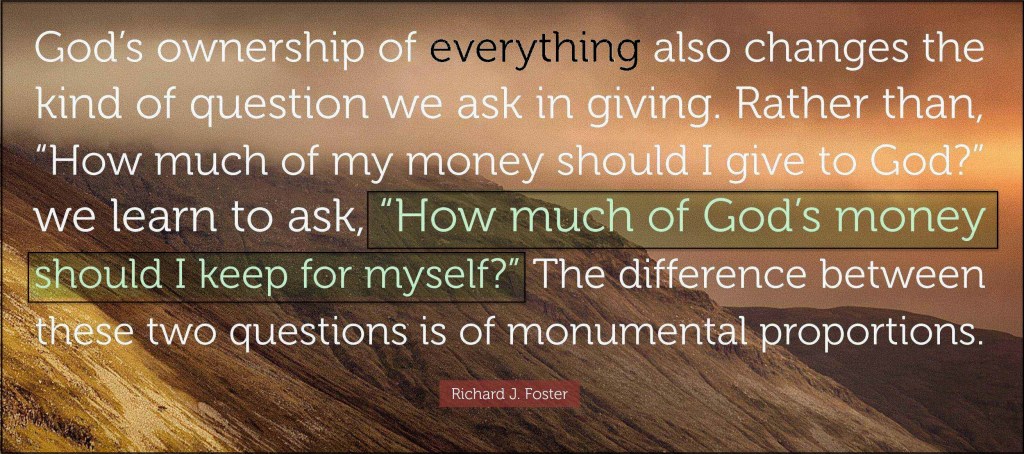
Stewardship: If God owns everything, then humans are seen as stewards or managers of His creation. This means that we are responsible for managing and caring for the earth and its resources wisely and ethically. We are responsible for managing his IRA and ROTH IRA. It is his SUV and his garden. It is his and we are just the caretakers.
Generosity: Understanding that everything belongs to God can inspire a spirit of generosity. Believers are encouraged to share their resources, knowing that they are merely custodians of what God has provided. A custodian or trustee doesn’t own what is entrusted to their care. Generosity means you are sharing what God trusted you to use on his behalf. Are you generous? Am I?
Trust: Recognizing God’s ownership can lead to greater trust in Him for provision and guidance, as He is the ultimate source of all that we need. One of the things I am sometimes asked is “what if God took everything you own away from you? My response is that I hope that I would be like Job. Job said this when he lost EVERYTHING: “Then Job arose and tore his robe and shaved his head and fell on the ground and worshiped. And he said, ‘Naked I came from my mother’s womb, and naked shall I return. The Lord gave, and the Lord has taken away; blessed be the name of the Lord.’” Job 1:20-21 Jesus also talked about this in Matthew 6:25-34.
Rust Prevention, Moth Reminders and Thieves
There is a long-term solution that reminds us of the Owner’s place and position, and it involves your heart. God is the heaven God. There are no other gods. Matthew 6:19-21 says, “Do not lay up for yourselves treasures on earth, where moth and rust destroy and where thieves break in and steal, but lay up for yourselves treasures in heaven, where neither moth nor rust destroys and where thieves do not break in and steal. For where your treasure is, there your heart will be also.”
Death is 100% Certain: I don’t know how Alistair Begg said it word-for-word, as I cannot find his quote. However, he did say that there is something about death that brings clarity to how we should be living life. If you ignore death, it is highly likely that you are ignoring it in a way that causes you to make poor decisions that implications for this life and for all of eternity. If you know you will die, then some “important things” become inconsequential, trivial or petty. In my case it is something like a 1962 Corvette or lakefront property. Those are nice things, but they are not mine to keep.
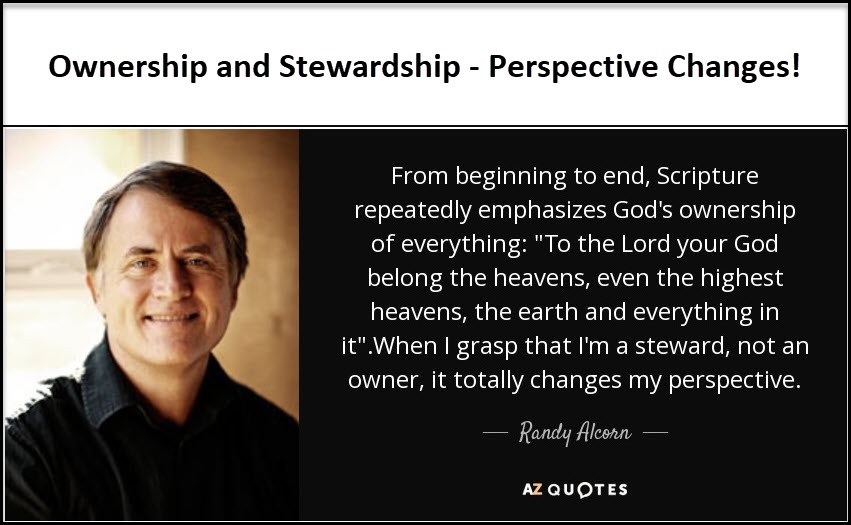
Also consider resources from Randy Alcorn and resources at Eternal Perspective Ministries. He said, “From beginning to end, Scripture repeatedly emphasizes God’s ownership of everything: “To the Lord your God belong the heavens, even the highest heavens, the earth and everything in it” .When I grasp that I’m a steward, not an owner, it totally changes my perspective.” – Randy Alcorn
In Real Retirement Life
You may not believe there is a God. If not, then you don’t think he owns anything because a being that doesn’t exist is fiction or a fairy tale. I encourage you to look around at what God has made and see if you think it is the result of a big bang or the creative genius of the Creator. If you get this wrong, the consequences are lasting torment. For God’s visibility see Psalm 8.
RECOMMENDATION REPEATED
Riches do not last forever on this earth. This is 100% certain. That doesn’t mean we give up. It means we care for the flocks and herds that God has entrusted to our care. Proverbs 27:23-24 says, “Know well the condition of your flocks, and give attention to your herds, for riches do not last forever; and does a crown endure to all generations?”
Seeking Alpha Subscription Information
Of all of the resources I use (except the Bible), the most helpful is Seeking Alpha. If you decide to explore a Seeking Alpha subscription, please use the following link. Seeking Alpha

SEEKING ALPHA INFORMATION AND SUBSCRIPTION
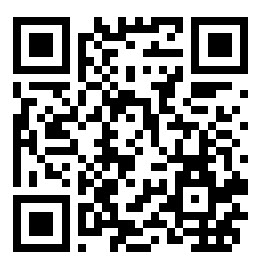
You can also scan this QR Code to get the same information.
Past performance does not guarantee future results, Seeking Alpha does not provide personalized advice, and it is not a registered investment adviser.
We accept advertising compensation from companies that appear on our site. This website represents my opinions, which may not reflect those of Seeking Alpha, and does not constitute an investment recommendation or advice.
 Know Your Flocks & Herds