

Ask Some Questions in the Right Sequence

In my previous post I addressed the first of two questions my friend asked. The first question was “Can a person retire in a recession?” My answer was “yes”, but that is based on answering some other questions. For example, “What will my sources of income be during retirement?” Income and expenses can help clarify the decision-making process.
The second question is the topic for today: “If so, how do you protect yourself as a retiree in a recession?” The second question is really about identifying risks and probabilities. We do this with our finances and the rest of life all the time, even before we retire.

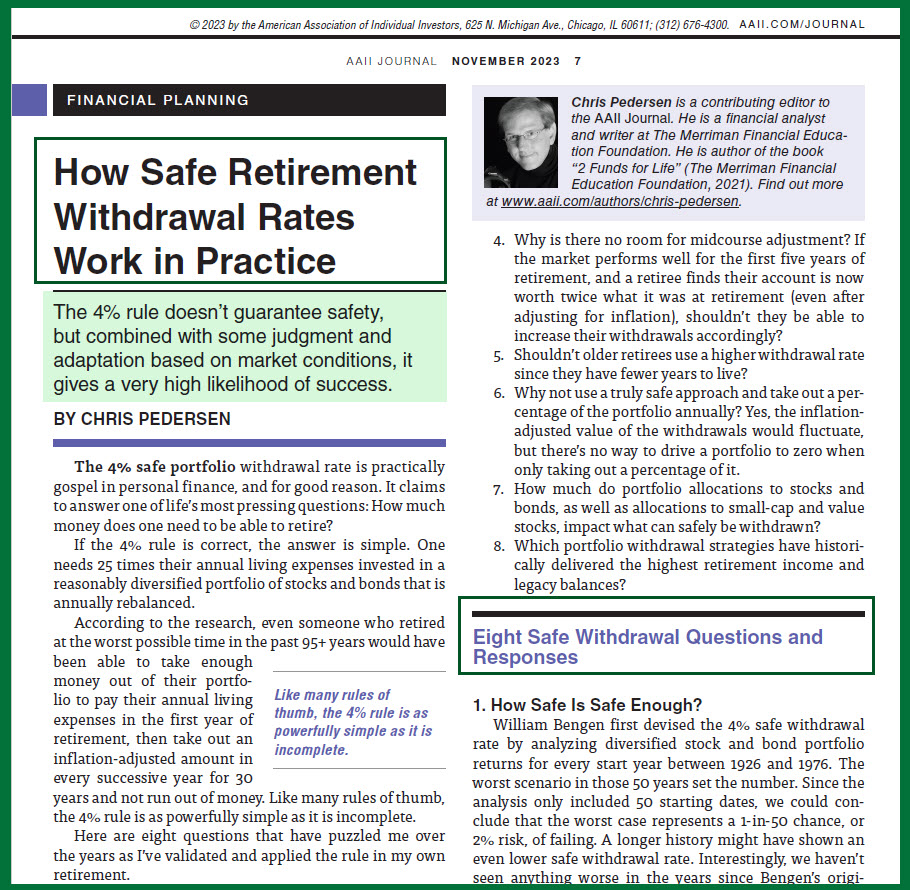
In the November 2023 AAII Journal Chris Pedersen, a financial analyst and writer at the Merriman Financial Education Foundation, wrote an article titled “How Safe Retirement Withdrawal Rates Work in Practice.” What he discussed applies to the question at hand. The article includes “Eight Safe Withdrawal Questions and Responses.” I want to draw some main ideas from the article in a more summarized fashion. We will look at two of Pedersen’s eight questions.
Question Number One is Safety-Related
“How Safe Is Safe Enough?” The author rightly observes that “future returns are unpredictable.” That is a common statement in every investment-related document: “past returns are no guarantee of future performance.” No one knows the future, and even if you did you wouldn’t necessarily be safe. You would only be informed.
That isn’t to say we just give up and not address the question about protecting oneself. At the same time we should admit that there are far too many variables and unknowns to really protect ourselves. Therefore, the same decisions we made before retirement about investing, saving, giving, and spending should carry forward regardless of recession, bear market downturns, or huge market upswings. Buy quality investments and stay the course.
Question Number Three is Timing-Related
His third question of the eight in the article is “What Is So Magical About the Balance on the Day Someone Retires?” That is an excellent question. Assume, for example, your total retirement investment account balance was $2M (or $500K) on January 1 of the year. Assume furthermore, that you decide on that day to retire on June 30 of the same year. You notify your employer, and the wheels are set in motion. The day approaches, your replacement has been hired and trained, and your coworkers throw a retirement party to recognize your big day. You pack your belongings and head out the door.
Suppose that on July 1 some terrible news hits. Perhaps war is declared with China, or perhaps civil unrest erupts in all of the major cities in the USA. Perhaps there is a huge pandemic, or it is discovered that the banking system appears to be shaking on its foundation. Stock markets don’t like stuff like that, so the stock market plummets.
There was a “Black Monday” in 1987. On Monday, Oct. 19, 1987, the Dow Jones Industrial Average plunged almost 22%. Then there was the “Dot-com” bubble in 1999-2000. “During the late 1990s, the values of internet-based stocks rose sharply. As a result, the technology-dominated NASDAQ Composite Index surged from 1,000 points in 1995 to more than 5,000 in 2000. But in early 2001, the dot-com stock bubble started to burst. The NASDAQ peaked at 5,048.62 points on March 10. The index would go on to plummet by 76.81% until it reached a low of 1,139.90 points on Oct. 4, 2002.” – SOURCE: Motley Fool
If something like this happens, then your $2M could easily drop to $1.5M and your $500K to $375K. To make matters worse, you decide to “get out of the market” and sell your investments, even though your advisor tells you not to. Stop and think. Remember that your investments are not just dollars, they are shares in a business or businesses. Most of those businesses will continue, even with difficulties. Most of them will navigate through the difficulties and continue to figure out ways to be profitable and even more efficient. Most will continue to pay dividends to the shareholders if they were paying dividends.
We must stop thinking of our investments solely in terms of what the current paper value is of those assets. On any given day they can be worth 1-2% more or 1-2% less. The real question has to do with income risk.
Actionable Step
Therefore, if one is to be protected in retirement (in so far as that is even possible), one must have a source of cash for living expenses. This can come from Social Security, a pension, or from investments. If your investment mix is not producing at least quarterly income, then perhaps it is time to change your investment mix. That is one of the reasons I transitioned to a dividend growth model before retirement. The income from investments I receive each quarter makes it entirely unnecessary to sell any investment during the year. This is very important when you must start taking RMD withdrawals from traditional IRA or 401(k) accounts.
When you are receiving income, the current share price of each investment becomes less important for the long-term investor/retiree. I don’t care if the market thinks my Seagate (STX) shares are worth $50.21 (last December) or $85.30 (December 22, 2023, close). I owned 1,600 shares back then and I still own the shares. The stock market said those shares were worth $80,336 twelve months ago. The stock market now says my shares are worth $136,480. What has changed? The opinions of the buyers and sellers. During the entire twelve months I continued to receive my dividends 0f $0.70 per quarter per share or $1,120 per quarter. I did not have to sell shares to gain income. My STX sheep still kept giving me lambs (dividends.)
My point is this: Focus less on the current prices of the stock market and more on the quality of your investments and the income flowing from those investments. This is true the day before you retire, the day you retire, and the day after you retire.
Solving the Real Problem
The real problem involves knowing how long I will live. If I am going to die in 2024, then what the stock market does today, tomorrow, or six months from now doesn’t matter to me. (It does for the sake of my wife, and I should plan accordingly.) Because we don’t know anything about tomorrow or the length of our days, then the same prudent decisions we were making going into retirement should be the same types of decisions we make going forward. In other words, live like a shepherd or cowboy. Keep an eye on your flocks and herds. Don’t make rash decisions and don’t worry about tomorrow’s wolves and lions.
Think Biblically
We should have a healthy balance in our thinking. On the one hand we need to be observant and pay attention to our investments. But we should never view them as a place of safety.
Proverbs 11:28 “Whoever trusts in his riches will fall, but the righteous will flourish like a green leaf.”
Proverbs 27:23-26 “Know well the condition of your flocks, and give attention to your herds, for riches do not last forever; and does a crown endure to all generations? When the grass is gone and the new growth appears and the vegetation of the mountains is gathered, the lambs will provide your clothing, and the goats the price of a field.”
All scripture passages are from the English Standard Version except as otherwise noted.
LINKS: MOTLEY FOOL
 Know Your Flocks & Herds
But in early 2001, the dot-com stock bubble started to burst. The NASDAQ peaked at 5,048.62 points on March 10.
typo-early 2000
LikeLiked by 1 person
This is a quote from Motley Fool, so I did not tamper with the original author’s statement. Thanks for pointing it out.
LikeLiked by 1 person