

What Keeps Water Out of a Ship with Doors?

I was trained to be a signalman in the US Navy in 1971. The navy spent a lot of time and money to train me in the methods for sending signals. There was Morse code, to be sent via flashing light. There was semaphore, which communicates individual letters using the position of the flags you hold. (That is why we were called skivvy wavers. Skivvies are underwear.) We could also send a signal using the flags that stood for letters and numbers. For example, a red flag was the letter “B” which we called “Bravo.” (I still use Bravo and Echo and Papa (B, E, P) when I spell something over the phone because these letters can be hard to understand as they have a similar sound.
After the navy trained me in signaling methods, they sent me to NAS Barbers Point on the Hawaiian Island called Oahu. NAS stands for Naval Air Station. In other words, I was sent to an island to serve on a base where there was no need for my skills. As a result I spent several months cleaning dishes in the base galley. Then some bright mind decided I should learn how to drive JP-5 fuel tankers and refuel Navy jets and other aircraft stationed at the NAS. There were methods for preparing the trucks in the morning and for refueling aircraft. Those methods mattered.
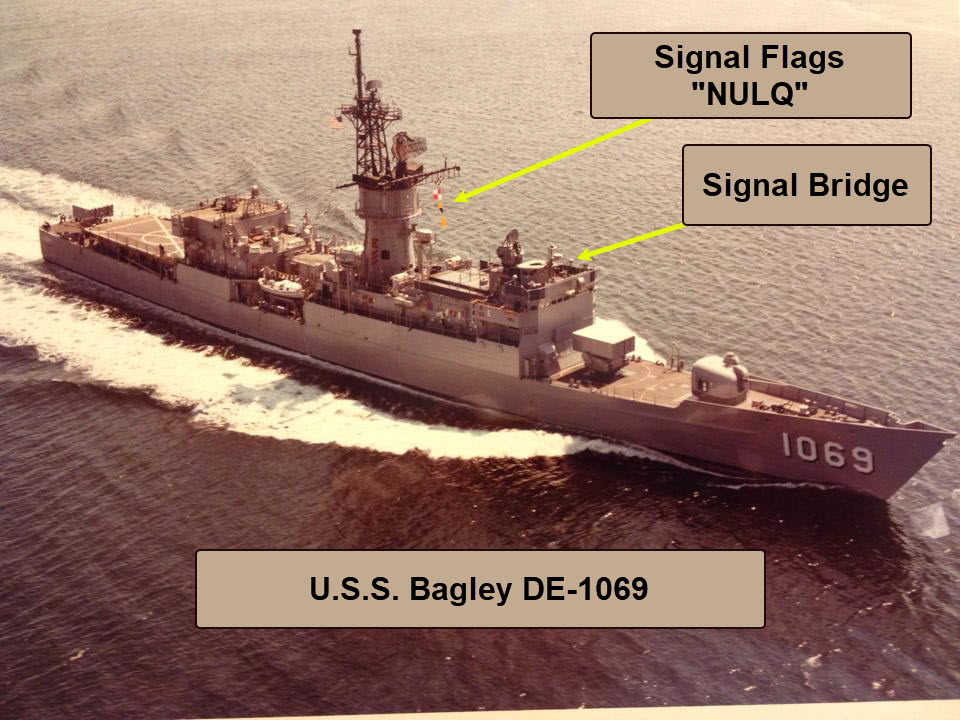
When I reached the level known as “E-4”, I was a 3rd class petty officer. So now I was known as SM3 Winquist – Signalman Petty Officer Third Class. Someone in the Navy took note and realized they needed an SM3 on the U.S.S. Bagley, DE-1069, so off I went to join that team in San Diego. When I arrived on the ship, the first-class signalman (SM1 Leasman) asked me to show him my signaling skills. I had virtually forgotten most of what I had learned a couple of years earlier, so the navy sent me to a “Signalman Refresher Course.” Apparently, I wasn’t the only one who was trained one way and sent to another place. I was retrained because methods matter.

So, by know you are asking, why did you start this post with “What Keeps Water Out of a Ship with Doors?” For those unfamiliar with most ships, they have doors. Most of them are “water-tight.” One job, of many, that needs to be done is maintaining the doors. When a ship sustains damage, it is necessary to close doors so that the ship does not capsize or sink due to water entering the hull or the superstructure of the ship. So, I was given the very mundane, repetitive task of making sure the doors were in top working condition.
I was given instructions about how to do the job. Someone showed me how the job was to be done. There were step-by-step written instructions for lubricating the levers and checking the seal. This included doors exposed to the weather, and doors that were below deck in the sleeping areas, doors leading to the torpedo room, and various doors for the engine room. You get the idea. What looked like “just another door” was really a key part of the integrity of the ship.
Methods Matter in Investing
I have two main areas of focus in my blog articles. One, of course, is of interest to many of my readers. It is a focus on investing for and in retirement and the methods I use to find dividend growth investments. The reality is that the methods are not difficult to learn, and the tools can be used with some minimal instruction.
However, an even more important focus is on things that go far beyond the few years I have remaining on this planet. It has to do with investing my life in things that matter and that last. For that reason, I actually spend more time studying and preparing to teach things of eternal value.
While it is nice to have “investing disciples” who ask me questions, and sometimes even thank me or praise me for my investing instructions, there are others who have an even more profound impact in my life and weekly activities. There is a very small circle of people I am seeking to disciple in the way a follower of Jesus should go.
Jesus said to his followers, “Follow me.” Then, after spending time with them, he sent them out with some good news. They not only learned some foundational truths from Jesus, but they also learned how to communicate those truths to those in their lives. In other words, they had orthodoxy. Orthodoxy is “straight” or right belief about things that are true versus heresy, which consists of countless twisted lies.
But Orthodoxy without Orthopraxy is wasted truth. Orthopraxy or orthopraxis is simply “correct practice” or “correct behavior.” (GotQuestions)
Just like investing, where truth must be applied to see success and good results, biblical truth must be both right and applied to have value. Jesus cut to the core of the matter when he said this: “Then Jesus told his disciples, ‘If anyone would come after me, let him deny himself and take up his cross and follow me.’” Matthew 16:24
“Evangelical Protestantism emphasizes correct doctrine, and critics sometimes caricature the evangelical position as teaching that, as long as you believe the right things, it doesn’t matter what you do. That is not a genuine evangelical position, and neither is it a biblical understanding of the relationship between orthodoxy and orthopraxy.” (GotQuestions)
You might believe the right things about investing, but if you don’t apply what you know, you will likely be very disappointed for the 70-90 years you might live. You might also believe the right things about God and about the Son of God, Jesus, but you will find your life wasted if you don’t practice and model those truths in your life.
Pass It On and Make Disciples

In the end, both for this short life and in the eternal life the scriptures speak of, methods matter. Get the right truth, then apply it in life. I often tell investors that the only “payment” or “compensation” I require (or suggest), is that they pass on to others what they have learned. The same is true about the spiritual truths and realities of this life and the life to come.
All scripture passages are from the English Standard Version except as otherwise noted.
 Know Your Flocks & Herds